
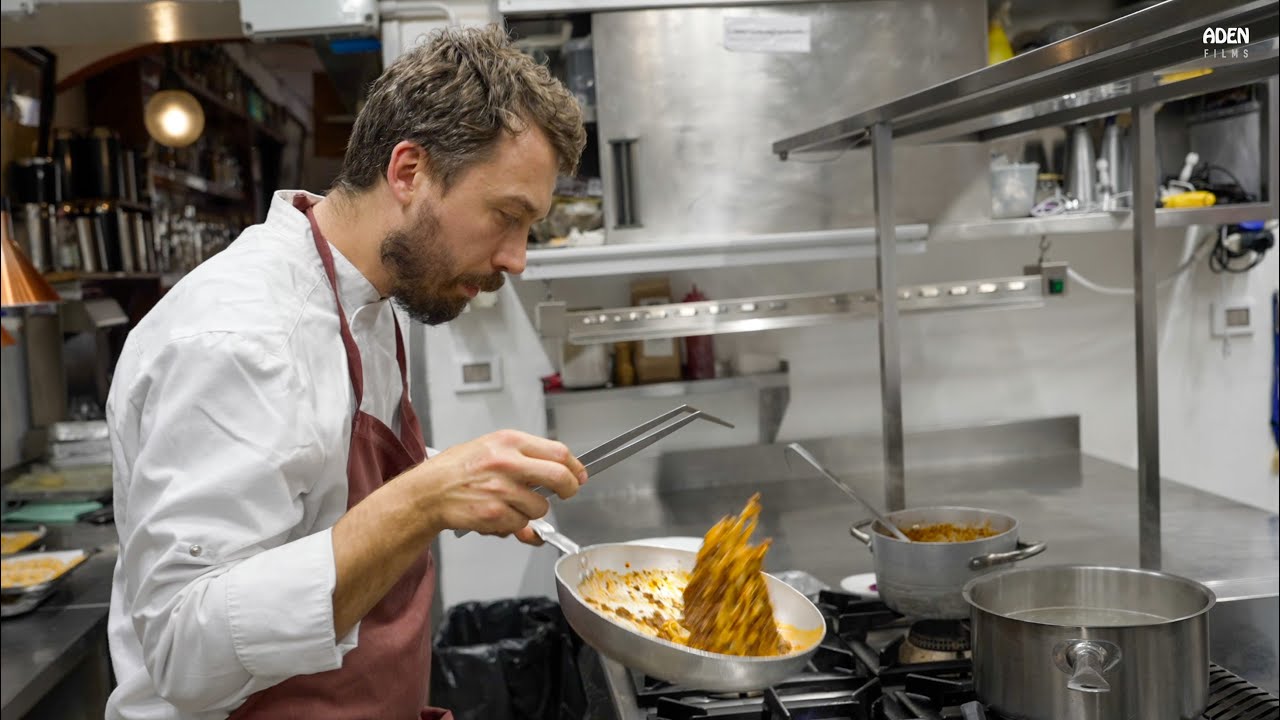
A visit to Trattoria da Amerigo where head chef Giacomo Orlandi shows how to prepare Pasta with Bolognese Sauce.
Michelin: 1 Star
Instagram: @amerigo1934
Good morning, I’m Giacomo Orlandi, the chef at Trattoria da Amerigo. Today I’ll show you how we make our ragù, our traditional Bolognese ragù recipe. We have all the ingredients here. Beef, pork, chopped carrot, celery, onion, and ham. Tomato paste, peeled tomatoes that we’ve squeezed and blended, salt, oil, and white wine. The first thing we do is sauté the celery, carrot, and onion in the largest pan. We don’t need much oil. Medium heat. Let’s get started. We’ve chopped these vegetables. Quite finely. They should sauté for about ten minutes, until they’re nice and soft. [Music] Now let’s start sautéing the two pieces of meat in the pan. We don’t do it directly with the other legs, we do it here, so we can brown them better. High heat. Let’s wait for the pan to heat up well, turning our vegetables every now and then. Let’s start with the pork. But we don’t put a lot of it in the pan. so that we can brown it well. We grind it with a handful of breadcrumbs over high heat. The meat must brown, without losing too much shine. We try to separate the large pieces a bit so that there aren’t any clumps in the ragù later. This is almost ready. We add a little white wine, let it evaporate over high heat. We’re still a little behind here. Meanwhile, continue cooking here, as it takes time. Let the water and wine evaporate well. Yep. We add this too. Now let’s salt. We always salt each piece of meat, each pan, so that all the meats are salted equally. Now let’s put the meat in a container because this part here isn’t ready yet. We repeat the whole operation from the beginning until we’ve finished browning all the meats. Then add oil, turn the heat up. Here we salt each pan again, mind you, so that each piece of meat is balanced. Same thing, let’s brown. Use a strong pan, not too high, not too much, so it browns well. Let’s check our vegetable stock, we’ll keep our soffritto like this. Okay, let’s add salt. Okay. The beef will release a little more fat because it’s a fattier meat and the folder or diaphragm is a fattier meat and will release some of its fat. Another container like this is similar. Go ahead. Yes. Let’s already. Let’s let it evaporate. The alcohol has evaporated here. However, the juices from the meat that we’re keeping remain, they will help us later for cooking. Let’s add salt. Let’s add. All right . Let’s check. Okay, we can add the ham now. Let’s not brown the ham, otherwise it becomes too salty. Let’s go straight to the pan. [Music] [Music] Okay, now we can add the two meats. Beef, [Music] Let’s mix immediately. C never Let’s mix well. Perfect. Now that we’ve mixed, let’s adjust. Let’s add the tomato paste. Let’s mix again so that everything is well distributed. Okay. And the blended peeled tomatoes. [Music] Let’s go. From now on, we won’t be adding any more salt, we’ll only add salt at the end, when the cooking is complete, because this ragup will take more or less 4-5 hours. Low heat, it just needs to simmer. During cooking, if it dries out too much, we’ll help ourselves with a little meat broth. But we’ll add a little at a time. Perfect. Now we’ll wait 5 hours. I’ll take this one with me, I’ll take that one with me, then I’ll say goodbye. Then I’m already done because that’s your job, I wouldn’t be able to do anything to you. Have you kept ahead? Yes, yes. If you’re not ahead, you have to stay behind, you know, Roberta? She kept ahead. The allergies. How good of her. But they’re not capable of making nests. You know I go and get birds’ nests to copy them? Yeah. I go and get birds’ nests. I ‘ve never been able to. But she was able to do it because they didn’t teach you, maybe they didn’t teach me. Listen, Roberta, I took that little bit of everything that was there. Did you do it? Are you okay with that? You did great. I took it because I want to give it a try. But then he’ll take Claudio’s desserts, and I told him I wanted to give it a try, then I’ll see you next time. Are you coming back this week? No, no, you’ll never come back. Now you see you’re not capable of doing it because I make them like you do. But I don’t make them evenly. I have a scale with a little bowl and I put all the weights in it. Then I raise the scale so the scales don’t catch me. But I’d have to make some little dishes that I could take up. You say I’m not very good at making little dishes because then I’ll settle for the ones with the little birds, you know. Bye. Bye Anna. Thanks. Those beautiful little birds. Go at random. [Music] Now let’s cook our tagliatelle. The ragù is ready. You can see the final result here, the more it’s cooked, the more homogeneous it is. And we made our tagliatelle, our sfoglina made our tagliatelle, which are made with a local Bologna type 1 wheat flour, so a little coarser. Let’s put our ragù in the pan. As we do during service. Hot, salted water. Let’s take our tagliatelle. Let’s open them a little. It won’t take long to cook them, eh. Let’s stir. Less than a minute and they’re ready. Let’s keep them stirring so they don’t stick. Here we go. We’ve heated our lagù. Almost ready, eh. 30 seconds, we can taste it. Let’s turn on the heat. Here we go. Super fresh tagliatelle, 30 seconds. Enough. Let’s go and stir. Let’s add the pasta. Add the pasta. Done . Stir well. Keep. Perfect. This result. Beautiful tagliatelle. Blended. The sauce has absorbed all the pasta and we serve them nice and long. We try not to squeeze them. Instead, we leave the tagliatelle open. Plenty. Pagliatella is ready. We’ve historically served it here at Merigo with a red onion and salt. It’s a country tradition in these parts, and we recommend our customers try taking a forkful, a bite of tagliatelle, and a bite of onion like they used to do in the countryside. We’ve finished our preparation. It takes a long time, but it’s a historic preparation. From all over Bologna and Emilia Romagna, and the result is always very, very satisfying and delicious. Thank you. Thank you. Bye bye [Music] Me too. I’m going to check it out. [Music]
48 Comments
Il prosciutto di cui si parla, sono cubetti di prosciutto crudo?
La felicità ❤️😋🤩😍✨
To sum up, you cook food in aluminum, which is bad for your health, meat in Tefal cookware contaminated with PFOA, which is deadly to humans, mediocre ground meat, and so on. I will never eat your bolognese.
CSAPE International Its mission is to fight corruption and crime.
La cuisine traditionnelle italienne, miam miam !
Buongiorno di Francia !
È un capolavoro il suo ragù Chef, non c'è nulla di più buono della vostra cucina , una cosa che stuzzica l'appetito per chi non lo conosce
Anche io la faccio così 👍però invece di vino bianco della casa, metterei vino rosso in bottiglia e dei odori tipo alloro ❤️
Rega ma i cappelli sulla testa????? La barba lunga… Ma che schifo è???
❤️❤️ herzlichen dank für dies sehr sympathische video. ❤❤
6:43 someone’s grandma who KNOWS what’s up❤
I think I would prefer grated Parmesan cheese instead of onion if asked, but I would like to try it
British version add red wine , only beef mince and put enough garlic in to kill a horse
Looks beautiful. Love the red onion as an accompaniment.
Bolognese pasta ! A real art ! Everyone adds their personal touch. Nice video. Always the mama turning in the kitchen… otherwise she handles the cash register 🙂
Thank you sir for the video. There is nothing more authentic and enticing than watching an Italian chef in his own kitchen. I was a bit surprised by his processes. I always cook the pancetta first and then the soffritto in the fat and I like to cook the tomato paste for a few minutes before adding it. Again, my thanks for another behind the scenes education.
spinning the fork counter-clockwise is outrageous.
Oh my, that spagarti nardle looks to die for.
Che arte! Che cultura abbiamo in Italia!🇮🇹🇮🇹🇮🇹✝️
?? pates a la bolognaise?? n'importe quoi
That looks absolutely delicious as I’m sure it is. Interesting – no cheese. No parmeggiano. I love the red onion. I will try that with this recipe! Thanks for the wonderful video. Love this channel!
No nutmeg?
Chiodo di garofano e pepe…minimo.
Oooooooooh ! Bravo .
Credevo i cucchiai o spatole in legno non fossero permessi nelle cucine a causa della porosità del materiale.
io e la mia consorte sono 10 anni che andiamo da Parma a Savigno a cenare da Amerigo per il nostro anniversario
ATS??????? senza berretti capelli alla Elvis barbe e orecchini in evidenza……
Complimenti
Bravisimo👍
Grande 🙏
Spettacolo!
Prenoto e arrivo! 💪😀
Hai aggiunto l'olio alle verdure! Non si fa…..
C'è poco da fare noi italiani in cucina comandiamo su tutti 🎉🎉
Complimenti, processo ineccepibile. Rimpiango (ho abbandonato le carni).
Was there no garlic at all?
Not a spice in sight. No thyme. Italian spice or even pepper??
La barba me la farei con 1 stella Michelin sulle spalle.
Quello che prova a mangiarle ruotando la forchetta al contrario..😂
No comment.
I’m surprise there is absolutely no herbs in the recipe
Si piu o meno la bolognese io la faccio uguale. Ma il macinato del maiale e quello bovino io li faccio cucinare tutto assieme nella pendola quella grande, assieme con le verdure una volta che sono ben bene arrosolate gli metto dentro il pomodoro assieme ilsale lo zucchero ecc ecc.
I ate there this year. The best restaurant of my life so far. Now that I see with how much love they cook, it makes sense, that everythink tastet so amazing.
mi avete fatto fare un salto in dietro negli anni, nonna Emiliana, quanto mi manca……. ❤
Magnifico!
Va bene lo chef strafigo, ma li chi fa la differenza sono lesignore che fanno i cappelletti 6:42
Cost of the bill ?
Would I get knocked out if I asked for Parmesan?
Alla seconda padella di macinato di maiale l'hai salato due volte 😂
Cosa pesa a fare le tagliatelle se poi nel piatto non le mette tutte 😂
Couple of lessons for me there, what a treat that was.