
Let’s be honest, baking is a pretty great hobby. Not only is it a fun stress reliever, but it also has some delicious results. That’s why when it comes to your baking sheets, you want the best of the best.
We’re not talking about the most expensive baking sheet; truthfully, a higher price doesn’t always mean it’s the best. No, we’re talking about the color and style of the baking sheet.
There are hundreds of baking sheets on the scene, but there are four main styles: dark, light, colored, and textured. We’ll let you in on a little secret: the color and style of a baking sheet can and will affect how your bakes will turn out.
What do we mean exactly? Each baking sheet will produce a different result. That’s why a lot of people opt for different baking sheets when they’re making different types of food—one baking sheet for cookies, one for pizzas, one for sheet pan meals, etc.
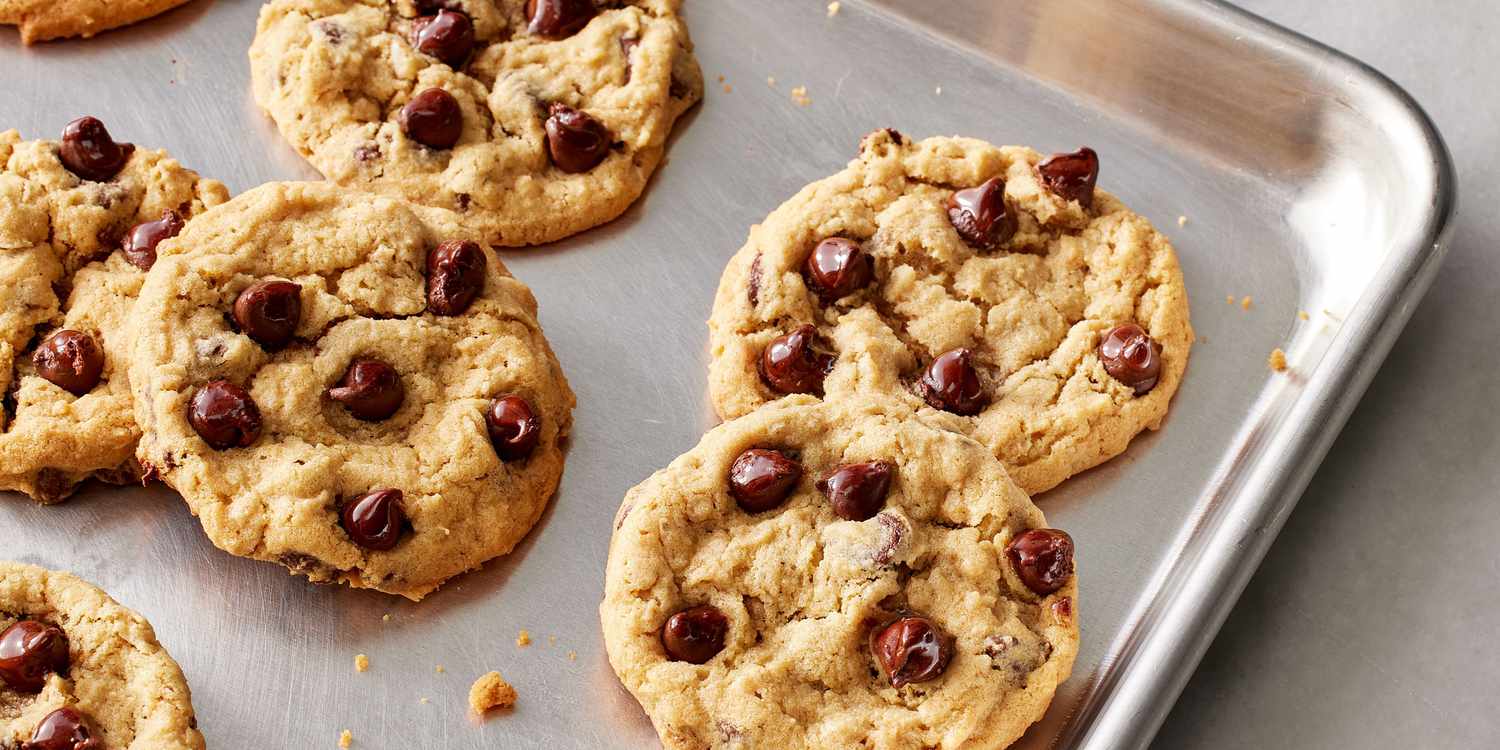
To test out how each type of baking sheet performs, we used them to make the most popular sheet pan recipe: cookies. The four pans were put to the test using our Best Chocolate Chip Cookies recipe to determine once and for all which style of sheet is the best for baking cookies. Here’s what we discovered.
Light Baking Sheets
Most light baking sheets are made out of some kind of steel—typically carbon or stainless—or aluminum. Much like a light t-shirt, light baking sheets reflect heat, meaning they won’t absorb as much heat and your cookies won’t be overly browned.
For this test, we used Calphalon’s Non-Stick Baking Sheet.
The light baking sheet required two extra minutes of bake time before the cookies were done. The cookies were textured and crispy on the very bottom, but the edges weren’t that brown. However, when we bit into the cookie, the whole outside was nice and crispy while the middle was fairly chewy. They were just what you’d expect from a traditional chocolate chip cookie.
Overall, the pan did exactly what you’d want it to when making a classic cookie.
Dark Baking Sheets
Dark baking sheets are usually made out of the same material as light baking sheets—typically a type of steel or aluminum. However, the difference is they have a dark non-stick coating. This means, much like dark clothing, dark baking sheets absorb heat in the oven. The absorption means your bakes will brown quickly and all around.
For this test, we used Made In’s Non-Stick Half Sheet.
The cookies required six extra minutes of baking time before they were fully baked. However, when they came out of the oven they looked like a quintessential chocolate chip cookie. They had a beautiful crinkly top and were evenly golden brown on the bottom. The cookies were perfectly crispy on the outside and provided a nice crunch when you bit into them. However, they weren’t as chewy on the inside, but rather pretty crispy throughout the whole cookie.
We wouldn’t say they were burnt, but they were quite a crispy cookie—almost like eating a Chips Ahoy.
Textured Baking Sheets
Textured baking sheets are almost always made from some type of steel—either aluminum or carbon — and have a layer of non-stick coating. The major difference between these sheets and others is that they have a textured surface that promotes airflow when baking, which purportedly allows for a more even bake.
For this test, we used OXO’s Non-Stick Pro Sheet Pan.
The cookies needed five extra minutes of baking time, but they were basically perfect when they came out of the oven. They were a good height, didn’t deflate, and had a nice even brown on the bottom. Biting into them, the cookies were crispy on the outside and light and gooey in the middle.
Truthfully, we couldn’t ask for more ideal cookies.
Colorful Baking Sheets
The most notable brand that produces colorful baking sheets is Great Jones—there aren’t too many other colorful sheet pans on the market. However, the color isn’t the important part. The unique thing about these sheet pans is the ceramic coating. The pan itself is aluminized steel, but it has a ceramic non-stick coating; it acts almost like a cross between a dark and light baking sheet.
For this test, we used Great Jones’ Holy Sheet.
The cookies required three extra minutes of baking time and when they came out of the oven, a lot of them were flat and deflated. With that being said, the cookies were nicely browned on the bottom — though the very bottom was crispier than the edges. Biting into the cookie it had a nice crunch, it was crispy on the outside, and the inside was chewy (just like it’s supposed to be).
Overall, the cookies were baked nicely, we just wish they had a little more height.
The Best Baking Sheet for Cookies
You could say this was a toss-up between the light baking sheet and the textured baking sheet since they both made great cookies. While there isn’t a clear winner, we think the textured baking sheet did a better job overall.
You do have to wait a little bit longer for the cookies to bake—though that might have something to do with the oven we used since every test required more time than the recipe called for—but it’s definitely worth it. In the end, the textured baking sheet provides a slightly more even brown than the light sheet.
Textured baking sheets do tend to cost more than the average light baking sheet—or maybe you already have a light sheet and don’t want to buy another. In any case, the light baking sheet is a solid second option that we’d also happily reach for when baking cookies.
While the dark sheet and colorful sheet still produced great cookies, we’d probably stick to using those for sheet pan meals and cooking veggies rather than baking.
Dining and Cooking