


 Instagram/Judy Joo
Chef Judy Joo is sharing her recipe for a mouthwatering South Korean noodle dish — inspired by an Oscar-winning film!
In her new cookbook Mukja: Let’s Eat!: Fan-Favorite Recipes from K-Pop, K-Dramas & More — which hits shelves November 10 — the 51-year-old celebrity chef features a jjapaguri recipe with fun nods to the 2019 black-comedy thriller Parasite. In the movie, the wealthy Park family, led by Dong-ik and Yeon-gyo, are infiltrated by the poor Kim clan after 17-year-old Ki-woo scams his way into a job as a tutor. His father, Ki-taek is then hired as a chauffeur, his mother, Chung-sook, becomes their housekeeper and his sister, Ki-jung, begins working for them as an art therapist.
Jjapaguri plays into Parasite’s themes of wealth disparity by combining cheaper ingredients like instant noodles with a premium ingredient like steak. In the movie, Chung-sook whips up the dish.
Joo exclusively chats about the recipe and its connection to the film with First for Women.
 MUKJA
MUKJA
Why did you choose to put this Jjapaguri recipe in your cookbook?
JJ: How could I not? Parasite didn’t just put Korean cinema on the global stage — it made history. Bong Joon-ho’s masterpiece became the first non-English-language film to win the Academy Award for Best Picture, sweeping up four Oscars in total, including Best Director, Best Original Screenplay, and Best International Feature Film. It also won the Palme d’Or at Cannes.
And somehow, amid all that cinematic glory, a humble bowl of instant noodles became a global sensation, too. Jjapaguri went viral practically overnight, with home cooks around the world scrambling to recreate the dish, social media flooded with recipes, and Korean instant noodles suddenly enjoying their own moment in the spotlight. It was a brilliant example of how Korean pop culture can turn even the simplest dish into an international obsession. Mukja celebrates precisely that delicious intersection of food and entertainment, so naturally, this recipe had to make the cut. After all, how many bowls of instant noodles can claim an Oscar-winning supporting role?
What is the inspiration behind the dish?
JJ: Jjapaguri is a clever mash-up of two beloved Korean instant noodles: Nongshim’s Chapagetti, with its rich, savory black bean sauce, and Neoguri, known for its spicy seafood broth. Koreans were mixing the two long before Parasite came along, but the film gave this humble comfort food a rather extravagant upgrade, topping it with cubes of expensive steak.
And that’s where the genius of the dish lies. In Parasite, food is never just food. The wealthy Park family casually elevates inexpensive instant noodles with premium beef, creating a rather delicious metaphor for the film’s central theme of class inequality. It’s a collision of two worlds: everyday, affordable noodles dressed up with a luxury ingredient that costs many times more than the noodles themselves. The extravagance is almost absurd, yet the wealthy family treats it as perfectly ordinary. Meanwhile, the housekeeper must scramble to prepare it at a moment’s notice. That contrast says volumes about privilege, wealth, and the invisible labor that supports it. It’s social commentary in a bowl.
What makes the recipe special?
JJ: It’s the contrast that makes it so irresistible. You’ve got chewy, springy noodles coated in a deeply savory, slightly spicy, umami-rich sauce, mixed with beautifully seared, juicy cubes of steak cooked in luscious, creamy butter. The butter adds an extra layer of richness, making the whole dish feel wonderfully indulgent.
It’s instant ramen dressed up in designer clothes. The steak brings a touch of luxury, but the beauty is that the dish never loses its humble, comforting soul. You get this fabulous combination of textures and flavors — tender, buttery beef, bouncy noodles, and that punchy, deeply satisfying sauce. It’s a little bit fancy, a little bit naughty, and utterly craveable. Proof that sometimes the most delicious things in life start with a packet of instant noodles.
When do you most enjoy this dish?
JJ: When I’m craving something comforting, indulgent, and ridiculously satisfying, but don’t want to spend ages in the kitchen. It’s my idea of a fabulous lazy-night supper, preferably curled up on the sofa watching a good K-drama or movie. A bowl of jjapaguri, a pair of chopsticks, and something binge-worthy on the television — my kind of perfect evening.
Is there a certain time of year it’s best to make it?
JJ: Jjapaguri is a year-round pleasure, but there’s something particularly wonderful about tucking into a steaming bowl of spicy, savory noodles on a cold, rainy evening. That said, Koreans don’t need an excuse to eat hot, spicy noodles in the middle of summer. We happily slurp away regardless of the temperature. Some cravings simply don’t follow the seasons.
Could readers substitute the steak for another protein? If so, what do you suggest?
JJ: Absolutely! While the steak is a delicious nod to Parasite, there’s plenty of room to play. Thinly sliced pork belly would be fabulous, adding a lovely richness, while shrimp or scallops work beautifully with the seafood notes of the Neoguri noodles. Chicken is another easy option, and for a meat-free twist, I’d go with crispy pan-fried tofu or meaty shiitake mushrooms. Just make sure whatever you choose gets a lovely golden sear for extra flavor and texture. The noodles are the star of the show — the protein is simply the glamorous supporting act.
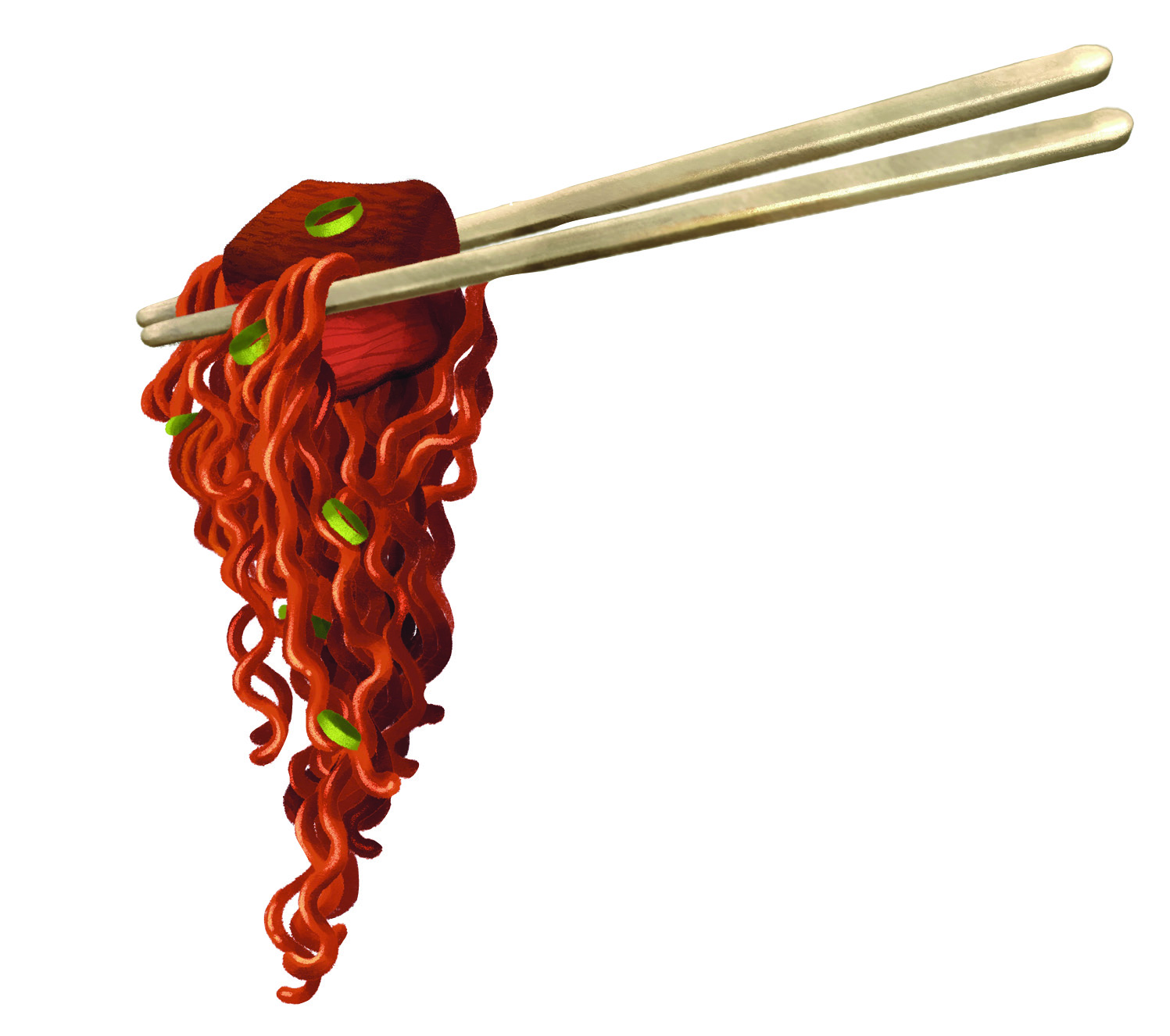 illustrations from MUKJA
Academy Award-Winning Jjapaguri
Ingredients:
½ lb sirloin beef steak, cut into 1-inch dice
Sea salt or kosher salt
Freshly ground black pepper
3 cups of water
1 package Nongshim Chapagetti
1 package Nongshim Neoguri Udon
Vegetable oil or other neutral oil for cooking
3 tbsp unsalted butter
1 green onion, thinly sliced (optional)
Instructions:
With only minutes before the Park family pulls into the driveway, cook like your life depends on it. In a large bowl, season the steak cubes with salt and pepper, turning them over with the precision of Ki-woo forging a flawless resume. Every side deserves equal attention — after all, appearance is everything when you’re trying to pass for high society.
In a medium saucepan, bring the water to a rolling boil. Drop in both packs of dried noodles and their vegetable flake sachets, but hold back the seasoning and oil packs for later; timing, as Ki-taek knows too well, is the difference between a tidy lie and a tragic mess. Cook the noodles for 4 to 5 minutes, until soft and pliant.
Meanwhile, heat a large nonstick skillet over medium-high heat, slick it with oil, and melt in 1 tablespoon of the butter. Sear the steak cubes until they blush with golden ambition, 1 to 2 minutes per side (or until desired doneness). Add the remaining butter, swirling until the cubes gleam as decadently as the Park family’s glass-walled living room. Transfer to a bowl to rest, juices pooling like secrets beneath polished marble floors.
Set a heatproof bowl in the sink and strain the noodles, catching a bit of that liquid gold beneath — about 1 cup should do. Return the noodles and reserved water to the pot, then stir in the reserved seasoning powders and oil packs. Mix until everything glistens with that inky, umami sheen — half instant noodle grit, half Michelin-star illusion. Add the steak and its juices, tossing together until it’s a union of rich and poor, glossy and grounded, a culinary metaphor in motion.
With a serving bowl in one hand and the pot in the other, channel Ki-taek’s nerve and fend off a basement squatter with a swift taekwondo kick.
Divide the jjapaguri into bowls, and crown with the green onions if you want a touch of elegance — Yeon-kyo would approve. Then dig in, slurping boldly, unbothered by etiquette or class divides. It’s the taste of han and hustle, where budget noodles crash headlong into prime beef — and somehow, for one delicious moment, everyone dines on the same floor.
Dining and Cooking