


René Andrade held up a student’s ceramic piece and put his other hand over his heart.
“This is one of my favorite things,” the acclaimed Phoenix chef told the class at Arizona State University.
“I have worked with a molcajete since I was a kid. This represents a lot and is so cool. I would love to put this on every table.”
The molcajete, a three-legged dish seen at many Mexican restaurants, was one of several tableware pieces created for Andrade by ASU ceramics students in a unique partnership this semester.
The 15 students in the class were tasked with making prototypes of tableware for Andrade, an award-winning chef — he won the 2024 James Beard Award for Best Chef: Southwest and the 2026 Michelin Guide Southwest Young Chef Award — who owns several restaurants in the Valley, including the wildly popular, Michelin-recommended Bacanora, located in Phoenix’s Grand Avenue neighborhood.
At the beginning of the semester, the students had lunch at Andrade’s Huarachis Taqueria in downtown Phoenix, which was recently designated a Michelin Bib Gourmand restaurant, to get a feel for his food and his inspirations.
During that visit, Juelz Rubio, a ceramics major, noticed that the salsas were served in metal molcajetes.
“The molcajete is a traditional tool used by Hispanic culture to grind chilies and spices, and I felt like they could use ceramics for them,” Rubio said.
After the Huarachis visit, the students got to work on their prototypes, making pieces on a wheel or by hand. Some students used 3D printing to create molds. Rubio hand-built her molcajete, which she’ll then use to create a mold.
The class created oblong platters, bowls with wavy rims, flower-shaped stacking plates, small pitchers and textured mugs. One student made a plate with a moat to separate sauce from tostadas.
Then they had to decide on a glaze — another challenging process.
“It’s this whole other problem to solve. How you glaze something turns the piece into a completely different thing,” said Lilia Tassinari, a ceramics major. She made two plates, one with a matte glaze and one with a glossy dark glaze.
“I wanted the plate to be a canvas for the chef’s food,” she said.
Last week, the students presented their prototypes to Andrade, who visited the ceramics studio to choose his favorite pieces and provide feedback.
He told Rubio: “I love this. Make it a little bigger. Try to get the glaze very dark because the original molcajete is volcanic stone, so try to mimic that as much as you can.”
The students are now working on mass producing the items he chose, making enough plates, bowls and accessories for dinner for 20. Some items he’ll use for flowers or candles. Others are designated for mussels, crudo or cocktails.
“Every single one is my favorite. Every plate we grabbed today was good enough to be in the restaurant,” he said.
He told them: “I want to create experiences with your art.”
At the end of the semester, Andrade will cook for the students and everyone will use the tableware they made.
Video by EJ Hernandez/ASU News
Using an engineering background for ceramics
Andrade’s enthusiastic feedback was mainly about elevating their designs — bigger, bolder, more texturized.
The technical feedback came from Andrew Smith, a 2021 ASU alum who makes all of the tableware used in Andrade’s restaurant through his studio, Augusta Pots. Smith was instrumental in creating the class project along with Samuel Chung, a professor of ceramics in the School of Art who is teaching the class.
At the presentation, Smith talked to the students about adding more “negative space” so servers could easily pick up the items and how to engineer the perfect mug handle.
Smith, who started throwing pots as a child, majored in biomedical engineering at ASU. After a year, he missed ceramics so much that he started taking classes with Chung, who convinced him to double-major.
In 2022, he went to the newly opened Bacanora for lunch.
“I was like, ‘Man, your food is amazing but we’ve got to fix these plates. They’re not food-safe at all,’” Smith recalls.
So Andrade told Smith to bring in some of his plates.
“I brought him a box and he reached in and banged my plate on the table and he threw it back in the box and was like, ‘Well, it didn’t break and you didn’t flinch. When can you start?’ And that was my entire interview.”
Smith credits his engineering background with his artistic success, using a disciplined iteration process with lots of testing.
Earlier in the semester, he talked to the class about the variables in restaurant tableware.
“You’re looking at the food, the drink, the service. Are they hand-washing the dishes? Is it a power washer? Do they have a lot of room to store this stuff? Are they heating the plates in a warming drawer or on top of the grill?,” he asked the students.
“Can you pick it up off the table without putting your thumb in the food? Most of the restaurants I work for, Mexican restaurants, they’re all saucy restaurants. I can’t make a super flat plate.”
Being able to quickly replicate their process is key when chefs want to replace a broken item, Smith said. They need to take notes along the way.
“I have been burned so many times when I thought, ‘Oh, it took me so many months to figure this out, I’m never going to forget it.’ A year later, they ordered the same thing and I had definitely forgotten it.”
He also gave out some basic business advice: Time is money.
“When I started out,” Smith said, “I decided, ‘This is what I want to be paid by the hour.’ And then every time I touched a piece, I added up the time,” — minutes spent prepping, throwing, drying, trimming, glazing.
“Then, you know, ‘OK, when I’m making a 10-inch plate, it’s going to take me about 22 minutes of touch time.’ Then you can establish your hourly rate, and that’s a good way to start out.”

Ceramics Program Coordinator and Professor Samuel Chung (right) teaches biochemistry student Evelyn Scheck how to replicate a vase during his Ceramic Tableware Design class at the Arts Building on ASU’s Tempe campus on Oct. 1.
Photo by Samantha Chow/Arizona State University

Ceramics student Lilia Tassinari throws a double-walled bowl.
Photo by Samantha Chow/Arizona State University

A student carves a design on the outside of a bowl.
Photo by Samantha Chow/Arizona State University

Ceramics major and first-generation student Mario Gamez looks for his pieces after they were fired in the kiln.
Photo by Samantha Chow/Arizona State University

Ceramics and first-generation student Kayla Sanchez Chavarria builds up the lip a bowl.
Photo by Samantha Chow/Arizona State University

James Beard Award winner and chef Rene Andrade (center) gives feedback alongside 2021 ceramics alum Andrew Smith (left) to ceramics student Lilia Tassinari (right).
Photo by Samantha Chow/Arizona State University

James Beard Award winner and chef Rene Andrade (right, in white Tshirt) takes a final look at all of the tableware prototypes made in Ceramics Program Coordinator and Professor Samuel Chung’s Ceramic Tableware Design class at the Arts Building on ASU’s Tempe campus on Oct. 15. Final selections will be produced in smaller batches and used at Andrade’s Phoenix restaurant, Bacanora.
Photo by Samantha Chow/Arizona State University

Students check their glaze tests. Test glazes are made before being selected and applied to the prototypes.
Photo by Samantha Chow/Arizona State University
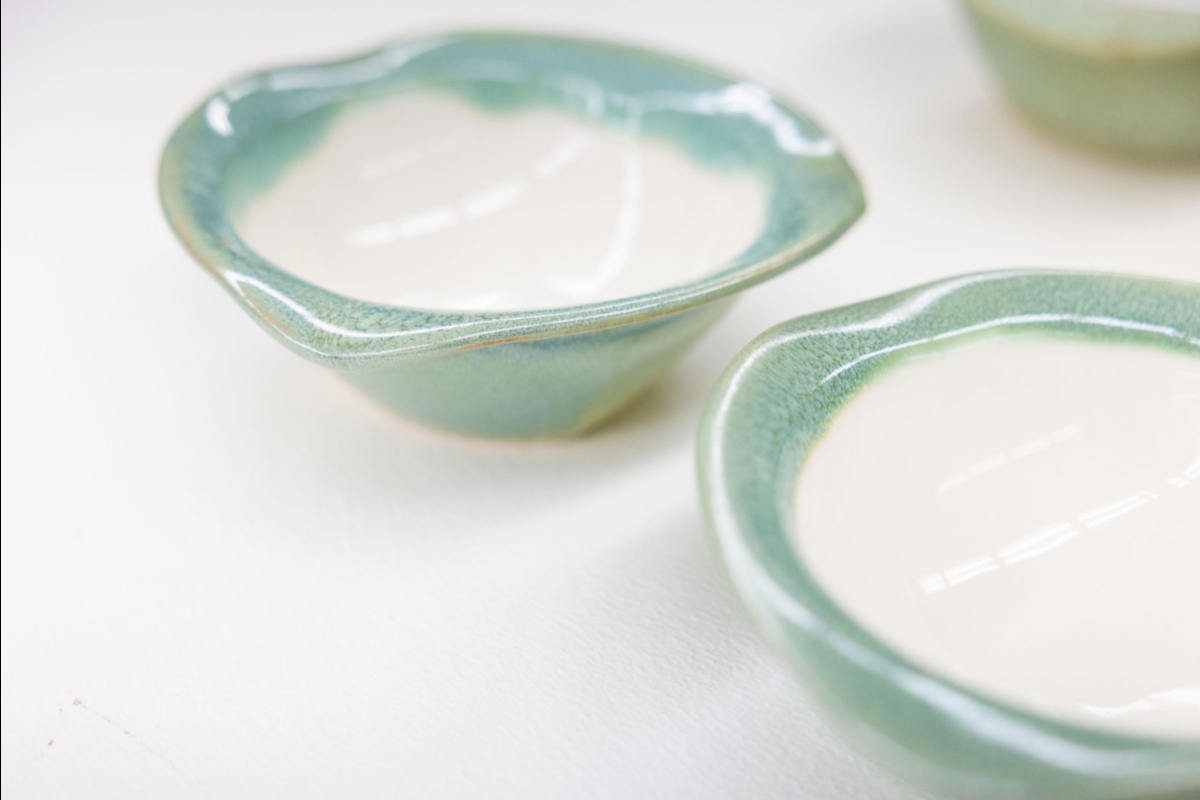
Prototype bowls made by ceramics student Kayla Sanchez Chavarria are displayed during a Ceramic Tableware Design class.
Photo by Samantha Chow/Arizona State University

Prototype vases made by medical microbiology student Tyler Abraham-Lodmell.
Photo by Samantha Chow/Arizona State University

Ceramics alum Andrew Smith takes a closer look at how prototype cups stack.
Photo by Samantha Chow/Arizona State University

James Beard Award winner and chef Rene Andrade (center, in white T-shirt), 2021 ceramics alum Andrew Smith (to the right of Andrade) and Ceramics Program Coordinator and Professor Samuel Chung (second from Andrade’s right) pose for a photo with students.
Photo by Samantha Chow/Arizona State University
‘You cannot expect perfection’
Among the items Andrade praised were two cups made by Evelyn Scheck, a medicinal chemistry major who took the ceramics class as a creative outlet from her studies and her job at the Biodesign Center for Applied Structural Discovery.
She hand coiled the clay for one of the cups and made the other on a wheel, then carved a design into the wet clay.
“I don’t mind putting in that extra work to carve by hand. It’s kind of therapeutic and gives a unique aspect to each of them,” she said.
Andrade and Smith were impressed that her cups mimicked the texture of a pina, the pineapple-like core of an agave that’s had its spiky leaves chopped off.
“They’re super pretty and I love that you can do this. Carry the texture all the way to the top,” said Andrade, who thought the cups would be good for coffee.
Several students in the class had very little experience with ceramics, Chung said.
“I try to emphasize that you cannot expect perfection. Sometimes the best thing a student can do is start over, which seems catastrophic to some people but oftentimes is more successful.
“Ceramics is a really humbling material to work with because it makes you feel human. It’s a good analogy for life because you have to learn how to accept failure, you have to learn how to accept loss,” said Chung, who also is a ceramic artist.
He hopes his students understand the relationship between Andrade’s food and the tableware they’re making.
“You’re part of that enhanced experience of going to this establishment and, hopefully,” he said, “making everything taste better.”
Dining and Cooking