


Digital subscribers can listen to this article.
Subscribe today for unlimited access to Texas Monthly. Already a subscriber? Log in.
Adrian Torres was at breakfast when his life changed. The 27-year-old chef sat at a floral-print oilcloth-covered table at Puebla Mexican Kitchen—one of his favorite restaurants, in Houston’s Heights neighborhood—surrounded by his fiancée and friends, all waiting to hear the news. The group shed their morning grogginess with plates of saucy enchiladas, salsa-lacquered chilaquiles, and migas, featuring soft tumbles of scrambled eggs and crunchy tortilla strips.
It was March 31, announcement day for the 2026 finalists of the James Beard Awards, the highest honors in the U.S. restaurant and hospitality industries. Torres, the executive chef of contemporary Mexican restaurant Maximo, in Houston’s tony West University Place enclave, had been named one of twenty semifinalists in the Emerging Chef category in January. That group would dwindle to five professionals judged on their talent, character, leadership, and potential to have a lasting impact in the industry. Torres planned to spend the whole day with his loved ones so that whatever happened, he was good.
The James Beard Foundation was set to announce the finalists on Instagram Stories just after 9 a.m. Torres couldn’t resist refreshing the social media app at the breakfast table. When it was finally published, he began to scan the list of names. His was the last one. “I’m like, ‘What the f—?’ ” he says. “I just pumped the phone in front of my girl.” The celebration continued into brunch, which slid into lunch and stopped sometime after dinner. Torres was in disbelief, even though Maximo received Michelin’s Bib Gourmand designation five months earlier. “The craziest part is how fast it’s all coming,” Torres says. “It’s scary, because eventually it’s going to peak. Eventually it’s going to come back down, and when is that going to happen?”
Torres wondered how he’d get to Chicago for the awards ceremony in June. It’s only a two-and-a-half-hour flight, but he was worried about what air travel would mean because of his immigration status. He’s a DACA (Deferred Action for Childhood Arrivals) recipient—one of nearly half a million people in the U.S. whose undocumented parents brought them to the country as children but are ostensibly allowed to live and work without fear of deportation. But recently, Dreamers, as they’re sometimes called, had been swept up in the Trump administration’s ICE raids and detained. Still, he had to find a way to be there for the biggest moment of his career so far.
Torres was born in 1998, in San Luis Potosí, Mexico. When he was five, he immigrated with his parents and older sister from the arid, high-altitude capital to Houston. They came looking for work and, like so many others, a better life.
But no sooner had they settled in the U.S. than his mother firmly instructed him on the rules. “Don’t tell anyone you don’t have papers,” she said. “Don’t talk about being undocumented.” Spanish was to be spoken at home and in the community, and English as perfectly as possible elsewhere. He needed to have an unshakeable awareness of his surroundings.
His professional calling came when he was thirteen years old. Inspired by the fantastical pastry creations on TLC reality show Cake Boss, he repeatedly asked his mother to help him make a cake. She eventually relented and bought a supermarket box mix and a little pan. “We did it together,” Torres says. From then on, he began baking cakes, cheesecakes, and flans. His freshman year in high school he took a home economics class and enrolled in his school’s culinary program the following year. It was around that time, at age fifteen, that he became eligible for DACA, so he applied for and received the federal status.
DACA was established as a policy in 2012 by President Barack Obama. The deferred action is bestowed on approved applicants who arrived in the U.S. before they were sixteen years old and have lived continuously in the country since June 15, 2007. U.S. Citizenship and Immigration Services is no longer adjudicating new applications in accordance with a July 2021 federal court decision, upheld in January 2025 by the Fifth Circuit court of appeals; but it’s still processing renewals. Since the status is valid for two years, the government recommends recipients, such as Torres, submit renewal requests four to five months before their permit’s expiration date. Processing time varies; there can be months between the expiration of DACA status and renewal. Reapproval is not guaranteed, and because DACA is not a federal law, neither is the program’s continuation.
Torres’s status didn’t become an issue until he was preparing for college. “There were always little hurdles that I could jump, but when I graduated high school, I wanted to go to culinary school,” he says. He visited private schools and learned DACA recipients are not eligible for federal financial aid. “That was the first time that I was like, ‘Man, I’m different, this is different,’ ” he recalls thinking. “You mean I can’t go to school?”
He finally found an affordable public institution, San Jacinto College, in Houston. Torres applied, enrolled, and swore to follow his dream. “I would come in early, stay late, [ask] what I can volunteer for, try to excel,” he says. His professors encouraged him. It was among the first times someone other than his mother had championed him and pushed him to fulfill his potential. “That just lit a fire in me,” he says.
On a rainy day in May, I watched Torres inspect his cooks’ station before Maximo opened for dinner. Dressed in a blue apron over a black, short-sleeved, button-down shirt, he offered instruction and support in English and Spanish. “Necesitas ayuda? Do you need help? Que onda? How’s it going? Oye, good job.” As he passed a young cook laying out dark tortillas made from nixtamalized kernels with the aroma of a cornfield, he laid an affirming hand on his shoulder.
He then moved on to rolling tight taquitos alongside his sous chef, placing them snugly into a shallow sheet pan. I lost count of how many he’d made. To prepare his pork belly carnitas, he sliced a slab of meat in half and trimmed it for the smoker, where it would cook for up to five hours. He finished by tapping his knife on the belly fat, grinning, and giving a thumbs-up.
At the preservice meeting with servers and hosts, Torres went through the night’s specials and reiterated protocol. “If a customer is deciding between two dishes, ask the kitchen to prepare the plate they don’t choose, and send it to their table, as a courtesy,” he said. Torres is quick but soft-spoken, giving him an authoritative timbre beyond his years.
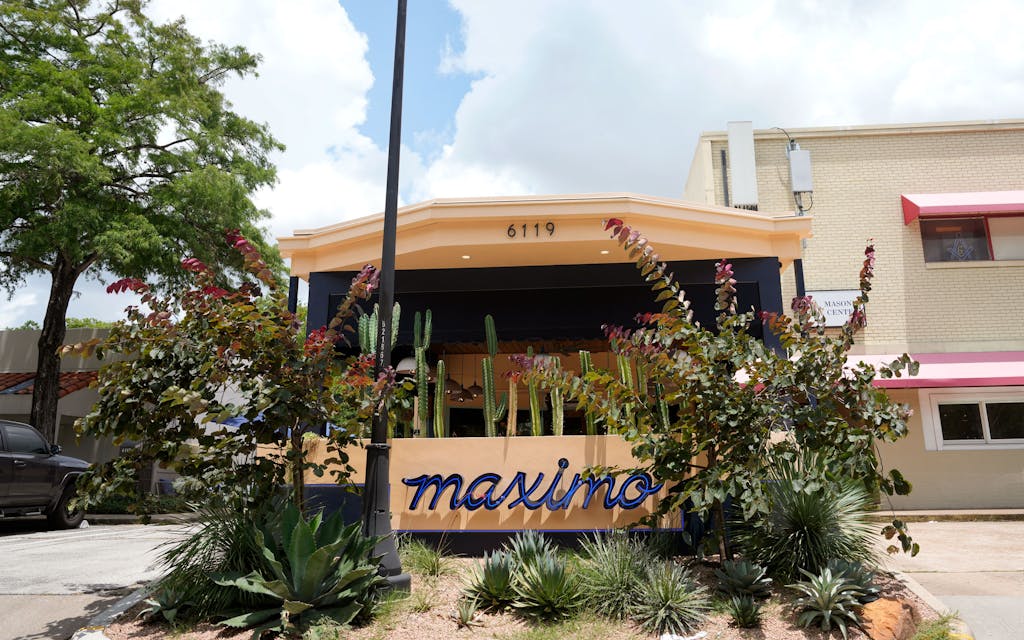 Maximo, in Houston.Melissa Phillip/Houston Chronicle via Getty
Seated at a corner table, I wondered where this young man learned such composure—his near-constant grin radiating grace and confidence—in the high-pressure world of fine dining. It’s something he’s possessed for a long time, says mentor and 2025 James Beard Award winner Thomas Bille, who has known Torres since he was twenty. “To see that maturity at such a young age is extremely rare,” Bille says.
Torres met Bille at Hugo Ortega’s modern Oaxacan restaurant Xochi, where Bille was the sous chef and Torres, in his first restaurant job, was an oyster shucker. Bille soon saw Torres’s curiosity and ambition. “He just asked questions constantly,” he says. Soon enough, after he started going through a case of oysters in twelve to fifteen minutes, Torres was promoted to prep cook, tasked with chopping and slicing. He leapt into the role that others saw as the drudgery of kitchen life. He never turned down a request to work on a day off or stay late.
He left Xochi two years later to work at Armandos, a vaunted Tex-Mex restaurant in Houston’s wealthy River Oaks neighborhood. In 2019, he reunited with Bille at his contemporary Mexican restaurant, Belly of the Beast, in Spring. “I called him, and I said, ‘Hey man, if you’re willing to learn and if you’re willing to grow . . . I’ll show you what I can if you work side by side with me,” Bille says.
The elder chef showed Torres a different way of looking at Mexican cuisine and how to add personal touches to the food to weave in your heritage and story. More importantly, Torres learned the business side of restaurants. He worked every aspect of the kitchen with Bille: receiving deliveries, prepping, cooking, serving, and deep cleaning. “At a small restaurant, sometimes you have to get on your knees and scrub,” he says. It was the kind of work that keeps egos in check. “I was able to see a different side of the business, like a lot of hustle, grit,” he says. Torres left Belly of the Beast mid-pandemic after Bille temporarily closed the restaurant. (He reopened it in 2023.)
In summer 2021, Torres got a job at El Topo, a Mexican restaurant from chef-owner Tony Luhrman. El Topo closed and reopened as Maximo in April 2024, still with Luhrman as chef but with Local Foods Group as the parent company. It closed in December 2024. Ownership reimagined the second iteration of Maximo as a progressive, nixtamalized masa-forward Mexican establishment informed by thoughtful wonder of the past, present, and future. “I had no doubt in my mind it was Adrian” that had to take the helm, says culinary and creative director Seth Siegel-Gardner.
Maximo reopened in January 2025, and reviews pegged Torres as a chef to watch. Noting Torres’s pedigree, Houston Chronicle restaurant critic Bao Ong concluded that “maybe it was only a matter of time before Torres’s cooking started drawing attention and fans.”
When I visited Maximo a few months later, I was struck by how Torres’s blend of Mexican cooking with traditional techniques, including smoking, was apparent in dishes such as a seared duck breast served alongside a bantam chile relleno draped in creamy, white nogada sauce made of walnuts and speckled with pomegranate seeds (served at a collaborative dinner with Bille). During other meals, I relished a triangular tetela of nixtamalized blue corn masa pressed with a squash blossom and filled with salty queso de rancho, presented on a pool of tart, seed-speckled tomatillo salsa showing off Torres’s careful plating. His creativity was visible on a platter of hamachi tuna served with a trio of strawberry preparations: fresh, pickled, in a spicy ponzu sauce.
Torres wanted his restaurant to maintain a casual air and be a place where locals could grab an affordable meal, so he introduced a $45 dinner tasting menu with five courses and the option of adding a $30 beverage pairing. While the dishes change depending on the season, ingredient availability, and the whims of the kitchen, there are two mainstays: an aguachile of silky, sliced fish in a briny, slightly spicy liquid and masa cornbread with quenelles of chapulines-infused butter and caviar.
To really understand Torres, you must order the enchiladas potosinas. Inspired by his grandmother’s recipe and a specialty of his native San Luis Potosí, Torres fills soft, guajillo chile-infused corn tortillas with queso fresco and queso de cincho, an orange-rind cheese. The enchiladas are then folded and fried. The edges are crispy. The centers remain tender. “They’re not as good as my grandma’s or my mom’s, but I’m very proud of the enchiladas,” Torres says. Although the enchiladas are currently off the menu, Torres reserves a stash for customers from San Luis Potosí.
Torres has childhood memories of Mexico, but he has not been back since. Once, a Mexican man making a linen delivery to Maximo remarked that Torres must have a blast visiting so often. “I can’t go,” Torres told him. “But I like to learn through people’s stories.”
The deliveryman recounted growing up in Michoacán, when he and friends would walk a lake’s edge to scoop up charales (tiny freshwater fish), which they’d fry in a pan and eat whole. Torres could imagine walking along the lakeside, with the vibrant blue sky above and hazy green mountains in the distance. “I was privileged to go there with him in the story,” Torres says. He enjoys these kinds of unexpected yarns. “I love talking to older people, people who have more knowledge than me, people who were born in Mexico, who got to live in Mexico,” he says. “They start telling me these stories, and that just gets my gears running around, and I get inspired.” His response is always the same: “How can I replicate this feeling for you?” Torres knows the best he can do, for now, is attempt to interpret their memories on the plate.
In the weeks after his James Beard Award nomination, Torres consulted his DACA advisor at the nonprofit immigrant advocacy group Familias Inmigrantes y Estudiantes en la Lucha, also known as FIEL Houston. The advisor suggested Torres not attend at all. It was too risky, given that Torres’s DACA renewal was taking a lot longer than normal to go through.
Torres experienced a scare in January, when he got word that federal immigration officers were allegedly canvasing the streets near Maximo. He told his staff to stay inside and then walked into the middle of the street looking for the agents. He saw two unmarked, black SUVs driving away from the restaurant. As a DACA recipient, a potential interaction with authorities that day could’ve led to detainment. Last July, Department of Homeland Security assistant press secretary Tricia McLaughlin told NPR that DACA recipients “are not automatically protected from deportations” and that “DACA does not confer any form of legal status in this country.” Torres called some of his staff and asked them to be careful coming into work. Two cooks called in that day, which he understood. “I have the luxury of being quasi legal here, but I am very familiar with the fear that comes with interaction with federal officers, including immigration officers,” he says.
Torres wants his employees to feel safe at work and to know that he’s going to protect them. He knows them as household providers and stand-up guys. “It sucks having to have those conversations with your staff,” Torres says. He remembers frantic, quiet calls from his own family beseeching him not to speed en route to work, as well as relatives who wouldn’t leave their houses for days after news of local ICE activity.
He hopes to allay some of his family’s fears by applying for the EB-1A visa, a path to permanent residency for individuals at the top of their field. To qualify, he must submit major prizes and published material about his work as evidence. So missing the awards ceremony was out of the question.
Two friends, Rodrigo Bravo and Bo Bundy, planned a road trip from Houston to Chicago to ensure Torres could make it. As much as he wanted to attend the awards ceremony in Chicago, Torres hesitated, anxious about being pulled over by police officers. But his pals were determined. “When you meet someone like Adrian—someone so sweet, caring, and thoughtful—you naturally want to do everything in your power to help him because you know he’d do the same for you,” Bundy says. Torres’s only requirement was that his fiancée accompany him. “She’s been with me since my first kitchen job,” he says.
So they went, subsidized in part by private donations. The group spent two days on the road, stopping overnight only in Nashville. “I loved it,” Torres says.
 Adrian Torres speaking onstage during the 2026 James Beard Restaurant And Chef Awards.Jeff Schear/James Beard Foundation via Getty
The troupe finally reached Chicago a few days before the June 15 ceremony. In the dining room of their Airbnb, Bundy gave Torres and his fiancée a two-stepping lesson ahead of a country concert they’d attend later in the week. Ella Langley’s “Choosin’ Texas” played over a Bluetooth speaker. A tornado warning had been issued for the area, but the couple was unbothered, turning in tight circles, holding each other closely. They smiled and laughed as they fumbled the moves.
They’d still be smiling (perhaps still in disbelief) and also crying when Torres was announced as the winner of the national Emerging Chef award at the Lyric Opera. “Today, standing on this stage, I want to say something I never thought my younger self would have the opportunity to say,” he told the audience during his acceptance speech. “I am proud to be the son of immigrants. I am proud to be an immigrant. I am proud to be a DACA recipient.” He took off his cowboy hat as he thanked his parents in Spanish, saying, “Mamá y Papá, gracias por dejar su tierra para darle a su familia una oportunidad. Nunca podré pagar ese sacrificio, pero espero que momentos como este les recuerden que todo valió la pena.” He knows he’ll never be able to repay the sacrifice they made, he said, but he hopes the award not only shows them his appreciation but also that everything they did was worth it.
Read Next
Dining and Cooking