


In 2013, a seventh grader named Natchez Lee was barely hanging on at Willard Middle School. Childhood health issues meant constant doctor’s appointments and missed classes, and the transition from elementary school had been, in their words, “extremely rough.”
But twice a week, Lee walked into an elective where students grew vegetables, cooked them, and sold the results to the neighborhood. Something clicked.
“It was pretty much the only thing that I was looking forward to doing at school,” Lee said. “I honestly think that program kept me coming to school.”
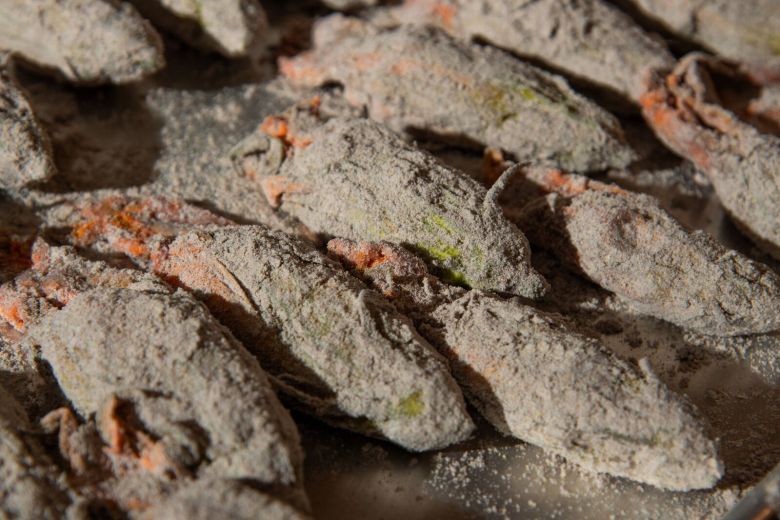 Natchez Lee prepared stuffed zucchini flowers coated in blue cornmeal for a side dish at their June supper club. Credit: Ximena Natera for East Bay Nosh
More than a decade later, Lee is the chef behind Daffodil Projects, a plant-based pop-up and supper club exploring what they call “produce-driven diaspora food from the American Southeast.” The class that changed Lee’s relationship to school, Growing Leaders, is still running at Willard. Still selling hundreds of meals to the community every other Thursday. Still run by the teacher who refused to let Berkeley’s School cooking programs die. (Disclosure: Lee volunteers with Berkeley Supper Club, a community dining project founded by the reporter.)
20 students, $20,000 and a plan to rescue Willard’s cooking program
Matt Tsang arrived at Willard as a garden teacher in 1997. A cooking program followed a couple of years later, part of a broader Berkeley Unified effort to add a garden and cooking teacher at every school in the district, supported by roughly $1 million a year in nutrition education funding.
Then, in 2013, Berkeley Unified lost $1.9 million in annual federal and state funding for its districtwide cooking and gardening program. Nearly every cooking program in the district was cut.
Tsang wasn’t ready to let Willard’s program disappear. With cooking teacher Susanne Jensen, one elective class, and about 20 students, he made a proposal.
“Our [fundraising] goal this year is going to be $20,000,” Tsang remembers telling the class. “I’m not sure how we’re going to do it, but we’re going to do it together.”
What emerged was Growing Leaders, a student-run food business that would fund the classroom it lived in. The students weren’t following a lesson plan. They were building the program alongside the adults. They voted on menus. They voted on prices.
“It wasn’t like, ‘Hey, here’s a curriculum, let’s execute it,’” Tsang said. “It was, ‘Here’s our goal, and let’s figure out how to do it.’”
It worked. A dozen years later, Growing Leaders is still going strong and operates on a two-week cycle. One week of curriculum: food safety, the science of pickling, why people preserve food. And one week of prep, culminating in a Thursday evening meal sale where customers pick up 350 to 400 pre-ordered meals between 5 and 6:30 p.m.
The program harvests several hundred pounds of its own peppers every year and lacto-ferments them into hot sauce, cans 400 to 500 pounds of tomatillos into salsa, and turns the after-school program’s leftover fruit into tarts.


(Left) Growing Leaders executive director and founder Matt Tsang poses with some pot pies. (Right) Growing Leaders students work on shaping dough. Credit: Amy Dobras
Two years ago, Tsang expanded to Berkeley Technology Academy, the district’s continuation high school, where a new kitchen lets paid student workers produce kombucha, kimchi and pantry items. The operation runs on what Tsang describes as a for-profit/nonprofit model: make 100 quarts of potato leek soup, sell 50 at $10 a quart, give 50 away through the program’s food pantry. The pantry itself grew out of a classroom discussion about pricing, when a student pointed out they couldn’t afford the meals they were cooking.
For Tsang (who in his other life, coaches ultimate frisbee at the national team level) the food is almost beside the point.
“While I really have a passion for cooking, I’m not actually looking to turn out chefs,” he said. “Our public education system doesn’t serve all people. We’re offering an alternative way from the mainstream classroom.”
Still, the chefs happen. “I walk into Pizzaiolo right now, and from the front of house to the back of house, five or six kids that I taught,” Tsang said.
From an alternative classroom to a career
Lee was in the Growing Leaders’ first cohort, and Tsang remembers them vividly. Partly for the creativity and individual drive, and partly because Lee spent roughly a year wearing a kilt to school.
For Lee, this classroom was the first place school made sense.
“It didn’t feel like an academic setting,” they said. “It was a lot more collaborative than any other subject … it felt like a very safe and relaxing space.” Mistakes weren’t failures, but opportunities. An oversalted batch became a lesson in how to correct, adapt, and sometimes even improve a dish.
“I never met such a calm and gracious person as Matt,” Lee said. “When you’re around Matt, you want to take care of people, and you want to nurture people. I don’t feel like he really has to tell you that. I think that’s just the energy of the space he creates.”
 Stuffed squash blossom and succotash with Cacahuazintle hominy, snap pea and zucchini was one of the menu items at the Daffodil Projects June supper club. Credit: Ximena Natera for East Bay Nosh
Lee graduated high school in June 2020, straight into the pandemic, and did what Growing Leaders had taught them was possible: they started selling meals to their neighbors. “This neighborhood kid is cooking for us, that’s cute,” is how Lee describes the reception. “Maybe it wasn’t, but it felt that way.”
A first restaurant job followed at Homeroom (yes, the mac-and-cheese restaurant) until Lee realized that three months in, they were the most senior non-manager in the kitchen. Looking for a kitchen where they could grow, Lee cold emailed Eric Tucker at Millennium, Oakland’s pioneering vegan fine-dining restaurant.
”Natchez was at the right place at the right time. We happened to need a line cook when they applied,” Tucker said.
Tucker told them they were green, then hired them anyway. “Natchez had drive to do well. Natchez learned about a sense of urgency and accuracy when there was a wall of tickets on their station,” Tucker recalled. “Hopefully through working at Millenium, Natchez was able to add to their skill set.”
In 2022, Lee took a gamble on Nashville, where their father’s family has lived for six generations. They worked at Etch and Henrietta Red, and it was Henrietta Red that completely rearranged their understanding of the food they’d grown up visiting.
“Southern food can be produce-forward,” Lee said. “It doesn’t have to hide behind pork.”
 Cucumber and plum granita was one of two desserts, along with a chocolate birthday cake to celebrate Lee’s June birthday. Credit: Ximena Natera for East Bay Nosh
Lee returned to the Bay Area in 2024, cooking as a chef de partie at Merchant Roots in San Francisco and staging around the Bay, including at Burdell, Geoff Davis’ celebrated Oakland soul food restaurant. Davis told them something that stuck: he’s not cooking Southern food, he’s cooking soul food. The distinction convinced Lee there was an open lane for exploration.
Daffodil Projects is named for a daffodil garden Lee’s great-great-aunt planted along the Natchez Trace in Tennessee, a patch of flowers still maintained today. Lee describes the project as “a study of the movement of people to and from the Southeastern U.S.,” and the study began in April 2025 with three bites paired with three glasses of wine at Adega Azul, the Brazilian-inspired wine bar on Gilman Street, whose owner had seen Lee’s food. They were neighbors at the time and offered access to the space.
That first night, a couple who had been vegan for 40 years and had eaten Michelin-starred plant-based tasting menus in Portugal told Lee a dish reminded them of one of those meals.
“It was the first time that I felt like somebody who’s traveled, and much older than me … recognized the value of what I did,” Lee said.
The food itself resists easy categorization. Lee’s signature is a riff on pemmican, the Native American preparation of dried fruit and nuts bound in animal fat, traditionally bison tallow. Lee’s version, inspired by Cherokee food traditions, builds a shortbread-like base from native nuts like pecans or peanuts soaked in apple Brandy. They top it off with native fruits like kumquat marmalade, loquat, hawthorn apple and encase it in cultured plant butter. It appears, in some form, on most Daffodil Projects menus. Lee is careful about what it represents.
 Chef Natchez Lee explains the menu to their guests. For the dinner, Lee invites around eight people, and converts their apartment living room into a dining room. Credit: Ximena Natera for East Bay Nosh
“I’m not claiming to represent [Cherokee cooking],” they said. “I just want people to be more curious when it comes to what they’re eating.”
That curiosity drives how Lee talks about the South. Ask what Californians misunderstand about Southern food and the answer comes fast: “It’s very African, and it’s very Japanese.” A striking share of Tennessee’s plant life shares a lineage with Japan’s. Shiso, known there as beefsteak plant, is highly invasive and grows in sidewalk cracks. The documented canon of Southern cooking, Lee notes, was largely the work of enslaved West African cooks whose techniques were recorded under other people’s names.
 Lee prepares blue corn masa dumplings a day ahead of the June supper club. The Daffodil Project Supper Club is a free monthly event designed by Oakland chef Natchez Lee. Hosted at their Chinatown apartment, the supper club features an experimental menu rooted in indigenous ingredients and traditional preparation methods. Credit: Ximena Natera for East Bay Nosh
“It’s a land with a rich history and a very problematic history,” Lee said. “I want those conversations to be had … we’re all human, and we all have to coexist.”
Lee keeps the operation deliberately small for now (supper clubs, pop-ups, collaborations with local makers) while working towards something bigger. A restaurant, maybe, someday. “Opening a restaurant is a dumb financial decision,” Lee said, laughing. But: “I caught a bug. I want to keep cooking, and I’m not gonna stop.”
Tsang has yet to taste his former student’s food. He’s seen the photos, the pemmican, the sunchoke and sunflower-seed terrine wrapped in seaweed, and last month, an invitation to an upcoming Daffodil Projects meal arrived.
“I would love to actually experience that,” Tsang said.
The teacher who built a program out of a funding crisis, who insists he isn’t trying to turn out chefs, is about to sit down to a dinner cooked by living proof that sometimes he does anyway.
Daffodil Projects upcoming East Bay pops up and supper club:
Donkey & Goat Winery, Aug. 28
Supper Club, Sept. 7
Best Friends, Sept. 17
Supper Club, Oct. 5
Find events and the supper club at daffodil-projects.com or @daffodilprojects on Instagram.
 Natchez Lee cooks in their Oakland kitchen for a Daffodil Projects Supper Club meal in June. Credit: Ximena Natera for East Bay Nosh
“*” indicates required fields
Dining and Cooking