


In Mobile’s beloved Oakleigh Garden District sits a historic house that is now home to The Hummingbird Way Oyster Bar. Cozy and intimate, it welcomed me in this summer for an evening of thoughtful hospitality and some truly memorable food. But as a Birmingham gal, what impressed me most was the way Chef Jim Smith uses local ingredients to tell the story of our Gulf Coast—by honoring the people, traditions, and ingredients that make this region so special, and with a deep sense of intentionality.
Since opening the Mobile restaurant more than six years ago, Smith has watched it become part of the city’s food scene and, in the process, become part of the community itself. That relationship has meant more to him than he could have anticipated.
“The way the city has embraced both me and the restaurant has been really meaningful,” Smith says. “I’m incredibly grateful for the support we’ve received.”
That sense of connection is also at the heart of what Smith hopes The Hummingbird Way can represent. He believes Mobile has everything it needs to become a destination for food, much like other Southern cities that have developed reputations that draw people from beyond their borders. What Mobile needs, in Smith’s eyes, is the continued confidence to tell that story and to recognize what it already has.
“We have the culture, history, ingredients, and access to incredible Gulf seafood to make that happen,” Smith says.
Starting with what Alabama gives us

(Chef Jim Smith/Contributed)
For Smith, that begins with a very simple question: Where did this food come from? As plate after plate arrived out the kitchen, from locally-sourced oysters to Alabama blue crab, it became more and more clear that they told the story of our fishermen and our farmers. When creating a dish, Chef Smith and his team ask a simple question: does it reflect Mobile and Alabama’s foodways in a meaningful way?
Alabama’s Gulf Coast provides an extraordinary home pantry. Shrimp, crab, oysters, and fin fish are all part of an industry that has shaped the region for generations, and Smith wants to make the most of what is available just beyond the restaurant’s doors. The same philosophy extends inland, where he works with farmers and producers to source vegetables, fruits, meats and other products grown and made throughout the region. On my plate, Alabama summer produce was in great abundance: heirloom tomatoes, zucchini, squash, butterbeans, and our beloved Chilton County peaches.
There’s a difference, Smith believes, between taking a familiar dish and deciding afterward how to make it local and beginning with the place itself and allowing it to shape the dish. “We start with those great local ingredients and then build the dishes around them, rather than deciding on a dish first and figuring out where to source the ingredients afterward,” Smith says.
That approach gives The Hummingbird Way a sense of identity that goes beyond a list of local suppliers. Smith wants the restaurant to feel like an expression of the Gulf Coast, Mobile and Alabama—not through a forced attempt to make every dish explicitly regional, but through an understanding of the ingredients and traditions that give the region its unique identity.
The people behind the oysters

(Murder Point Oysters/Contributed)
Few ingredients illustrate that better than the oysters that come from Alabama’s coast. Chef Smith has tremendous admiration for the people who produce them; it’s an industry that requires physical work, patience, and a willingness to live with uncertainty. Weather and other forces of nature can change conditions in an instant, and the people working in the water have little control over many of the things that determine whether a season will be successful.
One of the things that fascinates him most about Alabama oysters is how distinctly they reflect the waters where they are grown. Much like wine, oysters develop characteristics tied to their environment; different growing areas along the coast can produce oysters with remarkably different flavors, salinity, textures and personalities.
“These farmers aren’t simply producing an oyster; each farm is producing something distinctive that reflects a particular place on the Gulf Coast,” Smith says.
At The Hummingbird Way, Smith tries to give diners an opportunity to experience that difference for themselves. The restaurant keeps at least a couple of Alabama oysters on the menu, such as Murder Point and Point aux Pins, alongside oysters from some of the country’s most celebrated growing regions. Placing them next to one another allows guests to taste the differences, but it also gives Alabama oysters an opportunity to speak for themselves.
“In my mind, [Alabama oysters] always hold their own,” Smith says. “Depending on the farm, the harvest, and the conditions at that particular moment, there are plenty of times when I think the Alabama oyster is simply the better oyster.”
And, as I’ve experienced on the coast firsthand, an oyster becomes something different when you understand the person who raised it and the stretch of water where it spent its life.
Letting tradition lead the way
That connection between food and place is also what allows Smith to approach Southern food with both reverence and creativity. He doesn’t view tradition as something that needs to be abandoned in order to make room for new ideas. In fact, he sees the opposite. Tradition provides the foundation; the ingredients, stories, and foodways of the Gulf Coast give him a rich starting point from which to create.
The Hummingbird Way’s jambalaya is the perfect example. The dish has a deep connection to Mobile, where the earliest recorded recipe for jambalaya comes from a local church community cookbook. The restaurant’s jambalaya brings together oysters, shrimp and crawfish to showcase the seafood of the Gulf Coast. Carolina Gold rice from Marsh Hen Mill adds another distinctly Southern ingredient with its own history, while Conecuh sausage brings Alabama into the dish. Heirloom tomatoes are roasted deeply to create the foundation of the sauce. The finished dish is still unmistakably jambalaya, but it is also unmistakably The Hummingbird Way.
“That’s really how I think about balancing tradition and creativity,” Smith says. “I don’t feel the need to move away from Gulf Coast traditions to make something new.”
Creating a place where people feel cared for
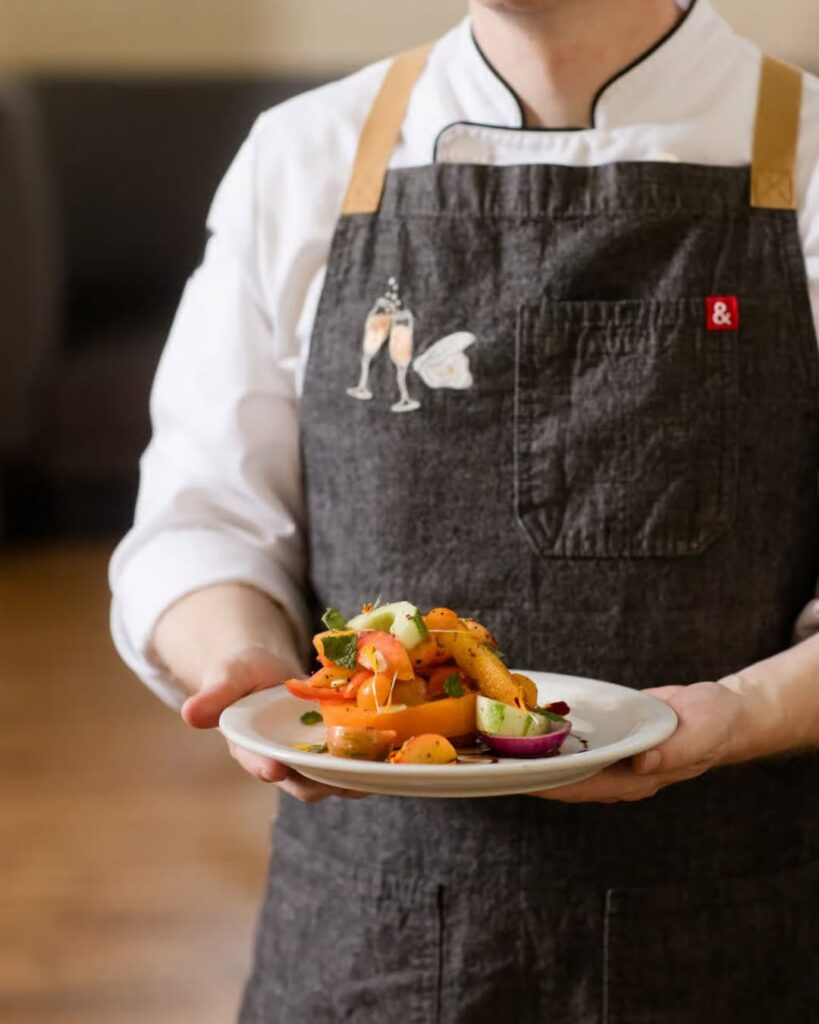
(Chef Jim Smith/Contributed)
And for all of the attention that can be placed on ingredients and technique, Smith ultimately comes back to something more fundamental: how a person feels when they walk through the door.
“One of the things I’m most proud of about The Hummingbird Way is that I really do feel like we’ve created a restaurant where people can walk through the door, shed some of the troubles of the day, sit down, and experience what genuine hospitality feels like,” Smith says.
That, to Smith, is the real work of a restaurant—and it was a beautiful thing to witness, as I sat down to a spread of the Gulf’s freshest seafood.
The food matters, of course—but so does the service, the atmosphere, and all of the details that shape an evening. He wants guests to feel cared for from the moment they arrive until the moment they leave. In the South, the word “hospitality” can become overused, its meaning diluted. Smith talks about it as something much more personal.
“We want people to understand what it means to truly be taken care of and to recognize the thought and effort that goes into creating something special for them,” Smith says.
After more than six years, Smith feels that The Hummingbird Way has found its place in Mobile. The restaurant has won over the hearts, minds, and taste buds of the people around it, giving Smith something he considers even more valuable than recognition: a foundation from which to keep building.
There are projects ahead, though Smith is not ready to share all of them yet. He hints at big announcements to come, both for himself and for The Hummingbird Way, and there is a sense in the way he talks about the future that he is far from finished.
“I’m very proud of where we are, but I’m even more excited about where we’re going,” Smith says.
Want more stories like this? Join our newsletter for more stories rooted in Alabama, delivered to your inbox every Friday.
Dining and Cooking