


{p dir=”ltr”}After a weekend of eating around the world in Park City, one of the biggest lessons was waiting for me back on Nantucket.


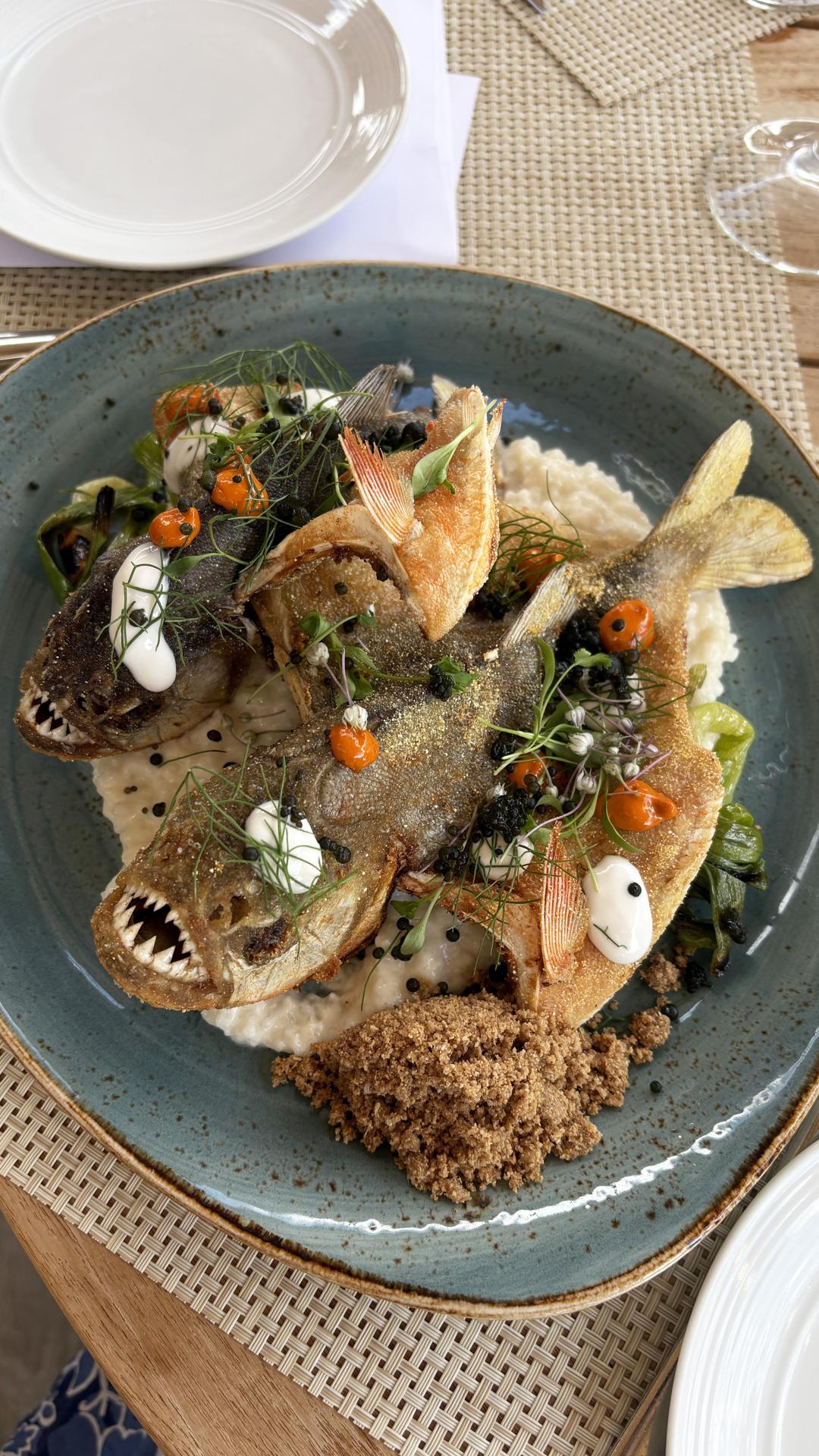

Chef Marsia Taha’s piranha






(Sept. 3, 2026){/span} The first time I ate piranha, I was sitting in a restaurant in Park City, Utah.
That is not a sentence I expected to write when I boarded a plane for the inaugural Chef’s Table Food Festival earlier this month. But after four days of meals, panels and conversations with more than 70 internationally renowned chefs, I could not stop thinking about that fish.
I first heard about the fish during a panel on creativity in the kitchen. Bolivian chef Marsia Taha talked about piranha, a familiar food where she grew up that can intimidate diners unfamiliar with it.
“People think it’s dangerous and sharp, but it’s delicious and shows creativity and traditions,” she said. “I’m grateful as a chef that I get to transform the way people see ingredients.”
A few hours later, I was eating it myself.
Taha served the lightly-crusted fish whole on the plate. Head-on, sharp teeth and all. It was, in some ways, the fearsome fish I had imagined.
But on top of creamy coconut rice with bright, sharp drop peppers and leeks and salty algae drops, it turned into something completely different. We ate the fish with our hands, at the chef’s request, and it was some of the most fun I had all weekend.
Taha was not simply serving an unusual ingredient to curious festival-goers. She had taken an ingredient deeply connected to her home and used it to tell someone else a little bit about where she came from.
That happened repeatedly throughout the festival.
I went to Park City expecting to spend four days eating some of the best food I’d ever encountered. I did. What I didn’t expect was to return to Nantucket with a deeper appreciation for the food already around me.
There is a word often used in the wine world to describe the way a place – its soil, climate, geography and traditions – can become part of what we taste: terroir.
After Chef’s Table, I found myself thinking about terroir much more broadly. Food has a geography. It carries the history of the people who make it, the ingredients available to them and the environment that produced those ingredients. Sometimes you can taste a place before you know its name.
At the festival, chef Isabel Coss put it another way.
“Playlists, music, attention to detail, you bring all of that back,” she said. “We’re a compound of our travels, lives and experiences.”
That idea came up again and again. Chef Matt Conroy talked about traveling through Mexico and gaining a deeper understanding of the complexity of mole.
“So much goes into mole and all Mexican food, people often don’t understand,” he said. “So going and figuring out ways to get that depth of flavor, we brought that back, so experiencing it was really important.”
Chef Tomer Blechman described wanting diners at his restaurant to feel transported to Mexico.
For chef Sara Aqel, who is from Jordan, you can learn new techniques from chefs around the world to incorporate into your dishes, but when you put together a dish, the food is inherently tied to the place you call home.
“Food is very geographic,” she said. “When you cook, you always want to cook from somewhere you understand.”
Sean Brock talked about sour corn, a hyper-local Appalachian food he grew up eating. Its history stretches across cultures: German immigrants craving sauerkraut adapted the tradition to Cherokee corn.
Brock also recalled tasting fermented locust bean while traveling in Dakar. He couldn’t recreate the flavor when he returned home. Ten years later, he tasted it again in Park City, in a dish by Senegalese chef Serigne Mbaye.
“I hadn’t tasted it in 10 years,” Brock said. “It was exactly like I remembered.”
These chefs were not simply collecting recipes as they traveled. They were collecting memories, techniques, smells and pieces of other places, then carrying them home.
It made me think about Nantucket.
Our geography is not simply scenery for the restaurants here. It is an ingredient.
On an island, that connection between place and food is particularly tangible. Nantucket cannot produce everything it eats, but the limitations of island geography make what can be grown, caught and produced here all the more meaningful.
And there is an entire community working to keep those ingredients in circulation.
Farmers, fishermen, growers, restaurants and organizations including Sustainable Nantucket have helped create a food culture in which local sourcing is not simply a buzzword.
At restaurants across the island, menus change according to what farmers are growing, what fishermen are bringing in and what the season allows.
At Sister Ship, chef Nathan Parsons told me, “If we can get anything and everything local that’s what we strive for.”
That requires flexibility.
“We’re adaptable, and I think that’s what people enjoy,” he said. “We’re always doing new things with the products we have.”
At Seagrille, where chef EJ Harvey has spent 35 years cooking for Nantucket, the same philosophy is even more straightforward.
“Whatever’s in the market, the freshest that we can do,” he told me. “A lot of times these things just pop up when the farmers bring it in.”
Harvey’s favorite summer preparation for local fish is similarly simple: grill it whole and serve it with vegetables from island farmers.
“We have such good gardens and farmers out here,” he said. “We’re getting so many good vegetables, it’s great.”
At Òran Mór, chef and owner Edwin Claflin has made the island’s food system part of his broader environmental philosophy, joining Sustainable Nantucket’s board to support local farms.
“The more we can source here, the more independent Nantucket can be,” he told me.
Local food is not only about freshness or flavor. It is about knowing where your food comes from and maintaining the relationships that make it possible to keep producing food here.
At Topper’s, chef Kyle Zachary told me that he starts with the ingredient rather than working backward from a finished dish.
“I try to focus on produce first,” he said. “I try to speak with our farmers, see what they have available and try to build dishes around that.”
A dish of Iberico pork, for example, incorporates carrots and fennel from local farms and local honey. “There’s a lot of local in that dish,” Zachary said. “Which I’m really happy about.”
It’s the same for Gabriel Frasca at Straight Wharf when he talks about a recent tuna dish he served at the restaurant. “It’s pretty and it’s delicious, but it’s island eggplant and island onions and island herbs and tuna that the Albacore brings in for us and cherry tomatoes that we get every morning from the island and it’s our own private label olive oil,” he said. “There’s just a bunch of little things there that please me. It sort of seems like a distillation of what it is that we try to do.”
Letting a place tell you what to cook was one of the things I heard repeatedly in Park City. And that similar exchange between traveling outward and bringing something home is central to Nantucket’s food culture.
Dylan Cavaliere, proprietor of Bloom Bar, spent time studying and working in Italy and now treats travel almost like culinary research, gathering inspiration to bring back to his restaurant.
He looks at what is available locally and seasonally when developing dishes, paying attention to “what’s going on in the culinary local farming economy.”
His summer panzanella pairs Nantucket heirloom tomatoes with Fog Hollow Farm peaches and house-made focaccia.
His food may be inspired by Spain or Italy, but it ultimately lands on Nantucket.
That is how places evolve. Traditions travel. Ingredients travel. People travel. And eventually, those influences become part of somewhere new.
Evan Marley’s Pi Pizzeria is another example. He came to Nantucket and was surprised the island didn’t have the kind of pizza he knew from home (Concord, Mass.). He eventually set out to make the kind of pizza he loved: rooted in the traditions of Naples and Rome, but made for this island.
Today, his Rustica pizza is one of the foods I most associate with Nantucket. I grew up eating it after beach fires and summer sunsets. It is an Italian tradition that traveled across an ocean and, somewhere along the way, became part of my own memory of this place.
Food can be a passport, but it can also be a map home.
At Chef’s Table, I ate food that transported me to Bolivia, Mexico, Spain, Colombia, Korea and the Swiss Alps without ever leaving Utah. I watched chefs explain how the places they came from shaped their cooking, and how the places they visited continued to shape them.
But the most valuable thing I brought home was a renewed appreciation for the place I already know.
The vegetables at the farmers’ market. The oysters, scallops and fish from our waters. The chefs who change their menus according to what is growing. The restaurants that have become repositories for decades of island memories.
The farmers, fishermen and community organizations working to make sure those ingredients remain part of Nantucket’s future.
We often talk about what visitors should take home from Nantucket. A souvenir. A photograph. A favorite restaurant recommendation.
But perhaps the best thing they can take is something less tangible: a deeper appreciation for fresh, local food – and an understanding that food is inseparable from the place that produces it.
Food can tell us where someone comes from, what their community values, what their landscape provides and what they have chosen to preserve. It can introduce us to unfamiliar ingredients and make us curious instead of afraid.
Protecting that philosophy means protecting the place that makes it possible. And Nantucket has plenty of food worth being curious about.
Dining and Cooking