


Guests in tailored attire emerge from a rooftop elevator for an evening of dinner and dance. A white-gloved host leads arrivals to tables set with classic napery, blue crystal and yellow china. A polished waitstaff performs table-side wine service.
Encircled by palms and lush greenery, attendants carry silver trays of French cuisine. Beneath a darkening and breezy sky, an orchestra strikes up a starlit jazz groove.
From the Rainbow Terrace atop the St. Anthony Hotel, a portrait of fine dining in 1936 San Antonio emerges: formal and luxurious with echoes of Waldorf Astoria glamour.
 The Rainbow Terrace at the St. Anthony Hotel in 1936.
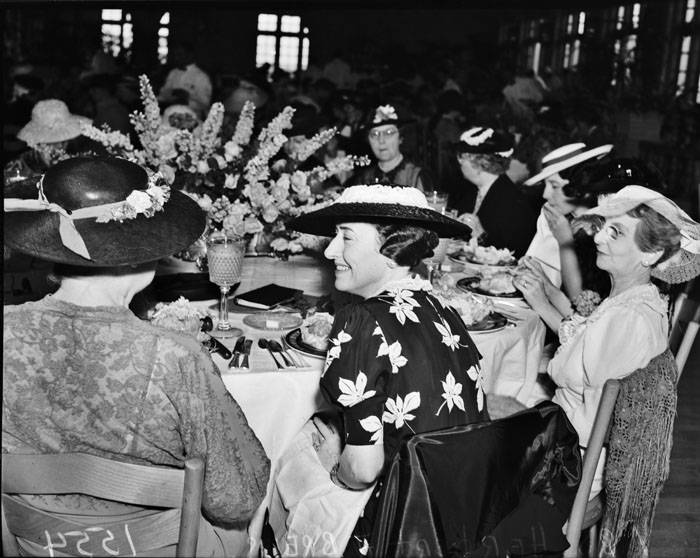 A luncheon at Rainbow Terrace in 1937. Credit: San Antonio Light Photograph Collection, UTSA Special Collections
A few blocks from the St. Anthony, a downtown supper club offered a posh alternative. The Turf Club featured an air conditioned dining room, female vocal entertainment, a mixologist from hotel bars in New Orleans and Mexico and charbroiled steaks for $1.
Soon after opening in 1934, the San Antonio Evening News reported: “Its beauty and splendor have attracted thousands of patrons from all over the South.” Within two years, the San Antonio Light reported the Virgil “Red” Berry-led bar was exposed as a gambling house.
The question before the city’s swanky set: Do we dine and dance on a rooftop garden? Or eat and drink in a speakeasy with roulette and blackjack tables ? Either way, couples could spend less than $2 for dinner (alcohol excluded).
Now step back into 2026. Take a padded seat at Michelin-starred Isidore and look around. There’s an open kitchen, a live-fire hearth, modern furnishings with brick and tile accents. Natural light pours through a wall of windows. A large plate of vegetables at the prep station gives the house a farm-to-table feel. Patrons are dressed as casually as the down-to-earth waitstaff.
 Servers tend to diners during a dinner service at Isidore on Aug. 12, 2026. Credit: Amber Esparza / San Antonio Report
Bill Kennedy and his girlfriend, Lisa Katona, visited Isidore on Valentine’s Day. What he paid for dinner — $615 — could have purchased a two-door, 1936 Pontiac Master Six when the Rainbow Terrace opened 90 years ago.
“It was a prix-fixe meal, eight courses with wine and parking and included a 20 percent tip and tax,” Kennedy said. “Everything from the service to the vibe to the food all hit a 10. We were amazed. It was worth the money and the place was packed.”
The Depression-era Rainbow Terrace and Isidore bookend almost a century of fine dining in San Antonio. The former drew patrons from a small population (the nation’s 37th largest) marked by widespread poverty. The latter draws guests from pockets of affluence in the seventh largest city (pop. 1.5 million).
The Rainbow Terrace and the Turf Club were outliers in pre-World War II San Antonio, rare, high-end gems in a culinary wilderness. Isidore, by contrast, operates in a food system with Michelin star restaurants and James Beard-nominated chefs. Nationally-recognized eateries in Southtown, downtown, the River Walk and Pearl have turned the Alamo City into a fine dining destination.
The evolution from culinary obscurity to prominence took decades. A few high-end restaurants secured national attention in the 1980s and 1990s. But it wasn’t until the birth of Pearl in the early 2000s and the Culinary Institute of America (CIA) in 2007 that the city’s reputation began to change. Once dismissed as a queso-scented sprawl of Tex-Mex, San Antonio now struts with a Michelin star swagger.
 Adrian Rodriguez at the raw bar station begins to walk over dishes to the pass for the chef de cuisine to look over before they are sent to diners at Isidore. Credit: Amber Esparza / San Antonio Report
“San Antonio has come a long way,” said Patricia Sharpe, the former Texas Monthly restaurant critic. “It is much more sophisticated than it was and has probably come farther than a lot of other large cities, maybe because it had farther to go.”
Progressive Mexican culinaria Mixtli earned the city’s first Michelin star in 2024. Co-owner and chef Diego Galicia and chef de cuisine Alex Cabrera are CIA graduates. A third CIA alumnus, Jorge Hernandez, divides his time between two Michelin star restaurants: Isidore and Nicosi Dessert Bar at Pullman Market.
Christopher “Kit” Goldsbury envisioned a blossoming culinary hub when his company, Silver Ventures, founded the 22-acre brewery property known as Pearl. He hoped to elevate Latin American cuisine when he invested $35 million to launch the CIA. The development of both, he says, have exceeded his expectations.
“The CIA calling Pearl and San Antonio home changed cuisine in the city,” said Goldsbury. “The best part of this evolution is watching people behind these restaurants live their dreams.”
 Culinary arts students work in the kitchen during the first week of classes of a new semester at the Culinary Institute of America. Credit: Amber Esparza / San Antonio Report
A culinary outpost
High-end dining came to America in 1837. Swiss immigrant brothers John and Peter Delmonico opened a three-story New York City restaurant that featured white marble pillars, an extensive wine list and European-inspired cuisine. From Delmonico’s French-American menu came iconic dishes, lobster Newberg and baked Alaska, and a signature cut of meat, the “Delmonico steak.”
The first glimpse of gourmet dining came to San Antonio in the late 19th Century. After the railroad arrived in 1877, the Menger Hotel began serving wild game, snapper soup and mango ice cream. According to the Handbook of Texas, the hotel “was praised for the cuisine offered in the Colonial Dining Room.” Before he became president, Theodore Roosevelt visited on a javelina hunt and recruited his Rough Riders to the Menger Bar.
The St. Anthony Hotel emerged as a rival when it opened in 1909. The hotel featured Venetian mosaic tile and walls wainscotted in white Italian marble. One early menu offered a crab meat cocktail, Waldorf salad, fried halibut sauce tartare, potatoes Julienne and crème de menthe sherbet.
A dining room added in 1910 featured massive pillars of quarter-sawed oak. “Stepping from the sunlight and hurry of the lobby into this dining room,” wrote the San Antonio Express, “it is like turning back the calendar to the banquet halls of feudal times. …”
 The Tapestry dining room at the St. Anthony Hotel in 1936. Credit: General Photograph Collection, UTSA Special Collections

The climb from the culinary wasteland occurred slowly. The Gunter Hotel attracted guests in 1918 with rooftop dining, live music and dancing. The Plaza Hotel opened nine years later with a 500-seat roof garden ballroom.
Sophisticated European dining did not arrive until La Louisiane opened on Broadway. The San Antonio Evening News issued an arresting headline on Nov. 2, 1935: “New Restaurant Offers Famous French Dishes.”
The News reported that the owner, Max Manus, once served as “maitre’ d hotel at Antoine’s, a world-famous restaurant in New Orleans.” La Louisiane’s menu, the story said, would include oysters Rockefeller, creole gumbo, bisque made with crayfish, fine steaks, seafood and baked Alaska.
“Few restaurants in Texas offer this extremely tasty and palatable type of food, which will prove a delightful new taste thrill to most, one that they will wish to repeat again and again,” the News reported.
As La Louisiane surged in popularity through the 1930s and beyond the post-war boom, its reputation spread. In 1952, Travel-Holiday magazine named it one of America’s 35 best restaurants. La Louisiane made the “best of” list every year until the magazine folded in 1988.
New gems and a private club
HemisFair ‘68 drew nearly six million visitors to San Antonio. Joe Cosniac and Nick Pacelli were two of them. Cosniac, a Canadian entrepreneur, came to the World’s Fair to sell Belgian waffles. Pacelli arrived to run Original Joe Pizza at HemisFair. The men met and formed a waffle partnership.
 A review of Paesano’s in the May 4, 1979 edition of the San Antonio Express-News.
When HemisFair ended, the businessmen opened a modest Italian restaurant on McCullough in 1969. Within months, the San Antonio Express-News reported that patrons were “packing” Paesano’s. In 1971, a San Antonio Light columnist wrote, “… the atmosphere at Paesano’s is great, the food excellent, and if you haven’t tried their Shrimp Paesano, you haven’t lived.”
Texas Monthly raved. “The food is so good it transcends its genre,” the magazine wrote in 1974. “Cannellone and Shrimp Paesano are some dishes you will rarely find equaled elsewhere.”
The neighborhood bistro expanded to accommodate the crowds. It grew and grew, a fine dining anomaly in a city of uninspired steakhouses, chain restaurants and Mexican eateries.
Less than two miles from Paesano’s, the Red Carpet carried its own swagger, serving an upscale clientele on Martin Street. After opening in 1957 as “the city’s newest and perhaps swankiest private club,” the Red Carpet welcomed the public in 1972. Guests donned evening wear for dinner. Waiters placed white linen napkins across laps and lit cigarettes for guests. Couples danced to the music of trios and quartets on a small stage.
Chef Fritz Loeschel served award-winning Continental cuisine. A review from the San Antonio Evening News lauded the Red Snapper Pontchartrain, the redfish in papillote and the tarama spread, a smooth paste of domestic caviar and moistened bread.
The restaurant bar served as a popular gathering spot for politicians and business leaders. The Red Carpet also attracted a number of celebrities, among them John Wayne, Tony Bennett and Nat King Cole.
Texas Monthly called it an “unpretentious gourmet restaurant.”
Just blocks from The Red Carpet, the St. Anthony Club dazzled with downtown luxury. Designed by interior decorator Dorothy Draper, the club opened as part of a $1 million hotel renovation in 1959. It featured mahogany doors, mirrors marbled with gold leaf and “draperies trimmed with tassels under Swiss-embroidered tambour.”
The Express reported, “The club has a spacious dining area in tones of white, gold, black and green, a cocktail room reminiscent of an ancient English pub and an entrance foyer in a classic motif featuring a waterfall.”
In the mid-60s, Rollin W. King drew a triangle on a cocktail club napkin, connecting San Antonio, Houston and Dallas. King showed the napkin to a friend, Herb Kelleher. According to the book, “Dusting Off A Legend: The St. Anthony Hotel,” King said, “Let’s start our own airline.” The diagram became an initial blueprint for Southwest Airlines.
The late billionaire Red McCombs conducted numerous meetings over lunch and dinner at the club. “Dusting Off A Legend” quotes McCombs:
“Most everything that happened in this town happened in The St. Anthony Club. San Antonio back then was barren of places to have top-quality food and top-quality drinking that was conducive to doing business. It’s where I learned how to drink at lunch, and also where I learned to drink a martini.”
 Bar Lead Campbell Dobes garnishes a Bread & Butter Old-Fashioned, a signature cocktail from the beverage menu at Isidore. Credit: Amber Esparza / San Antonio Report
At its peak in September 1973, the club boasted 1,610 members, many of them outside Texas. The club closed in the 1980s after Inter-Continental Hotels bought the St. Anthony and renovated the property.
The Red Carpet shuttered in 1992, due to a decline in business, fueled in part by the closure of NBC Bank across the street. Co-owner Harold Cohen lamented the restaurant’s demise. “It was a place where you could make a business deal,” he told the Express-News, “settle a lawsuit, close a real estate transaction or celebrate a marriage.”
Paesano’s, meanwhile, branched across the city. Today, it serves diners on the River Walk, in Lincoln Heights and on Loop 1604, and continues to win local awards for Italian dining.
Slow rise to prominence
William Ardid brought private club dining to the mainstream in the late 1970s. He took dishes he introduced at the St. Anthony Club — Steak Diane, cherries jubilee and bananas Foster — and served them with the finest wines at Chez Ardid on Broadway.
The owner chef created a stir. Before Chez Ardid opened in February 1977, the Light reported that the first two days were sold out. “Friday night will be a gala affair,” the newspaper wrote, “with many of the local jet-setters and lovers of better things in life showing up to enjoy food and drink and wish William well.”
 The second floor dining area of Bohanon’s Prime Steaks and Seafood before a dinner service on April 9, 2026. Credit: Amber Esparza / San Antonio Report
Anabelle Ardid Parry recalled that her father taught her and her siblings how to prepare French cuisine and introduced them to Romanée-Conti, Bordeaux and Spanish wines. Signature dishes, such as chateaubriand, veal grenobloise and escargots à la Bourguignonne, led to a Distinguished Restaurants of North America Award in the early 1980s.
“My father was a foodie but not a snob,” Parry once wrote for the Express-News. “His focus was on the product, and he was as local as he could be. His crabmeat appetizer, a favorite, was blue crab from the Gulf. Whole red snapper came in from Corpus Christi twice a week for his best-selling dish, Red Snapper Meuniere.”
Chez Ardid and La Louisiane enjoyed preeminent status until a London-born chef arrived from Houston. Bruce Auden turned Polo’s into a culinary sensation. On opening night in 1985, power brokers gathered inside an elegant, peach-hued dining room at the Fairmount Hotel. Black bean and goat cheese appetizers baked in a wood-burning stove. Guests grazed on beautifully-plated appetizers while a pianist played.
 Biga on the Banks Chef Bruce Auden, pictured in April 2025, reflects on his career and what led him to the kitchen. Credit: Brenda Bazán / San Antonio Report
The kitchen featured a future James Beard Award winner, Robert Del Grande, a future white tablecloth chef, David Garrido, a future Rising Chef of the Year, Mark Bliss, and Auden. The culinary firepower drew attention. Esquire named Polo’s one of America’s Best Bars and Restaurants in 1987. The following year, Food & Wine named Auden to its inaugural list of America’s 12 Best New Chefs. San Antonio’s first culinary rock star flexed new muscle and left to start Biga in Tobin Hill.
In the shadow of the 504-foot Tower Life Building, Auden enlarged his profile, opening Biga on the Banks in 2000. The River Walk restaurant grew to feature four kitchens and a 2,400-square foot wraparound terrace with a sweeping view of the city. A New American menu featuring filo-wrapped sea bass, chicken fried oysters and sticky toffee pudding earned Auden seven James Beard nominations for Best Chef: Southwest.
In 1998, a San Antonio native returned from European kitchens to open a modest restaurant downtown. Andrew Weissman spent $43,000 to open Le Rȇve, French for “The Dream.” The investment exceeded his dreams. A classic French tasting menu yielded positive reviews. Imaginative plating and extraordinary flavors generated three-month waitlists.
Le Rȇve’s arrival marked a turn in fine dining. Three years earlier, La Louisiane shuttered amid financial challenges. Two months after Weissman opened on Pecan Street, Chez Ardid closed as well. With the departure of the city’s most storied French restaurants, Le Rȇve filled the void and brought greater attention to San Antonio.
The impact appeared in Gourmet. While perusing the magazine at a local bookstore, Weissman came across a ranking of America’s Top 50 restaurants for 2005. “That’s unusual,” he thought when he recognized a name at No. 20. “There must be another Le Rȇve in California.”
 Andrew Weissman, four-time James Beard nominated chef, at his restaurant Max’s Sister on Aug. 26, 2026 Credit: Vincent Reyna for the San Antonio Report
There wasn’t. The following year, Gourmet ranked Le Rȇve No. 6 in the U.S.
The New York Times booked a reservation, conducted an interview and published a glowing piece. R.W. Apple, Jr., the legendary journalist, swooned over Weissman’s poached oyster on a half shell, caramelized onion tart and striped bass with trumpet mushrooms. “I doubt there is a better restaurant in the country so little known,” Apple wrote.
The review, the Gourmet ranking and the four James Beard Best Chef nominations that followed came as a collective blindside. “I never expected that,” Weissman said. “It was so shocking.”
Le Rȇve shone as the brightest fine dining light in the early 2000s. Other restaurants, some old, some new, drew patrons to the shine of elevated cuisine. The Fig Tree offered classic tableside presentations and cliffside views of the River Walk. Las Canarias delivered New American cuisine on an open-air patio. The Lodge emerged as a romantic destination in Castle Hills. Each earned four-diamond ratings from AAA.
Then there was Bohanan’s Prime Steaks and Seafood, an ambitious steakhouse that secured a four-diamond rating after opening in 2002. Fresh from Galveston, owner and chef Mark Bohanan arrived to create a private club atmosphere — without the membership — and take aim at Weissman. “I wanted to do food like him,” Bohanan told the San Antonio Report. “He was the competition.”
 Server Ofilio Arocha opens the curtains on the second floor dining area that overlooks Houston Street in preparation for dinner service at Bohanan’s Prime Steaks and Seafood on April 9, 2026. Credit: Amber Esparza / San Antonio Report
Bohanan’s exuded the grandeur of the Majestic Theatre across the street. A white tablecloth dining room featured Gilded Age decor and service. The kitchen grilled an Akaushi steak that ranked among the best in the state. Texas Monthly called it “the most ambrosial hunk of beef you’ve ever tasted.”
Almost a quarter century after opening, the two-story chop house has expanded to 18,000 square feet with seating for 300 guests. A cocktail bar swells with jazz music on the ground floor. The upstairs dining room offers American fare amid old-school elegance. The outdoor patio shimmers with the romantic glow of downtown.
Bohanan’s has won numerous awards and outlived its targeted competition. Le Rȇve closed in 2009, a casualty of chef burnout. Weissman touched every plate, worked himself ragged and left to prioritize home life.
“Le Rȇve was really special,” said Sharpe, the former Texas Monthly food critic. “It was the finest of fine dining.”
The rise of Pearl and the CIA
Local fine dining evolved with national trends. At the turn of the century, formal dining rooms gave way to casual elegance and open kitchens. Menus shifted from global imports to local ingredients. Instead of French butter and European truffles, elevated kitchens relied on domestic creameries and indigenous fungi.
 Adrian Rodriguez at the Raw Bar station garnishes a pair of dishes with cornflower petals before sending them to the pass during a dinner service at Isidore. Credit: Amber Esparza / San Antonio Report
Chefs transformed into celebrities. The Food Network turned Emeril Lagasse and Bobby Flay into household names with legions of followers. On the homefront, the best chefs were largely unknown outside of Texas.
A billionaire recognized an opportunity. Kit Goldsbury envisioned a food-focused, urban village rising out of 22 acres of industrial blight and transforming the culinary landscape of the city. In 2001, his company, Silver Ventures, purchased the land that holds Pearl.
Inspired by the Culinary Institute of America in California, Goldsbury invested $35 million to bring the CIA to Pearl in 2007. He persuaded Weissman, a graduate of CIA in New York, to open an eatery at Pearl in 2009.
 Trinity University marketing sophomore JR Law, left, receives instruction from Culinary Institute of America Culinary Arts seniors Gloria Castillo and Paul Brian Liban on how to prepare melon for fruit salad during a workshop in the CIA kitchen on Jan. 8, 2026. Credit: Amber Esparza / San Antonio Report
“He was excited about this mixed-use project that would blend into the neighborhood and asked if I would consider being the first full-service restaurant at Pearl,” Weissman said. “I did buy into the vision. My ego was massaged a little. Somebody wants me and my ideas. It dovetailed to when I was closing Le Rȇve. That was my next step.”
Weissman’s first two restaurants at Pearl, Il Sogno Osteria and The Sandbar Fish House & Market, became pioneering anchors. A wave of acclaimed restaurants followed, among them Mezquite, Ladino and Brasserie Mon Chou Chou. Patrons filled eateries with elite chefs at Best Quality Daughter and since-closed Cured, helmed by six-time James Beard nominee Steven McHugh.
Gifted culinarians graduated from the CIA and found work in kitchens across the city, reshaping the fine dining landscape.
Consider Diego Galicia. After graduating from the CIA in 2010, he worked in San Francisco and Mexico City kitchens before co-founding Mixtli in a railcar. He and co-founder Rico Torres — with support from CIA graduate and chef de cuisine Alex Cabrera — turned Mixtli into San Antonio’s first Michelin star restaurant.
 Chef de Cuisine Alex Cabrera, right, prepares individual pieces of pork belly as Mixtli chef Juan Mesa prepares another element for the Spanish Mayan portion of Mixtli’s Bay of Campeche menu on May 15, 2026. Credit: Amber Esparza / San Antonio Report
Mixtli mirrors the fine dining trend that swept America in the early 2000s. It welcomes guests into an intimate dining room with modern decor, natural light and an open kitchen. It sources protein and ingredients from local farms. It dazzles with a tasting menu, a wine cellar, storytelling and culinary art.
“Ambitious and detail-driven,” the Michelin Guide wrote, “Mixtli offers a singular perspective on contemporary Mexican fine dining.”
Galicia attributes his success to his culinary training, to elevated cooking, cleanliness and work ethic standards set at the CIA.
“The CIA was everything,” said Galicia, a James Beard Best Chef: Texas semifinalist. “I knew what I wanted to get out of a cooking career. I knew I would be getting into the best kitchens in the best restaurants. That’s the power of the CIA. As a school, it will get you anywhere.”
 Chef Diego Galicia is head down most of the night as he runs the expo station during dinner services at Mixtli. Credit: Amber Esparza / San Antonio Report
The CIA’s influence stretches across San Antonio and beyond with more than 1,800 graduates, according to Silver Ventures. Alumna Nicola Blaque, a James Beard Best Chef: Texas semifinalist, founded The Jerk Shack, a Michelin Bib Gourmand restaurant. Alumnus Aaron Juvera serves as chef de cuisine at another Michelin Bib Gourmand spot, Southerleigh Fine Food & Brewery.
Other alumni include: two-time James Beard nominee Sofia Tejeda, former pastry chef at Mixtli and Hotel Emma who’s now at Winnetu Oceanside Resort in Martha’s Vineyard; pastry chef Grecia Ramos from Michelin-recommended 2M Smokehouse; and Ana Liz Pulido, who worked in San Antonio before opening a taqueria in the Rio Grande Valley and winning a James Beard Award for Best Chef: Texas in 2024.
“We have an amazing scene because of those who stayed behind and pushed us forward,” Galicia said. “But we need more graduates to stay and make an impact.”
Beyond downtown and Pearl, Southtown has emerged as a high-end destination. Mixtli stands as the alpha in the food district with a bright beta cluster surrounding it. Bliss opened in 2012 with a Bruce Auden disciple, Mark Bliss, serving upscale, contemporary American cuisine and the best fried oyster sliders in town.
James Beard nominee Emil Oliva helms nearby Leche de Tigre, which offers the best Peruvian ceviche in South Texas. Across the street, Johnny Hernandez’ newly opened Alta Cocina features elevated mole and South of the Border cuisine in a sprawling space with the decor and feel of interior Mexico.
 Peruvian-Mexican chef Emil Olivo tastes a dish in his Southtown cevicheria restaurant Leche de Tigre on Thursday, Sept. 4, 2025. Credit: Amber Esparza / San Antonio Report
The culinary spotlight widens on the city. In 2025, Food & Wine ranked San Antonio among eight “under-the-radar destinations” poised to become one of “America’s Next Great Food Cities.” It cited the work of James Beard-nominated chefs Jennifer Hwa Dobbertin and Leo Davila, the wine at Re: Rooted 210 Urban Winery and the excellence at Pullman Market.
“The Pearl district’s Pullman Market exemplifies the city’s commitment to sustainability and local sourcing,” Food & Wine wrote, “featuring four distinctive restaurants that reduce kitchen waste while celebrating regional ingredients, including the innovative dessert omakase Nicosi from 2020 Food & Wine Best New Chef Tavel Bristol-Joseph.”
 Chef de Parties Delissa Ramos, left, and Ana Morena behind the counter at Nicosi Dessert Bar at Pearl. Credit: Amber Esparza / San Antonio Report
The Future
The St. Anthony Hotel stands at the corner of Travis and Navarro streets, a luxury property with a rich culinary history. When the hotel opened in 1909, San Antonio captured a glimpse of New York City glamour. With marble flooring, mahogany decor and five restaurants under one roof, the St. Anthony was christened, “The Waldorf on the Prairie.”
 An artist rendering of the St. Anthony Hotel in San Antonio, Texas. Postcard by the Dahrooge Post Card Co. in 1910. Credit: General Photograph Collection, UTSA Special Collections
Over the next 40 years, the hotel set the standard for fine dining. The St. Anthony employed a French chef who cooked for gilded locals and numerous celebrities, Fred Astaire, Judy Garland and General Douglas MacArthur, among them. The hotel held rooftop dinners and opened a private club that included President Lyndon B. Johnson and Dorothy Draper as members.
The book, “Dusting Off A Legend: The St. Anthony Hotel,” explained the appeal: “Because the handsome St. Anthony oozed ambience, the locals flocked to it for celebrating their most precious events, for dining on scrumptious food served from the finest kitchen by an ever-attentive staff, and for dancing on the roof and in any number of fine ballrooms.”
More than a century after opening, the hotel retains its culinary splendor. Anacacho Coffee & Cantina pairs an elite coffee program with a modern cocktail bar and a compelling menu in a space with wood, leather and terracotta accents. Put them together and you’ve got a concept that earned a James Beard nomination for Best New Restaurant months after it launched in 2025.
Down the hallway, Esencia leads guests into a culinary revival. The dining room bridges the city’s Spanish colonial past with the multicultural present under a chef of Mexican and Chinese descent.
 Dishes at Esencia, St. Anthony Hotel’s new restaurant, offer a blend of Asian and Mexican flavors from Chef Leo Davila. Credit: Courtesy / Clint Walker, Charlie Walker Creative
Leo Davila creates flavors that reflect his heritage and advances St. Anthony’s standing. His menu blends the local (Big Red and barbacoa tacos) with the global (tartare-style Wagyu-spiced beef and beets). A selection of wines from Texas, West Coast and Mexico producers is thoughtfully curated to complement a fusion of Asian and Mexican cuisine.
“Esencia is our opportunity to show a different side of San Antonio dining, one that respects where we come from but is not afraid to move forward,” said Davila, a two-time James Beard nominee. “We honor the ingredients and techniques that define this region while continuing to push the boundaries of what fine dining can look like here.”
Twenty miles to the north, a new gem enchants and bewilders: A white tablecloth restaurant with a modestly-priced menu. A modern eatery with no website. An unassuming spot helmed by a world-class chef with a disdain for self-promotion.
Max’s Sister sits in a quiet corner of Alon Town Center all but begging not to be found. Unlike the tenants around it, the restaurant has no signage out front, no visual cue to attract guests. Only a small script on the window — Max’s Sister — and two letters on the front door: M and S.
 The dining area of Max’s Sister on Aug. 26, 2026. Credit: Vincent Reyna for the San Antonio Report
Those with reservations pass by the spot not infrequently. Heads turn. Eyes squint. Where is it? The door swings open. A smartly-dressed host emerges and invites the confused — a Michelin inspector perhaps? — inside.
The decor, service and menu are James Beard worthy. Simple elegance. Professional waitstaff. Extraordinary cuisine: American fare. French flair. Less than a year after opening, Max’s Sister has become quite possibly the city’s finest. With Andrew Weissman in the kitchen, and wife Maureen at the front of the house, that comes as no surprise.
A recent visit yielded the most beautifully-plated cuisine in memory. The charred octopus in chili crisp beurre blanc, the seared Hokkaido sea scallops in saffron broth and the lemon crème brûlée with blueberry compote were stunning compositions of color, texture and taste. The bread service and wine selection rounded out an exceptional experience.
 Pan Roasted Chicken Breast served as the special of the day at Max’s Sister. Credit: Vincent Reyna for the San Antonio Report
As menu prices soar across the city, Max’s Sister holds most entrees under $55. Ninety years ago, a couple could enjoy dinner and dancing atop the St. Anthony Hotel for $1.65. In today’s dollars, that equates to $39.64, more than the cost of Weissman’s Faroe Island salmon ($35) thyme roasted crispy skin trout ($36) and Georges Bank skate wing ($39).
At Bohanan’s, dinner for two can easily cost $300 with drinks, tax and tip. At Mixtli, dinner cost this reporter $615.61. The price included a 10-course tasting for two ($340), standard wine pairings ($70), zero proof pairings ($45), coffee service ($25), a 20% service charge ($96) and taxes ($39.61), all paid in advance.
The tasting menu at Max’s Sisters costs $135-$145 per guest. The non-tasting menu is far less expensive. “We have guests that dine for $100 for two,” Weissman said.
 Dinner at Max’s Sister ends with petits fours, a dessert served as a form of goodbye after finishing a meal. Credit: Vincent Reyna for the San Antonio Report
He cited a regular couple that orders two $35 entrees. With complimentary amuse-bouches (bite-sized appetizers), avon (pre-dessert) and petits fours (tiny cakes) and one $12 glass of sparkling wine, the tab comes to roughly $100, tax and tip included.
Pricing, cuisine, service and ambience draw leading chefs to Max’s Sister.
“I grew up eating at Mr. Weissman’s restaurants,” said Christopher Cullum, the James Beard-nominated chef who runs the Michelin Bib Gourmand eatery Cullum’s Attaboy. “His impeccable cooking, paired with Maureen’s service, shaped me into the chef and operator I am today. I go as often as I possibly can. In fact, I’m making a reservation right now.”
Moments later, bad news. “They are booked for the night,” Cullum said.
 Owner and chef Chris Cullum in the kitchen at his Michelin Bib Gourmand eatery Cullum’s Attaboy in the North St. Mary’s Strip neighborhood on Nov. 24, 2025. Credit: Amber Esparza / San Antonio Report
Fine dining bookings have soared in select restaurants. The Michelin Guide’s arrival in 2024 spurred some growth, which came with a cost. For $2.7 million, the French tire company agreed to send inspectors to dining spots in San Antonio, Austin, Houston, Dallas and Fort Worth for three years.
Travel Texas, the state’s tourism agency, contributed $1.35 million. Each city kicked in $270,000. Fifteen San Antonio restaurants have appeared in the guide: three with one Michelin star, five with Michelin Bib Gourmand status (for quality food at great value) and seven as Michelin-recommended.
“The Guide has helped generate greater visibility for San Antonio as a dining destination,” said Mario Bass, president and CEO of Visit San Antonio, “and complemented the work we have done for years to tell the story of our culinary community to travelers and media.”
In short, San Antonio now competes in pay-for-play culinary tourism. Miami, Tampa and Orlando paid a collective $1.5 million for Michelin inspectors while Boston and Atlanta each paid $1 million. California paid $600,000 to bring inspectors to cities throughout the state. New York City and Chicago, the first two U.S. cities included in the Guide, did not pay for inspectors.
 Executive Sous Chef Riley McKinney works with garnishes while preparing a dish in the kitchen during a dinner service at Isidore. Credit: Amber Esparza / San Antonio Report
The Michelin-brand carries unique weight and influence. Even Weissman admits to its pull. He refuses to campaign for awards. He will not promote awards he’s earned. You won’t find any framed stories, plaques or mention of his four James Beard nominations. A food industry Oscar would be nice. But he would not post about it on social media.
A Michelin star, though, is different. Before opening Le Rȇve, Weissman trained at two Michelin star restaurants in France, Troisgros, a three-star, and Hotel de la Poste, Charolles, a two-star. “Those chefs were rockstars,” he said, “and the restaurants were storied and held in such high regard.”
Weissman does not believe Max’s Sister will earn a star when awards are announced Oct. 8. The restaurant, he says, is too new to be considered. But if a star were to be earned, a chef of self-restraint would lose self-control. He’d place a Michelin plaque outside the restaurant. Why?
 Andrew Weissman, four-time James Beard-nominated chef, conducts a meeting with servers and staff at Max’s Sister before opening for the night on Aug. 26, 2026. Credit: Vincent Reyna for the San Antonio Report
“As I grew in the industry and trained in Michelin restaurants, that was the gold ring everyone strived for,” Weissman said.
And how would he celebrate? “Everyone in the kitchen gets a raise,” he promised, “and we will have a party!”
Weissman does not need a star to cement his legacy. But San Antonio could use a fourth star to raise its profile. Thirteen U.S. cities claim four or more restaurants with at least one Michelin star. New York City leads with 69, followed by San Francisco (29) and Los Angeles (25). Tampa and Las Vegas round out the bottom with four each.
In Texas, San Antonio is middle-of-the-pack. With three Michelin starred restaurants, it ranks below Austin (6) and Houston (5) but ahead of Dallas (2) and Fort Worth (0).
Almost a century ago, San Antonio offered few restaurants for refined tastes. Today, it boasts dozens and the number is growing. The transformation is striking. San Antonio is a UNESCO Creative City of Gastronomy, one of two in the U.S. with that distinction.
It does not aspire to be New York City, San Francisco or Los Angeles. San Antonio is content to be itself, a city of bold flavors and ambitious chefs, a unique destination in an evolving culinary landscape.
Dining and Cooking