


At Apricity, just a few steps from the bustle of Oxford Street, chef-owner Chantelle Nicholson, aims to create dining experiences that nourish both people and planet. At this pared-back restaurant, using what is available and at its best is not viewed as a constraint, but a catalyst for creativity.
Working closely with suppliers, Nicholson has discovered innovative ways to give unexpected ingredients like ox tongue a moment in the spotlight (in this case, slow-cooked in a terrine and served with beetroot ketchup and mustard mayo). Meanwhile, her ever-popular chouxnut was born from a surplus of pastry. Her decision to centre produce from small-scale farms and foraging excursions, she says, “allows creativity to reign”. This approach has earned Apricity a Food Made Good Standard three-star rating – the highest level of sustainability certification awarded by the Sustainable Restaurant Association.
The result of Nicholson’s philosophy is a joyful tasting menu featuring more than 30 servings of plants, which deliberately connects guests with the farmers and suppliers who share the restaurant’s values.
Guests can choose either a five-course tasting menu or a seven-course option which includes an extra middle course as well as cheese. For each course, diners can stick with the plant-based option, or mix and match with animal protein dishes. For example, the main course – Flourish Farm aubergine, kimchi, fresh herb salad and makrut lime – can be swapped for Otter Valley Farm hogget shoulder, fennel, pea and herb velouté, or alternatively, butter-poached pollack, orzo, sweetcorn and tarragon. There’s also the option to add a wine or non-alcoholic pairing.
Originally from New Zealand, Nicholson swapped law for the kitchen after moving to London in 2004. She began her culinary career under Marcus Wareing at The Savoy Grill, before moving to Pétrus in 2006 and then Marcus Wareing at The Berkeley. She helped to launch Tredwells in Covent Garden in 2014, becoming chef-owner in 2016 and taking full ownership in 2018, establishing a clear emphasis on low-waste cooking and seasonal British produce. She opened Apricity in 2022.
We spoke to Nicholson about letting suppliers and seasons shape the menu, finding new life for ingredients that might otherwise be overlooked and why something as simple as a digital menu can give the kitchen the flexibility to respond to what is available, day by day.

The Chef’s Table offers an intimate view of Apricity’s kitchen. © Tim Lau/Apricity
How do you approach constructing the menu at Apricity?
There are many different ways, and it’s a dynamic process. Generally, it starts with the seasons, and what’s coming. Other times, I may have an abstract idea that I want to work on – a particular ingredient, a cookery technique, a fermentation or maybe a memory of something amazing I ate. There is no defined process, and to me, that’s what works – it’s of the moment.
From there, it’s about balance across the whole menu rather than treating each dish in isolation. We offer an à la carte, as well as the five- and seven-course tasting menus. So the journey has to flow. And there need to be options that work for a large range of guests.
Practically speaking, the menu is purely digital. This means we can be super dynamic, and work with our suppliers, versus it being a pure demand and supply relationship.
Why is it important to you to centre plants? I don’t think plants are celebrated enough. They can be so delicious! I’m an advocate of a holistic food system with plants and animals co-existing, and want to ensure the full joy can come from supporting this system. To me, being able to make a very tasty dish, heroing plants, is super interesting and allows creativity to reign.

Apricity’s tasting menu gives guests plant-based and animal protein options for each course. © Paul Richardson/Apricity
What happens to food waste once a dish leaves the kitchen?
Our genuine waste comes only from things that have already been utilised as much as possible. A fish frame becomes stock, a bread crust becomes pasta, whey gets caramelised. We value and respect all ingredients to ensure we can get maximum flavour out of them, to every ‘nth’ degree.
Give us some examples of where you turn what would traditionally be waste into an important part of a dish.There are many ingredients where we use what others would waste – and there are also instances when the byproduct actually becomes the hero ingredient.
One example is our chickpeas. We buy them from Hodmedods – they’re grown in Suffolk – then cook them to create our aquafaba. The chickpeas themselves actually have now become the byproduct.
Another example is our chouxnut, which is a hybrid choux bun and doughnut cross. It was born from waste, as at my previous restaurant Tredwells, we used to make fresh choux rings each day, and fill them with delicious things like rhubarb and custard. As they could only be used on the day they were made, the rest went into the freezer. I ended up with quite a stockpile so needed to find a way to use them. Hence, the chouxnut was born (we soak the choux in custard, deep fry it and coat it in cinnamon sugar). It was so popular that we now make the choux purely for the chouxnuts. So it’s a great story of how creative thinking can end up in something super delicious.
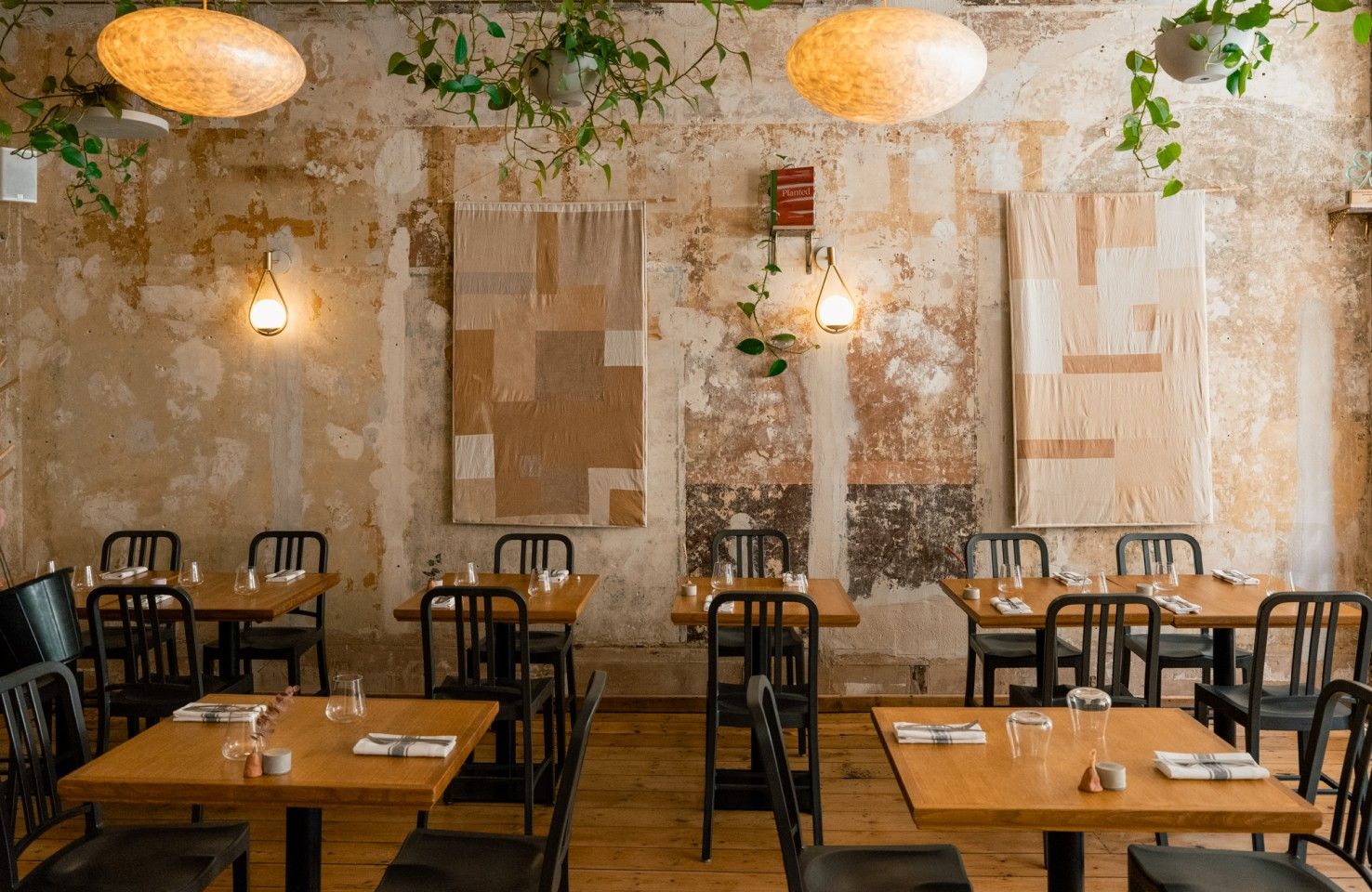
Apricity’s warm, pared-back interior features natural materials and reclaimed pieces. © Ben Carpenter/Apricity
You describe the meat you use as ‘regenerative’ and the seafood as ‘sustainable’. What does that mean in practical terms when you’re choosing a farmer or supplier?It means that we know the farm and their practices. We make our purchasing decisions based on this information first and foremost, then do the taste test for the final part, as both are of equal importance. While many may argue that the word ‘regenerative’ doesn’t have a set definition, for me it’s about working in tandem with nature.
In terms of seafood, we are quite specific about what we serve – for example we only use hand-dived scallops, nothing that is dredged or trawled. At the end of the day, it’s about relationships, not spec sheets, and the menu responds to that.
What does working with suppliers in a circular fashion look like in practice? It’s not a linear supply and demand relationship. We work on what our chosen suppliers have, and base the menu around that.
We aim to support them to keep them in business, and to ensure that they can continue the great work they are doing, as without them, we would be lost. In return, they need people and businesses to purchase from them, so it completes the circle. We also try to work with slightly more underused ingredients – one of the current examples is ox tongue.

Constructing Apricity’s menu generally starts with the seasons, Nicholson says. © Paul Richardson/Apricity
With much of the menu being plant-led, what are the techniques you find most useful for making vegetables feel as exciting and indulgent as more traditional ‘luxury’ ingredients?
It’s all about the produce. I cannot tell you how much better the fruit and vegetables we source taste. At the moment we have the most incredibly sweet and rich carrots, and the last of the season’s sweetcorn, which is just so indulgently good. In terms of techniques, I think heat and fermentation are key. They enable a richness and depth of flavour that surprise and delight our guests.
Layering is the other one – for example our lettuce dish has around seven elements which, alone, aren’t particularly ‘wow-ing’, but combined, create something pretty special.
What is the most memorable dish you’ve served at Apricity?There have been many but there are a few staples that have been on since day one, and that have evolved as we have gone on.
One of our most talked-about dishes to this day is our baked Winwin milk choc’ mousse with miso and dark brown sugar custard. Winwin has all the notes and deliciousness of chocolate, but is not made from cocoa. The dish is baked to order and is like a chocolate souffle, but slightly denser. Then the cold, seasoned custard is poured on top at the table. It’s like a big, tasty, warm hug and we constantly hear the phrase: “This is one of the best things I have ever eaten”. It also has a great story behind it with the Winwin which also piques the guests’ interest.

Apricity’s beverage list encompasses inventive cocktails, non-alcoholic pairings and low-intervention wines. © Paul Richardson/Apricity
Is there a particular grape or region you think is doing really interesting things in low-intervention wine at the moment?
There are many under the radar regions doing great things. Being based in the UK, it’s super exciting to see what is being made – from London’s urban wineries such as Renegade and Blackbook, to further afield in places such as Sussex.
We also have our own Apricity wine – it’s always been a dream of mine to have a wine that is truly connected to the restaurant. I’m so happy to have been able to collaborate with two wonderful souls for this dream to come to life: it’s made by Kosie van der Merwe and Wasted Wine Club.
It’s a 2024 blend of riesling, kerner, müller-thurgau, sauvignon blanc and several hybrids. It was born from an abundant harvest and a shared desire to transform surplus into something expressive and joyful. Harvested from the steep, slate-rich slopes of the Mosel, this wine reflects both the region’s deep-rooted traditions and its forward-thinking spirit of organic and regenerative farming.
Which initiative has helped you to minimise your impact on the planet most?
There are many but I would have to say that the digital menu, oddly enough. It sounds like a tech gimmick rather than a responsible initiative, but it means we’re not printing menus every time a dish changes, and more importantly it removed the pressure to lock a dish in for weeks at a time. That dynamic flexibility is what actually lets the rest of the sourcing work. If we can’t get something in one day, then we can switch it super quickly, ensuring things can be the best they can be.
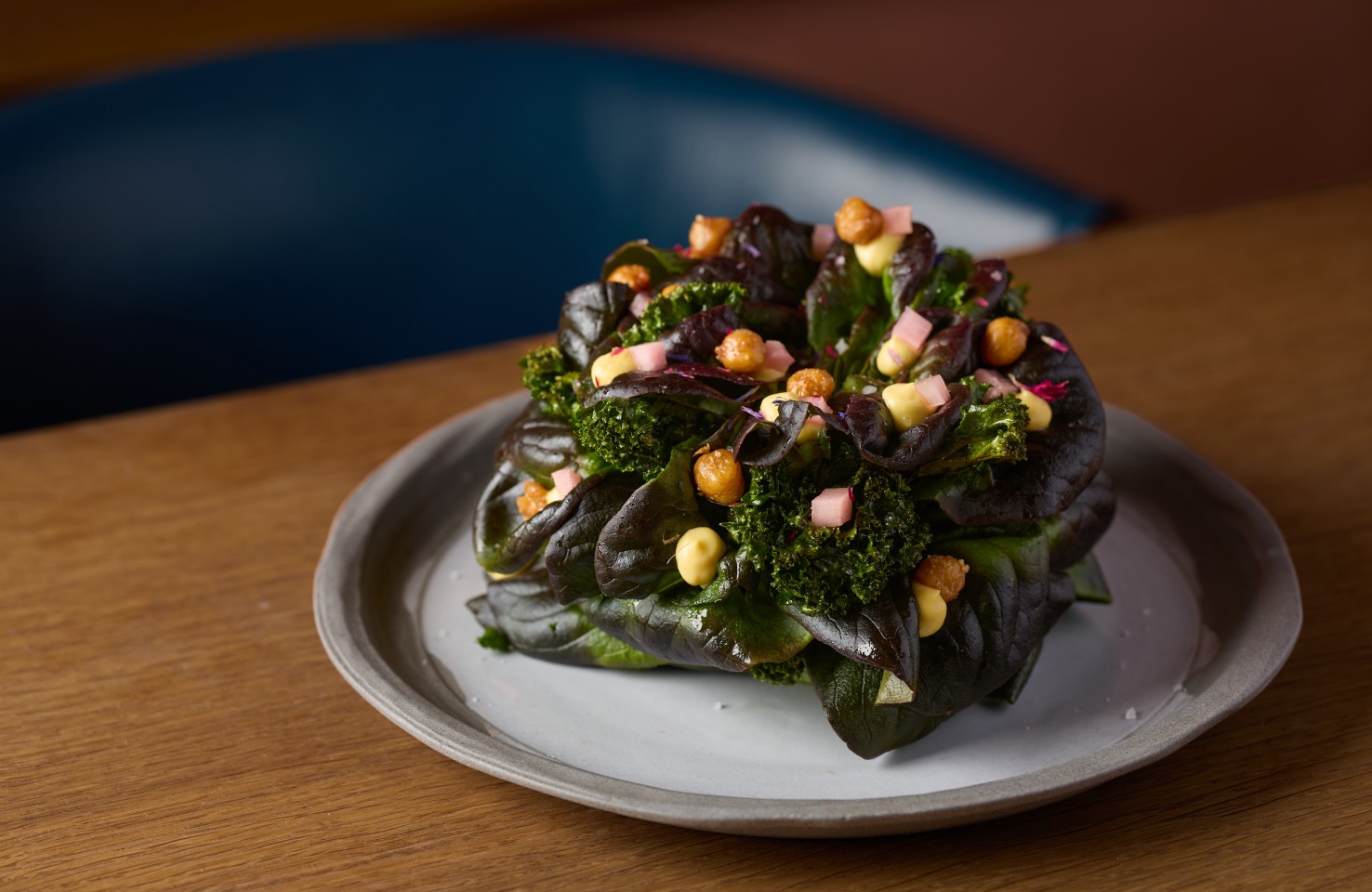
London Butterhead lettuce, miso, crispy kale and pickled rhubarb. © Apricity
If you could get every chef in London to change one thing about the way they source or cook tomorrow, what would you choose, and why?There are many small steps that would have an impact and I think that is probably the crux of it. If each chef just paused and thought differently about one facet – supporting local farmers or minimising waste – then we could make real progress. The first step is just thinking and setting an intention, then habits form and change happens.
Hero Image: Chantelle Nicholson, chef-owner of Apricity in Mayfair, which sits just a few steps from bustling Oxford Street. © Stefan Jansen Birch/Apricity
.png)
Written by
the MICHELIN Guide UK Editorial Team
Dining and Cooking