


MEDORA, N.D. — What started as a one-off, specialty dinner turned into an offer Candace Stock couldn’t refuse.
Asked to create a dinner at a land blessing ceremony in Medora, N.D., a few years ago, the chef impressed diners with her flavors and knowledge of foods.
That dinner resulted in the Fargo-based chef being offered and accepting the job heading Salt + Scoria, the kitchen at the new Teddy Roosevelt Presidential Library.
The
Medora attraction opened in early July
and within two months drew more than 100,000 visitors.
The operation recently shifted into fall hours, allowing Stock to take a breath.
“So far it’s going really well. We’re trying to be true to ourselves,” she said.
Being “true” means sticking with the vision for the casual eatery, serving food from and inspired by the Badlands, seen through the giant windows throughout the Teddy Roosevelt Presidential Library.
The name of the restaurant, Salt + Scoria, is a reference to the land itself. Saltbush is a native plant and scoria is the reddish colored rock of the Badlands.
“I saw this as a good opportunity to add to the movement in Indigenous cuisine and culture,” said Stock, who is a member of the Ho-Chunk nation and is also Cherokee, Pawnee and Choctaw.
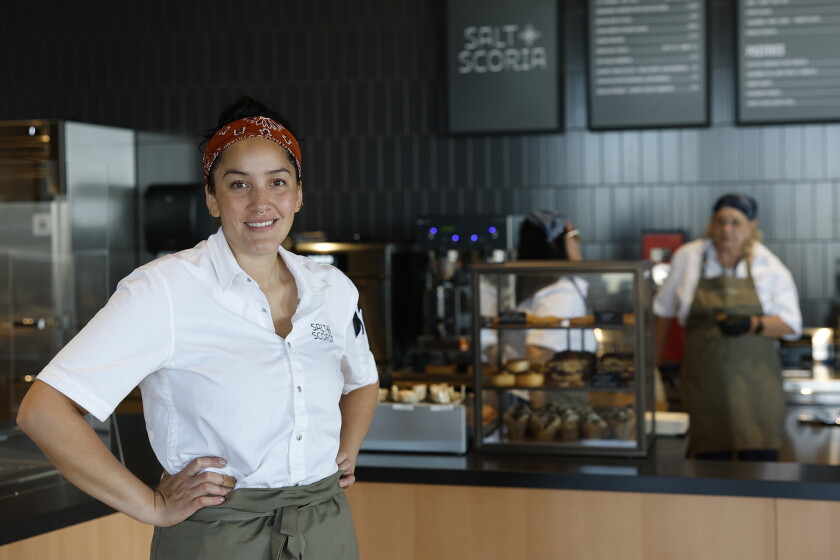
Candace Stock is the executive chef at the Salt and Scoria restaurant in the Roosevelt Presidential Library in Medora, North Dakota.
Eric Hylden / Grand Forks Herald
“To hold space in a library for a president that didn’t really feel that way toward Indigenous people, that means a lot,” said Stock, who was raised on the White Earth Reservation in Minnesota. “Creating a space where I could see myself was important. Growing up I couldn’t always see myself, as an Native American, in a lot of situations.”
The library addresses Roosevelt’s harsh views of Indigenous people.
The menu includes items that may not be entirely locally sourced, but have regional elements. While TR’s venison chili has clear local ties, the smoked salmon salad includes roasted squash, marinated beans, corn and pepitas.
In the first two months, the restaurant sold 1,000 bison sandwiches. The item has transitioned off the fall menu, replaced with a turkey meatloaf sandwich with turmeric pickled fennel and onions, cranberry sumac jam and mayo.
“The initial menu was ambitious,” she said. “There were menu items where people didn’t know what ingredients were.”
Some guests balked at the menu and asked for items that weren’t listed.
“People ask for burgers and pizza. You can go anywhere and get those things,” she said. “There was a lot of backlash for not being available. That stung a bit.”
There were some concessions. Roosevelt liked fried chicken, so there was a pan-fried fried chicken sandwich on the menu for a time, but Stock refused to buy a deep fryer for the kitchen.
“We’re trying to provide healthier options for people,” she said, adding that goes along with getting out and experiencing The Badlands.
With the change in seasons, she’s hoping to attract more locals who had stayed away during the busy summer months. Meeting them has been one of the highlights of her time in Medora.
“Getting to know the people of the area, they are a great reflection of who Teddy Roosevelt was,” she said. “They are resilient, rugged and incredibly gritty. That brought new fire to my life. I want them to have good ingredients and appreciate the food. This space is more of a classroom than anything.”
Getting locals involved hasn’t always been easy, especially when it came to hiring.
“The biggest obstacle is labor. The commute isn’t great when gas prices are high,” said Stock, who splits time between Medora and her home in Fargo where she raises her son.
The remoteness of the Teddy Roosevelt Presidential Library may be a draw for visitors, but it has presented some challenges.
“Getting product to the library has been a struggle,” she said, adding that wild rice in particular has been hard to keep in stock. The grain was a menu staple, but she found that it was just as popular for catered special events, stressing the supply.
Still, she’s largely had an outstanding staff and has let them create daily specials, like someone coming up with chokecherry bison sloppy joes.
While she’s had a couple of opportunities to go through the library, she’s looking forward to making sure her staff can experience it as well.
She’s even thought about what she would ask the interactive, Teddy Roosevelt hologram, a major feature of the library.
“I would ask him if he would let an Native American cook for him,” she said. “I’d like to know his perspective on food medicine.”
While Stock may not have appreciated some of Roosevelt’s views, she shares his appreciation of the land.
“He knew what this area was. It was not easy to live here, but it forced some reflection and that’s the basis for prayer and spirituality,” she said.
“Some of the recipes I found that he loved while he lived here were Indigenous recipes,” she added. “There’s a corn pudding with squash and herbs and I wonder how he came to experience that. Who was cooking for him?”
While Stock hasn’t been around the library much, she has spent a lot of time in a medicine garden just outside the kitchen where Indigenous staples are grown, like beans, squash and corn (what’s often referred to as The Three Sisters). There’s also sunflowers, tobacco and sage in the space and she’s foraged for cedar and yarrow nearby.
Being so hands-on with ingredients is crucial for Stock, whose sense of taste was damaged in a car accident years ago. She’s had to retrain her senses to maintain her abilities as a chef.
“Foraging is an incredible reset. My sense of smell and taste is tied to memory since it’s distorted,” she said.
So when she does have time to get out of the kitchen, she spends more time walking outside the library.
“The space I enjoy most is just being outside,” she said. “Walking on the boardwalk and seeing all of the native plants and the bees, that’s great.”
Dining and Cooking