

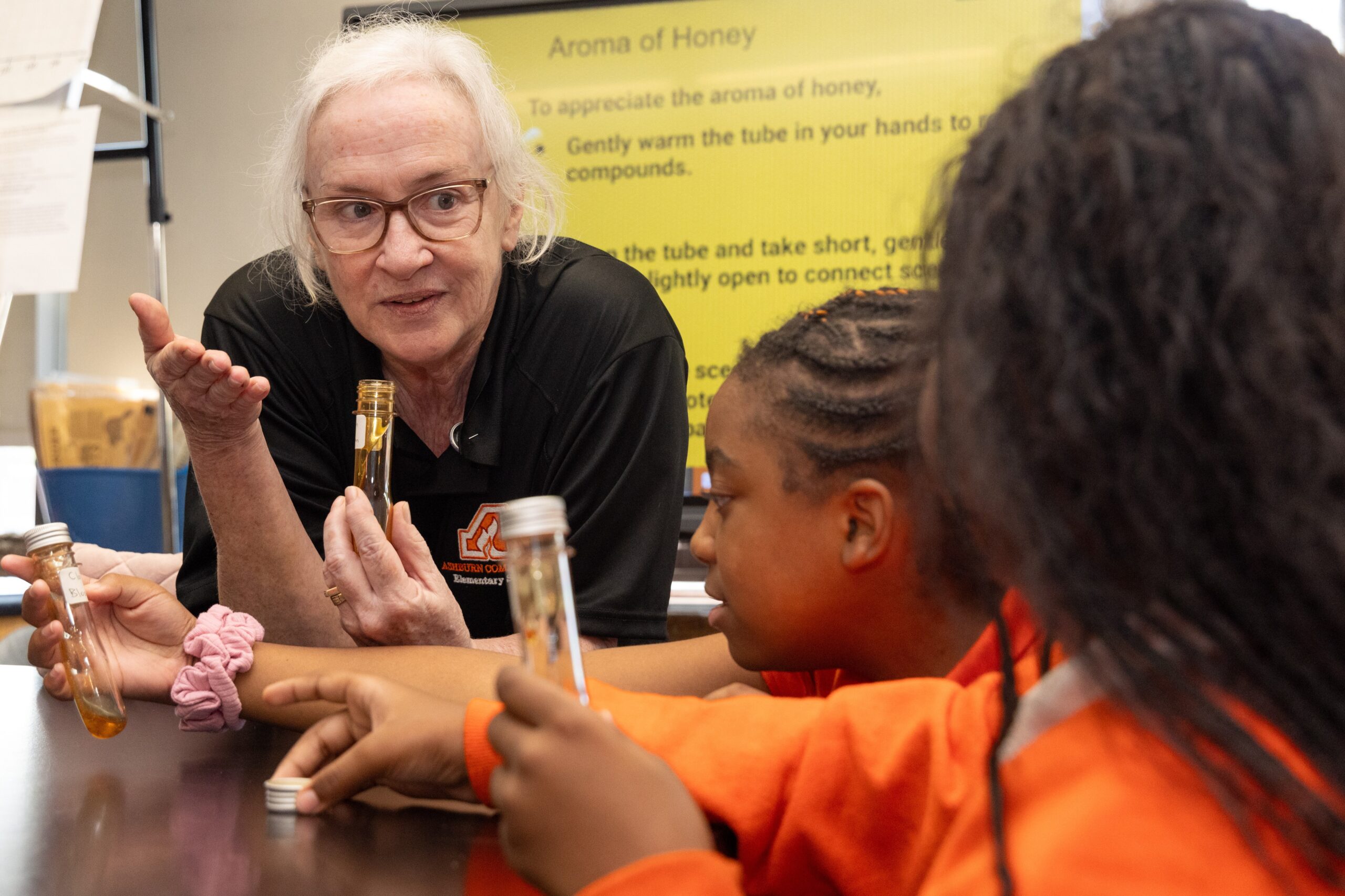
At least once a month, Rita Leary incorporates food into a science lesson at Ashburn Community Elementary School. On a recent Thursday, it was all about honey. Sticky, sweet, viscous, varied in hues of light to dark amber.
“Do you guys think it will taste like it smells?” Leary asked her mixed class of sixth, seventh and eighth graders.
The goal was to conduct a sensory exploration of honey samples native to Illinois, while hitting a core standard of food education: Food connects us and the food and the environment are interconnected.
Leary’s gooey lesson was sparked by Pilot Light, an organization founded in 2010 that developed a food-based curriculum for educators to integrate lessons about food, nutrition and the food system into everyday subjects like math, science and reading. The program’s emphasis is on using food as a learning tool and giving students ownership of learning and agency in their lifestyles, Leary said.
“It’s not like, ‘Oh here’s a carrot and here’s why carrots are good for you,’ but instead we use food to learn more about science,” said Leary, who has been an educator for 36 years. “Other things like robotics, only some kids like. Coding, some kids like it — art, just some. But food? Everybody likes food. And the students are so engaged, calm and so polite with each other.”
In September, Pilot Light launched an extensive update to its Food Education Center, a digital hub of free pre-K-12 lesson plans and resources for educators, parents and students that can be integrated across multiple subjects. The nonprofit, which started in a single Chicago classroom with notable local chefs, now partners with administrators, schools and teachers in 26 states. It’s also launching its first official chapter in New York City this fall.
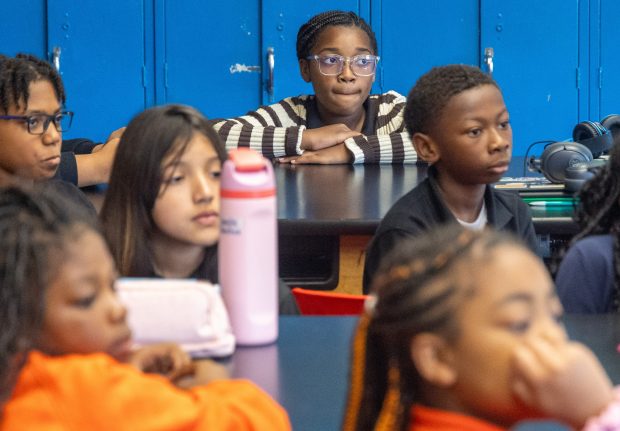 Students in Rita Leary’s science class listen to a Pilot Light food education lesson about bees at Ashburn Elementary School on Sept. 17, 2026. (Arthur Maiorella/Chicago Tribune)
Leary, a former Pilot Light Fellow, has been using a mix of self-made lessons and digital curriculum from the organization for more than five years. She wants more educators across Chicago Public Schools to find the benefit in incorporating food into classroom learning.
That Thursday, Leary’s students sat at their communal lab tables in groups of four, watching closely as their science teacher promised a tasting of pumpkin honey, apple blossom honey, blueberry honey and clover honey. Each flavor corresponds to the plant the bees pollinated, she reminded them.
But first — a few tests, for science.
Leary turned off the lights and asked her students to use mini flashlights to categorize the honey by shades. Then, to test each honey’s viscosity, the students flipped the vials over to see how fast or slow the honey moved down.
“Viscosity is thickness, how slow something flows — seventh graders, we’ll be talking about it a lot when we get to lava and volcanoes, because some lava is quite viscous,” Leary said, telling them to flip.
Leary explained, to many oohs and aahs, that when forager bees collect nectar from flowers, it’s almost 80% water. The worker bees fan their wings to make a phase change that turns it into that gooey honey texture.
Next, she asked them to smell each sample, using a gentle waft.
“Oh my god, the pumpkin one smells like NyQuil, the honey NyQuil!” screeched Lia Henry, a seventh grader.
 Taylor White, eighth grade, smells a honey sample during a Pilot Light food education class in Rita Leary’s science classroom at Ashburn Elementary School on Sept. 17, 2026. (Arthur Maiorella/Chicago Tribune)
When it was finally time to taste each one, Henry confirmed that the dark-hued pumpkin honey tasted like NyQuil, too.
Henry said she only ever has honey with tea, while her classmate, Tyjon Poole, also in seventh grade, said he’ll only have honey when his grandma gives him a spoonful for a cold or cough.
It was a “pretty cool” day in science class, Poole said, plus he never knew different kinds of honey could taste so unusual.
“If you really look and think about your tongue, it’s a map, right? All of those taste buds aren’t the same. They are chemical receptors, and they receive different kinds of chemicals,” Leary said, instructing the class to spread the honey on different corners of the tongue to experience the nuance in flavor.
Though the honey project was her own, Leary said if it wasn’t for Pilot Light, she may have never thought to incorporate food in her science lesson plan, because the public education system doesn’t necessarily require food education.
“And it’s not always eating — the next one for the sixth graders, because they’re looking at plant and animal cells, we’re going to see what cooking does to the cell wall,” Leary said. “A few years ago, when I was teaching social studies, we had a chef visit us through Pilot Light, and he gave a presentation on spices that traveled to Spain through North Africa, and that fit right in with our medieval history unit.”
Pilot Light’s ultimate goal is to make food education a part of every child’s learning, said Alexandra DeSorbo-Quinn, the organization’s executive director.
“What are all the ways in which we connect with food? What do we need to know about food? What is it we can do once we have all this knowledge? We can make different decisions. We can advocate,” DeSorbo-Quinn said. “There’s a lot of different ways in which food connects to our lives. You can teach anything through food.”
 Seventh grader Da’Sean Mackey tastes a honey sample during a Pilot Light food education class in Rita Leary’s science classroom at Ashburn Elementary School on Sept. 17, 2026. (Arthur Maiorella/Chicago Tribune)
Getting the Food Education Center to where it is now was a heavy undertaking, driven by teachers who were part of focus groups that helped shape the more than 200 available lesson plans grounded in Pilot Light’s Food Education Standards, which are designed by a multidisciplinary team of chefs, farmers, medical experts and psychologists.
These resources cover a broad array of topics, including agriculture, astronomy, historical events such as the Great Migration, ecosystems, geometry, global challenges like the refugee crisis, sustainability and food insecurity.
At Ashburn Elementary School on Chicago’s South Side, Leary also tries to educate students on alternative food options to processed items, which is particularly vital in an area that has long suffered from a shortage of local grocery stores. A Pete’s Fresh Market opened four years ago in Evergreen Park, but before that, the neighborhood did not have a grocery store for about 10 years.
“So many of my students are processed food eaters — I like chips too — but they’re not really aware of what food can be, so I try to give them some clear options, and they’re ambitious and they like to try things,” Leary said. “Recently, we made a cream cheese and brown sugar mixture to dip apples in, and the next night I got a picture from one of the moms saying, ‘Look what Ricardo made for us!’”
Leary said the most powerful of Pilot Light’s seven food education standards is that it can be used to advocate for change.
“That’s where the connection comes from… when you taste things and you’re sharing,” she said, pointing to a group of students huddled over a plate of Triscuit crackers, fruit and honey at the end of class. “These (students) never do anything together, and here they are. This is also good for the community and culture of our school.”
Pilot Light now reaches thousands of educators and classrooms, but it didn’t start that way.
“We were responding to, literally, a call to arms by Michelle Obama of, ‘Hey chefs, get involved in schools — kids need you,’” explained Jason Hammel, chef and owner of acclaimed Lula Cafe in Logan Square and one of the organization’s founding members. “We did not think about it as a program or a nonprofit at all. We thought about it as a way of getting connected to the school system and to children.”
 Science teacher Rita Leary teaches a Pilot Light food education lesson about bees and honey at Ashburn Elementary School on Sept. 17, 2026. (Arthur Maiorella/Chicago Tribune)
During the Obama administration, First Lady Michelle Obama’s signature “Let’s Move!” campaign urged chefs to partner with K-12 schools to weave nutrition and food into everyday life. Some chefs also helped students build school gardens.
“More and more, especially since COVID, chefs and restaurants are looked upon as resources for a variety of social needs — whether it’s actual hunger or community support,” Hammel said. “So it was natural for us to pitch in. But what was interesting about this was that we were doing our own program. We weren’t donating to someone else’s program. We did this ourselves.”
Even before the plan materialized, Matthias Merges, chef and proprietor of craft-driven hospitality group Folkart, was already working in select classrooms at his daughter’s school, Disney II Magnet Elementary, sharing insights about salmon farming, fish migration, how something goes from the ocean to someone’s plate and more. After he and other chefs went to Washington, D.C., for the launch of Michelle Obama’s “Chefs Move to Schools” program, they started to put a plan on paper.
The founding chefs — Hammel; Merges; Justin Large, former One Off Hospitality culinary director; and Paul Kahan, executive chef and partner of The Publican — would take turns going to classrooms on select days, first only at Disney Magnet but soon at multiple schools across CPS, using food to teach a lesson on any given topic.
“We’d email our list of teachers and ask, ‘What do you happen to be teaching that day?’” Hammel explained. “When the emails came back, like one classroom was doing fractions. OK, that’s easy. We’ll make a pie and cut it up or make a recipe. But then we got the Boston Tea Party, or plate tectonics, or how magnets work… the different chefs had to figure out a way to use food to teach (it).”
For that Boston Tea Party lesson 16 years ago, Hammel said the chef used herbal tea sachets and groups of students to market and brand their product to help teach consumerism and how “no taxation without representation” became a rallying cry for American democracy.
“As it started to take off, we were wrestling with (the fact that) there’s only a certain number of chefs, and there’s more than 400 schools in Chicago itself, there’s no way that we’re going to be able to do that,” Merges said. “That’s how it transformed into a system where the teacher was now the key. They could bring it back to their own classes and their own schools, and they became advocates for piloting and teaching food education themselves.”
 Tyjon Poole stirs a sample of honey during a Pilot Light food education class in Rita Leary’s science classroom at Ashburn Elementary School on Sept. 17, 2026. (Arthur Maiorella/Chicago Tribune)
Pilot Light also encourages student-led actions that impact school cafeterias and local food systems, while fellows are required to do a classroom advocacy project.
Recently at Ancona School in Kenwood, educator Christopher Weber brought together 80 elementary students, parents and teachers for a day of learning and cooking to fill their neighborhood’s Love Fridge with homemade soups and bread, with custom labels to promote allergy safety, to raise awareness of food insecurity in their community.
At Langston Hughes Elementary in Roseland, STEM teacher LaTina Taylor spearheaded a project that quickly became one of the most cherished stories within Pilot Light. K-8 students spent the year caring for a flock of chickens in their school coop — a hands-on “living textbook” that taught them about agricultural responsibility, animal husbandry and sustainable closed-loop food systems. However, the students encountered a harsh reality of farming midyear when predators breached the coop overnight, killing four chickens. The students then moved to safeguard the sole surviving chicken, using their STEM training to build him a secure, predator-proof “fortress.”
Back at Ashburn Elementary, Leary pointed toward the window in her class. Outside is the class beehive project — a fully functioning wooden hive box, with one queen bee and 10,000 worker bees — constructed and installed by the Roof Crop Foundation using money she secured from a grant.
Leary learned of the urban farming company through Pilot Light. A week before, beekeeper AJ Appledorn-Orozco, who leads hands-on educational workshops and apiary programs for Roof Crop, had stopped by the class to introduce them to the “world of bees.” Leary took it a step further and dove into honey.
As Pilot Light continues to grow, the crux of it has been the same since day one, DeSorbo-Quinn said.
“We were founded with this idea of food being a common language,” she said. “There are only a few things that will universally engage people, and food is one of them. It’s an extraordinary teaching tool.”
Dining and Cooking