

But that logic is outdated. Domestic tourism now accounts for the majority of visitors to Khanh Hoa, and of the 16.4 million visitors projected for 2025, domestic tourists will still dominate with approximately 10.9 million compared to 5.5 million international visitors. This group of tourists doesn’t come to resorts to eat pizza. They want to eat Vietnamese food, but it has to be well-prepared, in a clean environment, with ingredients of clear origin.
This is precisely the gap that the question “where are the best Vietnamese restaurants in Cam Ranh located?” is trying to fill.
Why does Vietnamese cuisine in Cam Ranh have its own unique advantages?
Khánh Hòa cuisine boasts several dishes whose flavors cannot be accurately replicated anywhere else. Jellyfish noodle soup, with its crispy jellyfish tentacles and broth simmered from mackerel, is a prime example – this dish almost never has a “decent version” outside the province, simply because fresh jellyfish only lasts for a few hours. Clay-baked rice cakes served with fermented fish sauce, squid pancakes filled with fresh squid in their ink sacs, and Ninh Hòa-style grilled pork skewers wrapped in pig liver dipping sauce – all are dishes heavily reliant on locally sourced ingredients.
In addition, there is a dual source of seafood: Cam Ranh Bay provides lobster, squid, and barramundi; Thuy Trieu Lagoon, covering approximately 12,000 hectares, provides blood cockles, oysters, and various mollusks. A Vietnamese kitchen located here has access to a set of ingredients that similar kitchens in Hanoi or Ho Chi Minh City would have to pay a high price to obtain.
The problem is that very few places have systematically taken advantage of this.
Four Vietnamese restaurants within the Alma complex.
Alma Resort Cam Ranh operates 14 dining options across its approximately 30-hectare grounds, where Vietnamese cuisine is not concentrated in one place but is distributed across four different approaches – each catering to a specific need.
An Nam – traditional Vietnamese dishes in the Food Court

An Nam restaurant, located in Alma Food Court, operates from 11 am to 4 pm and has a seating capacity of approximately 312 people. It’s a place for traditional Vietnamese dishes, cooked using Central Vietnamese recipes, and served in an open-counter format, allowing customers to see the cooking process.
The great value of the food court counter model lies in its flexibility. A family can have grandparents enjoy Vietnamese food at An Nam, children order fried chicken at Little New York, and adults have coffee at the Espresso Bar, all while sitting at the same table. This is a problem that restaurants with à la carte menus cannot solve.
Vietnam Express – controlled street food
Also located in the Food Court, Vietnam Express takes a different approach: recreating Vietnamese street food. Platters of spring rolls, Nha Trang jellyfish noodle soup, and a selection of snacks are displayed in a market-style setting but under the hygienic conditions of a resort kitchen.
For many customers—especially those with young children or sensitive digestive systems—this is a way to experience street food without taking risks. Jellyfish noodle soup is a must-try at this stall, as it directly represents the local cuisine.
The Noodle House – Pho and noodle dishes
The third counter focuses entirely on pho and other noodle dishes. Dedicating a separate counter solely to noodle dishes might seem redundant, but pho is actually a highly ordered dish in every survey of Vietnamese cuisine at the hotel, and having a separate broth pot instead of sharing it with other dishes makes a significant difference in quality.
Asiana – Vietnamese cuisine in an à la carte restaurant format.

Asiana is a restaurant serving contemporary Asian cuisine in the evening, with Vietnamese and regional dishes taking center stage. Operating hours are divided into two shifts, similar to other evening restaurants in the resort. This is a more formal format, suitable for family dinners or entertaining guests.
Detailed information about each restaurant’s menu, along with a list of highly-rated establishments in the area, can be found on the dedicated page for delicious Vietnamese restaurants in Cam Ranh.
Atlantis – where seafood is prepared in the Vietnamese style.
One often overlooked detail: Atlantis Seafood Restaurant, despite not bearing the name “Vietnamese Restaurant,” is a place where Vietnamese cuisine is clearly showcased. Located right on Bai Dai Beach, with its turquoise tiled roof, it has a capacity of approximately 170 seats and a live seafood tank at the entrance for customers to choose from.
The cooking methods here are almost entirely Vietnamese. Grilled Thuy Trieu blood cockles with scallion oil. A mixed seafood platter includes oysters, blood cockles, scallops, grouper, prawns, and squid, served with a dipping sauce of freshly ground green chili salt – a characteristic Central Vietnamese dipping sauce, spicy and aromatic, completely different from Western sauces. The seafood and papaya salad is a typical Vietnamese salad appetizer: sour, spicy, and crunchy, used to open the palate.
Chef Nguyen Bao Tung adheres to a minimalist approach in preparation – steaming or lightly grilling lobster to preserve its sweetness and limiting the use of spices that overpower the natural flavors. This truly embodies the spirit of traditional Vietnamese seafood cuisine.
Breakfast buffet and Vietnamese dishes at Alma Garden

Alma Garden serves a breakfast buffet from 6:30 AM to 10:00 AM with a capacity of approximately 450 seats, overlooking a series of tiered swimming pools. Within the restaurant’s live station system, the pho counter and the Vietnamese coffee counter are always two of the busiest spots.
A noteworthy detail is that the eggs served for breakfast are sourced from an organic farm within the resort grounds. For Vietnamese dishes that require eggs, such as banh can (rice flour pancakes) with quail egg filling or various fried dishes, the freshness of the ingredients makes a noticeable difference that guests can immediately appreciate.
Dipping sauces – the true measure of a Vietnamese chef.
There’s a quick way to judge a Vietnamese restaurant: look at the dipping sauces. The main course can be learned from the recipe, but the dipping sauces accurately reflect whether the chef understands the region.

Khánh Hòa cuisine uses very distinctive dipping sauces. Bánh căn (rice flour pancakes) are dipped in mắm nêm (fermented fish sauce), a salty, fragrant sauce, completely different from the sweet and sour fish sauce of Southern Vietnam that many places use as a convenient substitute. Boiled and grilled seafood is dipped in freshly ground green chili salt, which is spicy and aromatic, not the pre-mixed salt, pepper, and lime sauce. Gỏi cá mai (shrimp salad) is served with a rich and savory broth made from peanuts, sesame seeds, and tamarind. Nem nướng (grilled pork rolls) are wrapped in a dipping sauce made from pork liver or shrimp.
The fact that a resort kitchen maintains these four specific dipping sauces instead of simplifying them into a single generic one is a small detail, but it speaks volumes about the level of professionalism. At Atlantis, the green chili salt is freshly ground instead of pre-mixed – a detail that locals notice from the very first bite.
Vietnamese breakfast and why it’s more important than we think.
During a four-night stay, breakfast is the meal that needs to be repeated enough times to make a lasting impression. It’s also the meal where Vietnamese guests find it difficult to compromise – many are willing to eat European food for lunch and dinner but still want a bowl of pho or vermicelli soup for breakfast.
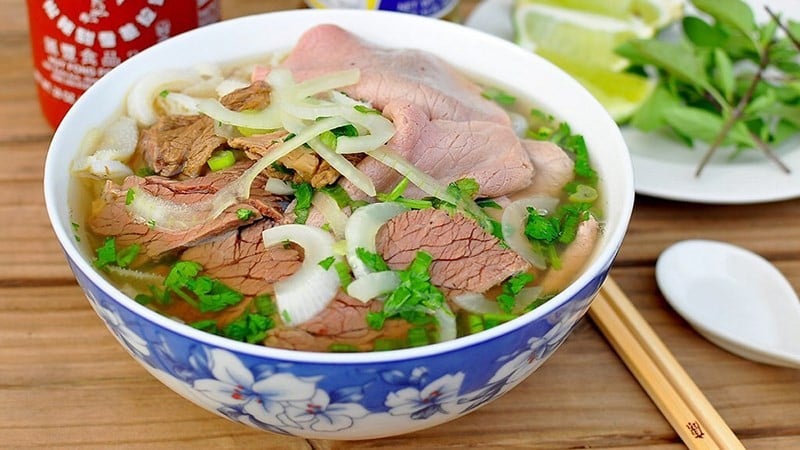
Alma Garden addresses this with a live station system, where the pho counter and the Vietnamese coffee counter are always the two busiest spots in the approximately 450-seat capacity. Cooking the pho at the counter instead of scooping it from a warming pot creates a clear difference in broth temperature and noodle doneness – two factors that determine whether a bowl of pho is perfect or not.
The same goes for coffee. Vietnamese filter coffee and Italian-style machine-brewed coffee are two completely different drinks, and offering both in the same buffet area is something not every resort does.
Vietnamese cuisine in the eyes of international visitors.
An interesting aspect: Vietnamese cuisine is now the reason many international tourists choose Vietnam as their destination, rather than something they are forced to eat. Khanh Hoa is expected to welcome around 5.5 million international tourists in 2025, and this group is increasingly actively seeking out local culinary experiences.
This places a dual demand on Vietnamese kitchens in resorts: to maintain authentic flavors to avoid disappointing domestic guests, while simultaneously presenting and explaining clearly enough for international guests to understand. The open counter model, like Vietnam Express, effectively addresses the second point – when guests see the preparation process and ingredients on display, language and psychological barriers are significantly reduced.
Several Vietnamese restaurants outside the campus.
It would be remiss not to mention the local establishments. Khang Viet on Pham Van Dong Street is among the well-known Vietnamese restaurants in the area. Com Ga Xoi Mo 45 is a familiar address for chicken rice. Nho 1984 on To Huu Street is famous for its catfish dishes. Ben Ben Moi on Hung Vuong Street serves seafood in a casual, popular style frequented by locals.
Located in the Thuy Trieu lagoon area, Mong Uoc Seafood Restaurant is highly rated on Google and offers a shuttle service from the resort area – a helpful detail for guests who don’t drive themselves.
The strengths of this group of restaurants are their affordable prices and casual atmosphere. Their weaknesses include fluctuating quality depending on the season and daily ingredient availability, and the inconvenience of going out in the evening for large families.
How to choose a Vietnamese restaurant for different situations
If you’re with a large group with diverse tastes, a food court is the optimal choice as each person can choose their own stall. For a more formal dinner, Asiana or Atlantis are more suitable options. If you want authentic local cuisine at affordable prices and are willing to compromise on convenience, restaurants in the Cam Duc area, Cam Ranh market, or Ba Ngoi fishing village are a good choice.
For seafood selected directly from the tank, always confirm the price per kilogram before preparation. Lobster prices in this area range from approximately 750,000 VND to 1,600,000 VND per kilogram, depending on the type and season. For restaurant meals within the resort, reservations should be made one day in advance during the peak summer months of May to July.
In conclusion…
Delicious Vietnamese food doesn’t need to be fancy, but it does require three things: fresh ingredients, a cook who understands the original recipe, and consistency day after day. Cam Ranh has the first condition thanks to its location between the bay and the lagoon. The second and third conditions are what distinguish a good restaurant on a good day from a reliable culinary system year-round.
Alma’s arrangement of four different approaches to Vietnamese cuisine – traditional stalls, street food stalls, noodle stalls, and à la carte restaurants – shows that this is not a haphazard effort, but a calculated strategy to serve the majority of domestic tourists in Khanh Hoa. For travelers, this means you don’t have to compromise between the convenience of a resort and the desire to eat authentic home-cooked meals.
AT
Source: https://baotayninh.vn/nha-hang-mon-viet-ngon-tai-cam-ranh-an-nam-vietnam-express-va-chuan-muc-moi-o-bai-dai-154436.html
Dining and Cooking