

Since 2014, anyone could look up Champaign County restaurant inspections online to check whether a food establishment failed to meet health safety standards.
The online database managed by the Champaign-Urbana Public Health District also allowed the public to easily view a restaurant’s inspection history, which health experts recommend, to see if the restaurant has repeatedly failed to meet public health standards.
But a new system implemented this April has discontinued several features, including the ability to search by a restaurant name or to easily see the history of its inspections.
The public can now only view Champaign County’s inspection reports on one date at a time. The search bar says the public can search by case number, inspection type and address, but only searches for results on one selected date at a time.
The results do not display the restaurant name but instead an inspection number and address. Clicking on the inspection number navigates to the details page, which still does not include the restaurant name.
 The details page that appears when clicking on an inspection number displayed in the table under “Today’s Inspections.” The page does not name the restaurant or food establishment. The unlabeled blue document icon in the top-right of the page navigates to the inspection report. Screenshot captured Aug. 7, 2026.
Only upon clicking the unlabeled blue document icon in the top right of the details page can a user see the inspection report, with the restaurant name at the top.
Sarah Michaels, director of environmental health for the public health district, acknowledged these flaws as “limitations” of the software provided by the company Tyler Technologies.
“It’s the limitations of the software that was provided. Like, we didn’t get to choose them,” Michaels said in an interview with CU-CitizenAccess. “After it went live and we started reviewing it, we saw those limitations, and then we were trying to come up with instructions to make that user-friendly on the public side.”
The previous database software, used between 2020 and April 2026, immediately displayed the recent inspection results, including the restaurant name, the color of the placard and the inspection type. A specific restaurant could be searched for and its full inspection history could also be viewed by clicking on the restaurant name.
The new version lacks those capabilities.
 C-UPHD Information about placards on the Champaign-Urbana Public Health District website.
Health inspectors routinely visit restaurants and food establishments in Champaign County to observe, evaluate and determine compliance with food safety standards. The restaurants are issued a green, yellow or red placard based on the violations found during the inspection:
Green indicates satisfactory compliance with food rules and regulations.
Yellow indicates less than satisfactory compliance and signals a food safety alert, requiring a follow-up inspection.
Red means the restaurant has been closed and is out of compliance with food safety standards.
Last year, CU-CitizenAccess reported health district data showed at least 97 yellow placards and 19 red placards were issued to county restaurants. In 2024, those numbers were 122 and 19, respectively.
The health violations compiled on the database are vital for food safety. In the last several months, 15 states, including Illinois, experienced an outbreak of cyclosporiasis.
“Cyclosporiasis is an intestinal illness caused by the microscopic parasite Cyclospora cayetanensis,” according to the Centers for Disease Control and Prevention (CDC) web page about the outbreak. “Most people infected with Cyclospora develop diarrhea, with frequent bowel movements. Other common symptoms include loss of appetite, weight loss, stomach cramps/pain, bloating, increased gas, nausea, and fatigue. Vomiting, body aches, headache, and fever may be noted.”
Eating foods with lettuce from Taco Bell locations was initially identified by the Food and Drug Administration (FDA) as a frequent commonality in those who had cyclosporiasis. Federal and state public health officials later traced the cyclospora to lettuce sold by Taylor Farms de Mexico, which sells salad kits and other fresh greens to retailers like Walmart, and provides the lettuce for Taco Bell and other food service customers.
 The landing page for the environmental health section of the Champaign-Urbana Public Health District website. The new inspection database web page and the instructions for accessing the page are among the main options. Screenshot captured Aug. 7, 2026.
Restaurant inspection reports include detailed information about which aspects of the food rules and regulations were or were not met, using both checkboxes and written observations made during the inspection. These reports are then made available online.
But easily finding these reports by name now requires several workarounds and instructions for cross-referencing a spreadsheet.
For example, the system lists restaurants by their addresses rather than by name. To get around this limitation, Michaels said she will update and sort the listings monthly by name in a separate spreadsheet, which is then uploaded on a separate web page with instructions for the public to search the database on another web page.
“I will update that every month, at the end of every month, so anybody that wants to look at any inspections for the month, we put that in alphabetical order by the facility name, so that way, it makes it a little bit easier so that you know what date to look it up,” Michaels said.
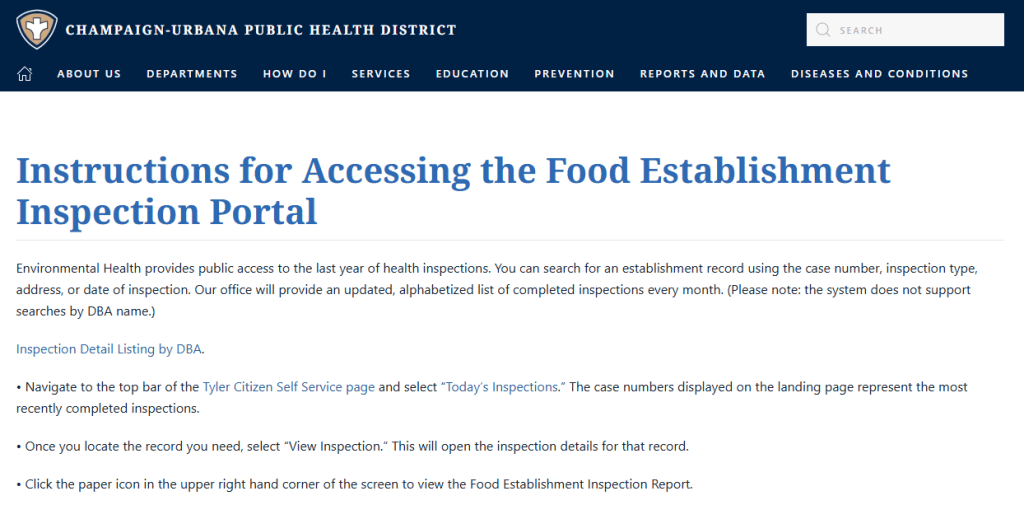 The instructions for accessing, searching and navigating the inspection report database. A spreadsheet of all inspections in the past year is linked for users to cross-reference when searching the inspection database for better search capabilities. Screenshot captured Aug. 7, 2026.
Michaels said in late July she plans to retire in the next couple of weeks. After her retirement, the interim director will be Penny Murphy, who currently works at the district as a program coordinator.
Despite the new system’s limitations, Michaels described the old system as obsolete because its software was no longer supported, meaning new features, like permit applications and renewals, were unable to be added.
As a result, one major focus of upgrading the system was to be able to add those features.
“We were still relying on mailing,” Michaels said. “And so, that would take a month of sorting and reviewing and sending out everything by the postal mail, and so it was a long process. So, my main goal was also to be available where an operator or manager could renew [a permit], and renew it online, and submit their payment, because we never used to have the luxury of withdrawing an E-check, or online credit card payment.”
Michaels said Tyler Technologies acquired the company that made the previous system, Digital Health Department, meaning it was able to access the district’s historical data and records and transfer it onto the new system.
Dining and Cooking