

In the days before freeways, Route 66 was an efficient way to cross Southern California.
A long stretch of it is on Foothill Boulevard, now called State Route 66, from the 215 Freeway in San Bernardino to the 210 Freeway in La Verne.
Along the way, there are a handful of eateries that enrich the history of the Mother Road, which is marking its centennial this year. Two weeks ago, we visited the Sycamore Inn, Vince’s Spaghetti, and the Magic Lamp Inn. This week we travel to eastern Los Angeles County.
Eating on Route 66: Steak and spaghetti in Rancho Cucamonga
Our destinations: Our first stop is 2975 Foothill Blvd., right on the border between La Verne and Pomona, and a couple of miles before we reach the freeway. It is currently the home of La Paloma Mexican Restaurant.
But in the 1920s it was a fruit stand in an orange grove run by Harry and Cora Wilson. They erected a more substantial building and called it Wilson’s Sandwich Shop, later Wilson’s Dinner House. It lasted into the early 1960s.
Joe and Hortensia Parker opened La Paloma there in 1966. It is still family-owned.
La Paloma serves traditional platters with tacos, chile rellenos, enchiladas, rice, and beans. One specialty is Pollo Diablo, chicken breast sautéed in a chipotle cream sauce for $23.50. lapalomalaverne.com
Route 66 changed constantly until it was rendered obsolete by freeways and decertified in 1985. Two alignments ran through Arcadia in the 1920s and ’30s, according to experts. The 1926-1933 alignment included a short stretch of Huntington Drive that was expanded in the 1934-1974 alignment.

The Derby occupies a 1931 building on Huntington Drive in Arcadia. (2024 photo by Fielding Buck, The Press-Enterprise/SCNG)

A jockey meets diners at the entrance of the Derby, an Arcadia restaurant rich in Santa Anita horse racing lore. (2024 photo by Fielding Buck, The Press-Enterprise/SCNG
Show Caption
1 of 2
The Derby occupies a 1931 building on Huntington Drive in Arcadia. (2024 photo by Fielding Buck, The Press-Enterprise/SCNG)
Expand
The Derby, at 233 E. Huntington Drive, is near Santa Anita Park and rich in horse-race history. It was built in 1931 as Proctor’s Tavern. In 1938, the property was acquired by George Woolf, a famous horse racing jockey who rode the legendary horse Seabiscuit in a pivotal race at Santa Anita the following year.
Seabiscuit’s primary jockey was Red Pollard, who was played by Tobey Maguire in the 2003 movie “Seabiscuit.” The 1939 race is dramatized in the movie, with Woolf played by real-life jockey Gary Stevens.
Woolf, known as “The Ice Man,” died in 1946 after falling from a horse at Santa Anita.
The Derby is filled with racing photos and memorabilia. Beyond that, it has the vibe of an old-school steakhouse with subdued lighting, red booths, and a well-stocked bar. The menu includes George Woolf Prime Rib, $59-$76, and the Gary Stevens, twin filet medallions at $55. Seafood is called “Seabiscuit’s favorites.” Baked Alaska, presented at table, is a signature dessert.
The Derby was slated for demolition in 2024 but spared when a redevelopment project was dropped. thederbyarcadia.com
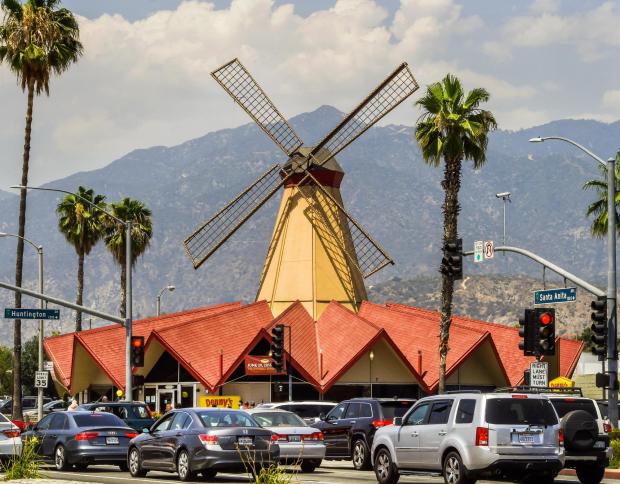 Denny’s restored the only remaining Van de Kamp Dutch bakery windmill, built in 1967, in 2016..(Photo by Walt Mancini/Pasadena Star-News)
Continuing west, we pass the last remaining diner in the Van de Kamp’s Holland Dutch Bakeries chain. Van de Kamp’s was a bakery in the Glassell Park neighborhood of Los Angeles and also had a chain of distinctive Dutch-themed restaurants. The restaurant at 7 E. Huntington Drive is now a Denny’s and no longer Dutch blue and white, but it still has a giant windmill on top. dennys.com
Huntington Drive becomes Colorado Boulevard, where Route 66 proceeds through Pasadena.
At 3838 Colorado Blvd., we pass the Original Tops, a family-owned fast food place that dates from 1952 and is known for its pastrami. theoriginaltops.com
Colorado Boulevard is loaded with interesting eateries, some in historical buildings. But we’re headed to Russell’s, a few yards north at 30 N Fair Oaks Ave. in One Pasadena, a shopping and entertainment district in Old Town.

Russell’s in Old Town Pasadena dates from 1930. (Photo by Fielding Buck, The Press-Enterprise/SCNG)

Croque monsieur is a specialty at Russell’s in Pasadena. (Photo by Fielding Buck, The Press-Enterprise/SCNG)
Show Caption
1 of 2
Russell’s in Old Town Pasadena dates from 1930. (Photo by Fielding Buck, The Press-Enterprise/SCNG)
Expand
Russell’s opened in 1930 as a diner, and retains some of that feel but with a French bistro mixed in. There are a few counter seats but also reproductions of Van Gogh and Renoir paintings on red walls.
Russell’s describes its menu as American-French cuisine. That means it includes croque monsieur, a ham and cheese sandwich, as well as chicken fried steak and all-day breakfast with pancakes, bacon, and hash browns.
The restaurant also boasts burgers, including Frisco Deluxe with Thousand Island dressing on sourdough. Meals run $20-$25. russells-pasadena.weeblyte.com
In two weeks we’ll get back on Colorado Boulevard and head to Los Angeles, where we’ll see what take-out stands and diners were like in the 1920s and ’30s.
Dining and Cooking