
About 15 years ago, when chef Sameh Wadi’s restaurant Saffron lived in Minneapolis’s Warehouse District, Wadi decided to close things down for a week. Something was stirring in his soul, or maybe his stomach: slow-cooked green beans with a luminous sliver of lemon on top. Wadi and his brother, Saed, stripped the dining room of its white tablecloths and the menu of its elaborate purees and reopened with a more casual, small-plate format. They served those green beans—cooked for five hours, swathed in olive oil, spiced with tomatoes and chiles—at Saffron then. In just a few weeks, when the Wadis’ restaurant roars back to life in the former Young Joni space in Northeast Minneapolis, they’ll serve them again, this time with a wheel of taboon bread fresh out of the red-hot stone oven.
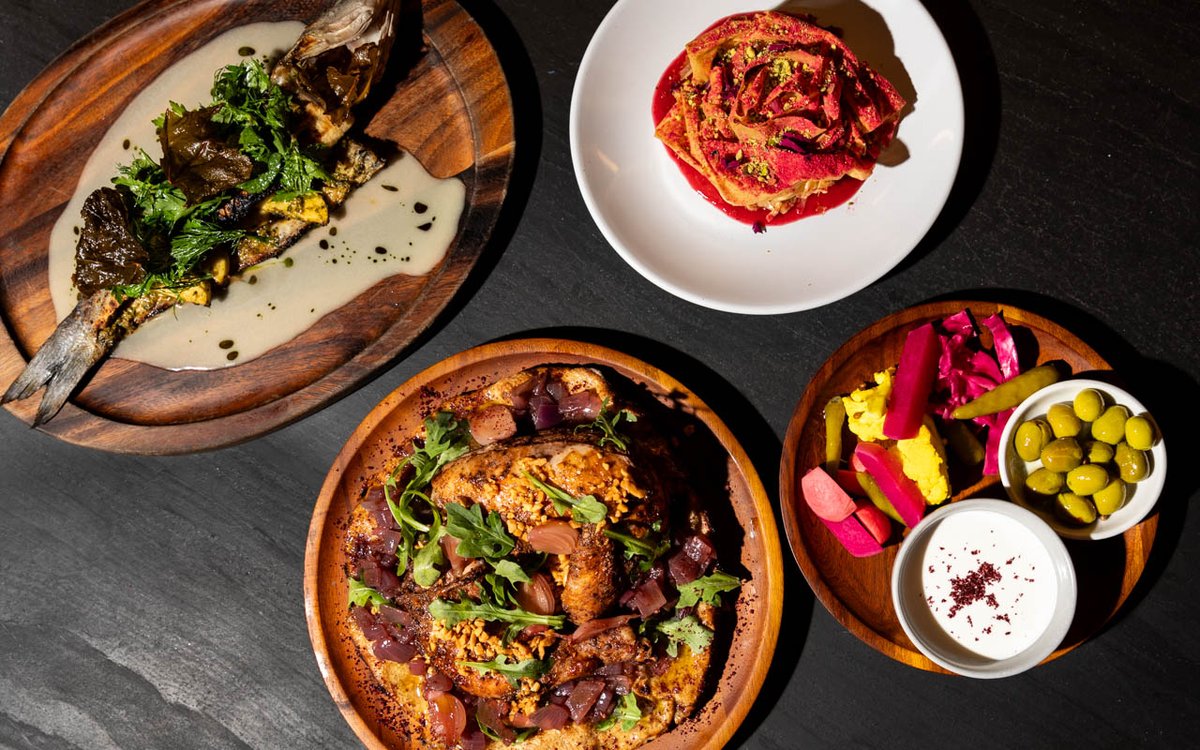
Wadi actually hadn’t planned to serve me the green beans when I stopped into the new Saffron space for a sneak peek last week. He and his team had plated musakhan (Palestine’s best-known and most-loved dish, a tangle of roast chicken and caramelized onions dusted with sumac and served over flatbread); a whole branzino cooked over the live fire and stuffed with apples; a plate of pickled vegetables with olives and yogurt; and a shatteringly pretty raspberry baklava, shaped like a rose and stuffed with sugared cashews. But at some point between photos, Wadi’s eyes flashed and he disappeared into the kitchen, then returned with a small plate of the green beans. I squeezed the lemon over them and tore off a piece of the taboon bread—dimpled and charred from those hot stones—to scoop up a bite. The beans had been cooked so long that their natural fiber had simply melted away; they dripped with olive oil and, thanks to the tomatoes, were delicately sweet. They were the most curiously delicious thing I’ve had in a long time.
The green beans are Wadi’s grandmother’s recipe. They were documented in The Encyclopedia of Palestinian Cuisine, the cookbook that his parents, living in Kuwait at the time, wrote but never published. Tens of Palestinian families mailed them handwritten recipes, which they then meticulously inscribed, tested, and photographed, along with many of their own. Both of Wadi’s parents were cooks themselves—his mother, who didn’t know how to fry an egg when she first married, grew to be the most respected cook in his entire family. But Wadi’s late father’s freewheeling style, in particular, influences his own.
“He cooked with no borders,” Wadi says. “He traveled the world and brought things back with him. His way of cooking was flowy, and intuitive, and free. He’d make traditional recipes with fish sauce; his kofta (meatball) recipe had soy sauce with it. Until I moved to this country, I thought soy sauce was an Arab ingredient.” (Wadi actually tracked down medieval Arab recipes in which murri, an umami-dense liquid condiment made from fermented barley, was ubiquitous, so he wasn’t that far off.)
The branzino, which is served under a bed of mint and dill and crisped grape leaves, is inspired by one of his father’s dishes. When his family was living in Kuwait, Wadi remembers, his father would venture out to the sea and return with fish, which he’d then filet, stuff with sliced apples, and grill. The fruit mutes the fishy undertones of the flesh and adds sweetness. That’s the sort of intuitive cooking that Wadi has transmuted onto the menu at Saffron. “Nafas is an Arabic term that means breath—it’s the idea that I can give you the same recipe, and you’ll make it, but it’s not going to taste the same because of what you breathe into the pot,” Wadi says. “It’s one of the pillars of Palestinian cuisine for me.” (Think, too, of the Korean term son-mat, or “hand taste”; the soul’s fingerprint on any given dish.)
Wadi can trace his family back seven or eight generations in Palestine, he says. His mother’s family house still stands in Jifna, a small village in Ramallah in the central West Bank. He’s importing certain ingredients from Palestine for Saffron’s menu: sumac, za’atar, freekeh, olive oil made from olives harvested and pressed just this season, even as violence continues to escalate in the West Bank.
“In this time where these farmers are just trying to do their best, it’s really cool to have them send us these things,” Wadi says. “I have some olive oil that showed up in a glass jar, unlabeled. It’s unfiltered olive oil that somebody pressed from their fruit and sent to me. I don’t know if I’ll be able to get this stuff again. That’s the truth. But I’ll cook it until I can’t get it anymore.”
Around town, Saffron has widely been known as a Middle Eastern restaurant—I called it that myself when I wrote about it this past winter. But I asked Wadi how he feels about that label, which in truth is a geopolitical shorthand invented and popularized by Westerners.
“I’ve struggled with this for years,” he says. “The ‘Middle East’ is hella made up, right? I’ve had deep conversations with my mother, my family, myself. I came to the realization that the food of the Levant—Bilad al-Sham, as we call it in Arabic—is a thing. It’s translated across these borders, but their roots are the same. I love celebrating my Arabness. I love celebrating the fact that I’m Palestinian American, and the food has some Midwestern-ness to it too. Respecting the land is a form of Palestinian cooking, and we have beautiful artisans in our own backyard that are making the most beautiful things, whether it’s sweet corn or tomatoes or squashes. Even five months ago, I don’t think I would have been able to say, This is Palestinian food. But the fact that we cook over live fire, that we cook with nafas and heart, that the food is meant to be enjoyed with people that you love and care for—that is the amalgamation that makes this Palestinian food.”
There are indelible traces of Palestine and the Levant that appear in the restaurant’s design, too: arches scaffolded into the space’s high-beamed ceilings; lush green on the walls to honor the olive trees; tiles glazed with the rose-like hues of saffron before it’s steamed and pillows in the deep ochre color it takes after. Local artist Abigail Holden has created much of the restaurant’s art. (The first time Wadi visited his mother’s ancestral home in Jifna, he snapped a photo of a lone poppy growing underneath a fig tree in the yard—keep an eye out for that poppy memorialized in one of her paintings.)
As for the rest of the menu: Robb Jones, of Meteor Bar and too many vaunted local bar programs to count, has returned to Saffron to lead cocktails and wine. The food menu spans from snacks like charred dates with almonds and honey to kofta meatballs in pomegranate glaze and charcoal-grilled spiced chicken served with tangy sesame yogurt. Wadi is also serving mana’eesh-style pizzas baked in the big copper Young Joni pizza oven, putting a retired icon to good use. An official opening date hasn’t been announced yet, but expect Saffron’s return in early September.
Dining and Cooking