

As recently as fifteen years ago, the L-shaped colonnade at sleepy Parque Santa Lucía contained little more than some busts, historical plaques, and a series of boarded-up rooms.
That slowly changed as the Centro flourished with a full-scale restaurant boom. First came La Tratto, which seemed groundbreaking in 2013. Every new restaurant or coffee shop seemed more polished than we were accustomed to seeing in Centro.

A big change at Parque Santa Lucia begins with the opening of La Tratto, a polished and professional pizza-bar.2013 file photo

Bryan’s became Pancho’s, another food in the La Tratto family, on the Calle 60 side of Parque Santa Lucia.2022 file photo
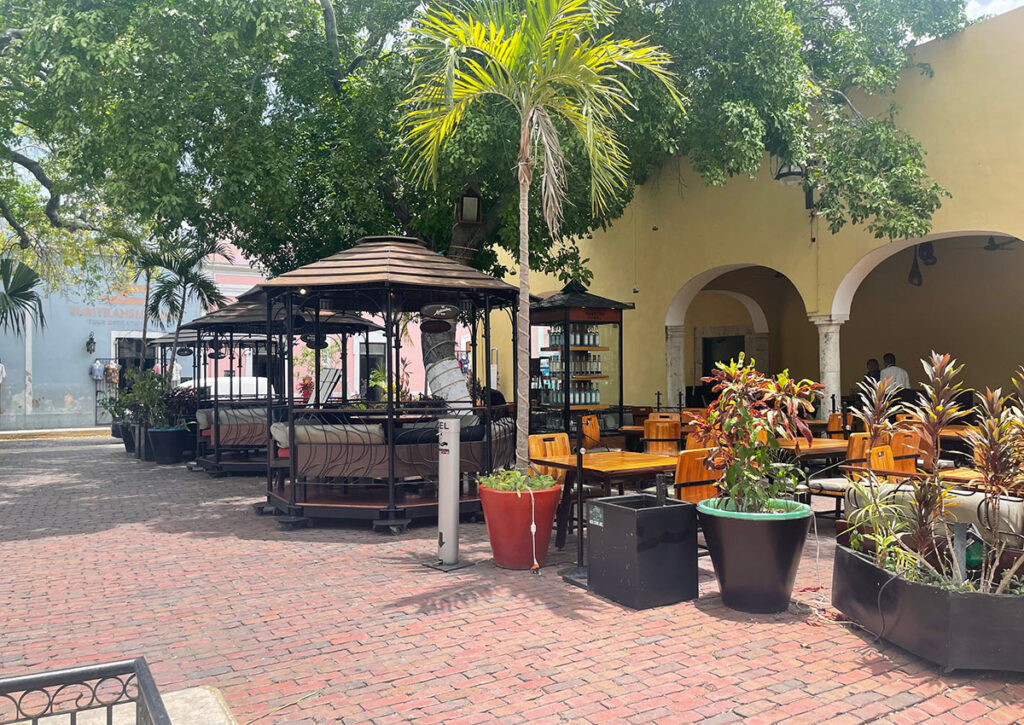
A steak house at one end of Parque Santa Lucia pushed banquettes and a beer sign into the park.2022 file photo

A steak house at one end of Parque Santa Lucia pushed banquettes and a beer sign into the park.2022 file photo

Apoala was a game-changer when it opened in the early 2010s.2013 file photo

A night of music at Parque Santa Lucia in Mérida.2014 file photo

A community stage is a mainstay at Parque Santa Lucia.2015 file photo

Restaurant seating began to crowd out public spaces at Parque Santa Lucia. 2022 file photo

A Sunday craft fair at Parque Santa Lucia.2022 file photo
The small plaza, three blocks north of Plaza Grande in Mérida’s Centro, built its reputation on a lineup of restaurants that spilled chairs and umbrellas onto the cobblestones, competing for the same crowd drawn in by the weekly Serenata Yucateca.

That lineup has thinned out. La Recova, Apoala and 500 Noches, three names that anchored the plaza’s dining scene for years, are no longer serving there, and their storefronts sit empty for the first time in years. We’re not sure what dynamics led to this. But two broader forces in Mérida’s Centro Histórico offer likely context: rising commercial rents and a municipal push to reclaim public space from private businesses.
SUBSCRIBE TO OUR NEWSLETTER
Delivered to your inbox every Monday, completely free.
The rent question
Commercial rents in the Centro Histórico have climbed sharply as foreign buyers and investors have moved into the neighborhood. A recent analysis put monthly rents for commercial space in the district between MX$12,000 and MX$40,000 (roughly US$620 to US$2,080), a range that puts pressure on restaurants competing for the same storefronts as boutiques, cafés and short-term rental operators. Property owners in colonial-era buildings, some of which are built of cut limestone, have increasingly converted their homes into commercial space to capture higher rents, according to reporting by Por Esto! on the district’s broader gentrification. Rodrigo Menéndez Cámara, the newspaper’s director, described the shift as one that has pushed out longtime local businesses in favor of tourist-oriented cafés, galleries and boutiques.
Santa Lucía sits at the center of that trend. Its arcaded buildings, prized for their views of the park and proximity to the Thursday serenade, are exactly the kind of prime, high-visibility real estate that commands premium rents in a tightening market.

One side of Parque Santa Lucia’s L-shaped colonnade appears as it did 15 years ago, before the Centro boom.Photo: Lee Steele / Yucatán Magazine

A row of restaurants has disappeared from Parque Santa Lucia.Photo: Lee Steele / Yucatán Magazine

Some of a steakhouse’s furniture remain abandoned at Parque Santa Lucia.Photo: Lee Steele / Yucatán Magazine
Taking back the park
The second thread is municipal. Mérida’s city government has spent years wrestling with restaurants that expand beyond their property lines into the park itself. In 2022, after a restaurant posted signs blocking street vendors from a section of the plaza, the city ordered the structures removed and said it was drafting a regulation to govern commercial use of public spaces, including parks and sidewalks.

That effort has continued. In July 2026, the city council approved a new regulation for markets and commerce in public spaces, replacing rules that had been in place since 2011 and adding clearer permit and enforcement procedures. Separately, Mayor Cecilia Patrón Laviada’s administration has run a sustained enforcement campaign it calls the recovery of public space: In the six months leading up to November 2025, the city reported 34 enforcement operations that removed 119 unauthorized vendor stalls, 35 food trailers and 151 signs and banners across the municipality, including in the Centro Histórico. City officials have described the campaign as an effort to guarantee “entornos seguros, transitables y respetuosos del marco legal”, meaning safe, walkable spaces that follow the law.
Neither the rent pressures nor the city’s enforcement push has been publicly tied to the closures of any restaurant. But both help explain why holding on to a table in Santa Lucía has gotten harder, whether the challenge comes from a landlord’s asking price or from tighter limits on how far a restaurant’s tables can spread into the plaza.
Who’s holding on
Not every operator has pulled back. La Tratto Santa Lucía, an Italian-American pizza-bar occupying a restored space on the park’s main corner, still overflows onto the terrace. Its sister restaurant, the historic tourist-friendly Pancho’s, is next door. Rosa Sur 32° is still there, flanked by empty storefronts that sold chocolate and craft cocktails, respectively.

Soberana, a steakhouse, is all the way on the other side of Calle 60, but has carved out a piece of the park for al fresco dining. Waiters dodge traffic to bring meals to tables.
Still a gathering place
Despite the turnover in restaurants, the park’s cultural calendar hasn’t slowed. The Serenata Yucateca, a program of trova music and folk dance, has run every Thursday at 9 p.m. since January 1965, making it more than 60 years old. City-run cultural programming, including Mérida es Cultura, continues to schedule trios, jaraneros and folk ballet troupes for the weekly show, and it remains free and open to the public. The park also hosts occasional artisan fairs and pop-up markets tied to the city’s broader Centro Histórico programming.
Related: Parque Santa Lucia’s connections to the Colonial-era slave trade
Fast Facts
Parque Santa Lucía sits at Calle 60 and Calle 55, Centro, Mérida, about three blocks north of Plaza Grande
The park dates to 1542, the year of Mérida’s founding
Commercial rents in the Centro Histórico range roughly from MX$12,000 to MX$40,000 a month
The city approved a new public-space commerce regulation in July 2026
Mérida reported 34 public-space enforcement operations between roughly May and November 2025
The Serenata Yucateca has run every Thursday at 9 p.m. since January 1965
La Recova, Apoala and 500 Noches no longer operate in the park
With reporting from Por Esto!, La Jornada Maya and Yucatán Magazine’s archives

Lee Steele is the founding director of Mérida-based Roof Cat Media S de RL de CV and has published Yucatán Magazine and other titles since 2012. He was Hearst Connecticut’s Sunday Magazine creative director and worked in New York City for various magazine publishers, including Condé Nast and Primedia, for over 20 years.
Dining and Cooking