
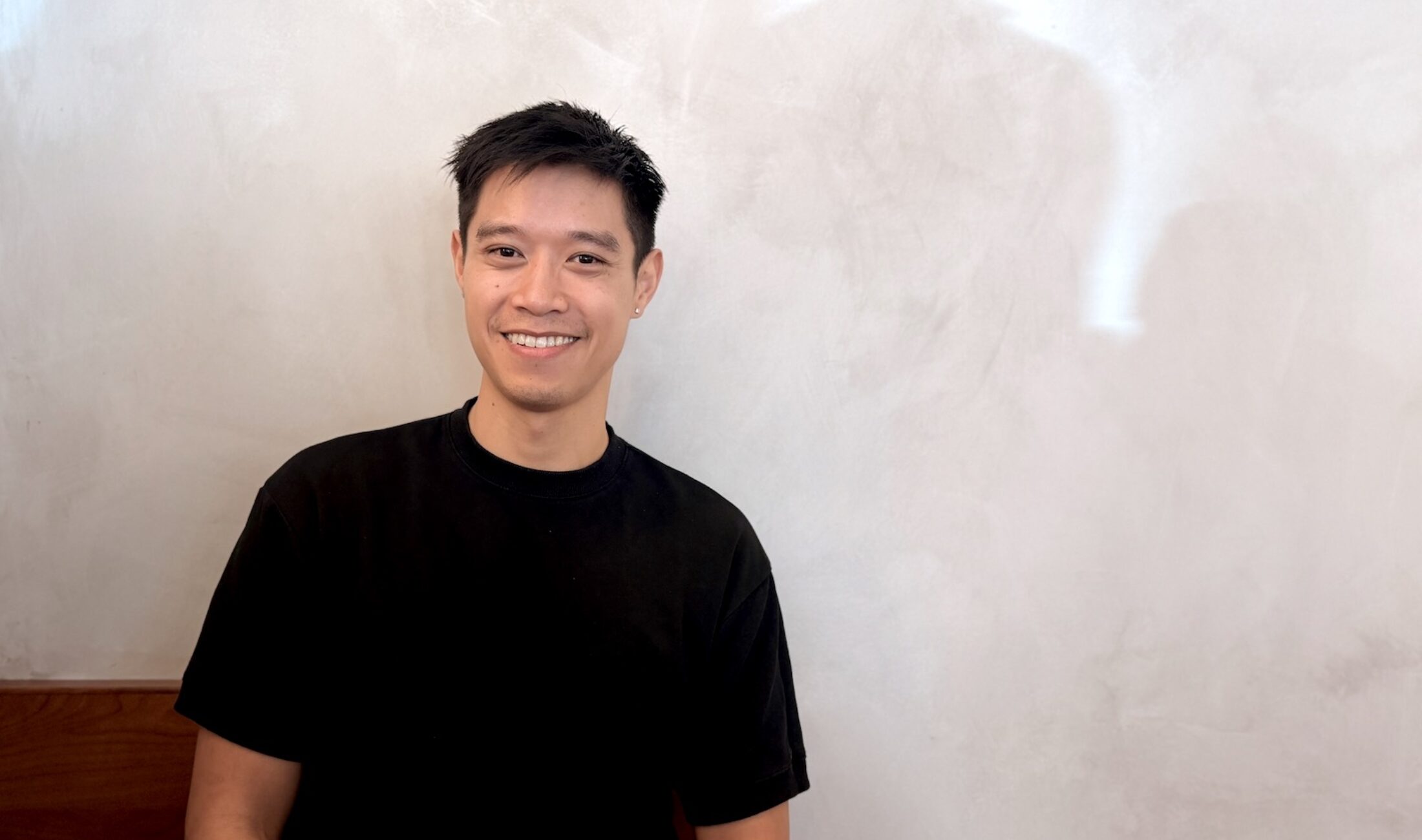
Steven Che is getting ready to open Haisan, a 30-seat tasting-menu restaurant at 2892 Commercial Drive, later this fall. To understand what he is building, it helps to work backwards through the restaurants, kitchens and ideas that shaped him.
The first thing I notice about Steven Che is that he sees food in numbers. Recipes are recorded, ingredients weighed and seasoning expressed as a percentage. When he makes something new, he measures it once and writes it down. He has been known to assign meals a number, too.
An eight is good. A nine is exceptional. Tens barely exist.
But at a certain point, the calculation stops.
Che tells me that if something clears his eight-out-of-ten threshold, the response is almost immediate. He doesn’t need to keep pulling it apart to figure out what worked. He can simply appreciate it. “Once it passes that hurdle, then absolutely, the beauty can take over.”
If something is slightly underseasoned, though, the analysis resumes. “That takes me out of it.”
That tension between calculation and instinct runs through the restaurant he is building. Haisan will serve a roughly 16-course tasting menu that draws from Pacific Northwest ingredients, spun together with Che’s Chinese heritage. It is what he has been working towards for most of his adult life, even when it wasn’t yet clear that’s what he was doing.
Che talks openly about Michelin standards, not so much (it seems to me) because he is building a restaurant for those stars, but because they give him a vocabulary for the level of execution he is chasing. He’s eaten and worked in those restaurants. He understands their systems from the inside and has firm ideas about what it takes to move beyond merely good.
Che was born in Macau and moved to Vancouver with his mother and two older sisters when he was six years old. He grew up around Victoria Drive and 50th Avenue. His mother was trying to support three kids and eventually opened a small juice shop in Richmond, which she still operates today. So things were busy, and Che spent a lot of time solo. This is when food became Che’s obsession. First on television, then in practice.
Rather than head directly to culinary school after high school, Che left Vancouver to study dietetics at the University of Florida. The program itself proved too clinical for what interested him. He started a culinary arts student union while he was there, organizing cooking classes and competitions, and during his summers began finding his way into professional kitchens.
Eventually, cooking won.
After graduating, Che worked in Orlando before sending emails to a handful of ambitious restaurants around the world. One of the replies came from three-Michelin-star restaurant Maaemo in Oslo.
Che offered to stage there for six months, reasoning that if he was good enough, they could hire him, and if he wasn’t, six months would at least give him enough time to understand what was happening inside a restaurant operating at that level.
They hired him after three months.
Maaemo threw him into the deep end. Despite limited pastry experience, Che found himself running pastry and managing stagiaires from different countries. He remembers struggling for the first month or two until one service when, finally, nothing went wrong. Everything landed on time. His head chef acknowledged it at the end of the night and Che remembers thinking simply: I can do this.
Over 11 months he worked his way through most of the stations and watched the mechanics of a three-star restaurant from the inside. There was enormous precision and enormous labour: a table of eight might have ten people approach it at once, plates landing simultaneously while two more people sauced. What interested Che wasn’t only the spectacle. It was the system underneath it.
From Norway he moved to Adelaide, where he landed a job at the highly acclaimed restaurant Orana. The scale here was dramatically different. It was another long tasting menu, but instead of Maaemo’s almost unlimited labour, Orana might operate with four or five people in the kitchen. Same ambition. Different machinery. It taught Che something useful: strip away enough of the apparatus and the essential thing can remain.
By early 2020, he felt he’d seen enough versions of high-level cooking to begin figuring out what his own might look like. He returned to Vancouver just before the pandemic, wanting to understand the local supply chain and restaurant business from the inside.

As the pandemic hit, and restaurants began to reduce hours and lay off staff, Che found a job working at Scratch Kitchen. He later used what he’d learned there to open Just Pizza on Kingsway. In 2024, the Chinese Restaurant Awards named him Rising Star Chef of the Year, recognizing not only the sourdough pizza but the fine-dining pop-ups he was running alongside it.
I’ve never eaten Che’s fine-dining cooking, which puts me at something of a disadvantage in trying to understand exactly where all of this thinking lands on the plate. I have eaten his pizza, though, and it’s pretty damn good.
On the surface, a counter-service pizza shop is a long way from a 16-course tasting menu. But Che’s fine-dining brain didn’t disappear when he started making pizza. He simply applied it to a different problem: at Just Pizza, the work is pushed heavily into preparation. Ingredients are seasoned. Recipes are fixed. Variables are reduced. By the time a pizza hits the oven, most of the decisions have already been made.
“Once you lock in the controls, then they’re locked in.” Back to numbers and equations. As Che explains it, the same thinking applies at Haisan; it just takes a much more ambitious path.
Che talks about front-loading labour so that service itself can become remarkably simple. He wants much of the menu ready to pick up in a minute or two. The complexity happens beforehand: building flavour, controlling seasoning, anticipating variables and working out exactly what needs to happen so that, when the room fills, the kitchen isn’t inventing the answer 16 times per guest.
The point isn’t to systemize the feeling out of cooking. The way I understand Che is that it’s almost the reverse. Che uses the math to remove as many things as possible that might interrupt the experience of the food.
You can hear it in the restaurants that have stayed with him.
Around 2016, he ate at the two-Michelin-starred Commis in Oakland and was struck by food that appeared almost startlingly simple. The work and complexity were there, but largely invisible.
More recently, a meal at a two-star vegan restaurant in Shanghai pushed the idea further. The room was lightly adorned. The ceramics were earthy and irregular. There was tea rather than alcohol. The food was lightly seasoned but not underseasoned. Che describes the experience as meditative.
He gave it somewhere around a 9.5. “I reserve nines and tens for stuff that is kind of life-changing.” What impressed him wasn’t complexity for its own sake. It was how thoroughly the complexity had disappeared. That idea runs all the way through Haisan – from cooking and service to lighting and textiles.
To achieve the aesthetic he envisioned, Che met with five architecture firms before choosing Scott & Scott. What convinced him was their willingness to consider the restaurant at roughly the same obsessive resolution he does. They have produced dozens of drawings, he says, sometimes redesigning details simply because something didn’t feel right. Seating has been reconsidered by inches. Much of the dining room is being acoustically treated. Narrow-beam lighting will concentrate warm light on the tables without cluttering them with candles.
For all that precision, Che doesn’t want Haisan to feel austere. He talks about the Pacific Northwest as a place that can be cold and rainy, and about the pleasure of walking through a door into somewhere that immediately feels warm and inviting. Natural materials will help, as will all that attention to sound and light. The work may be exacting; the experience isn’t supposed to feel that way.
Che has also spent the past two and a half years making ceramics for the restaurant himself. Hundreds of pieces are waiting in his closet. “We don’t need everything,” he says. “It just needs to be good.”
He is talking about the ceramics, but he could just as easily be talking about Haisan. There is an enormous amount of work happening behind the scenes, much of which a diner will never know about. The dozens of drawings, the inches gained or lost between seats, the plates that don’t make it out of the closet. The point isn’t to make all that effort visible, or to impress people with complexity. It’s to keep working at something until what remains is what he believes should be there.
The food is intended to belong here, too.
“Our menu is Chinese Pacific Northwest, one point of view, cooked the way I already think about food,” Che says. “Haisan cooks for the families who’ve lived this integration for generations, and for anyone curious what it becomes at this level of craft.”
The menu brings local ingredients together with techniques Che learned abroad and Chinese flavours he remembers from childhood. Rather than reproduce dishes he thinks others already make better, he is looking for new ways to carry those references forward. To help me understand, Che pulls out his phone and shows me some recent photographs of his dishes.
 Image courtesy Haisan
One dish takes quail, removes almost all of its bones and stuffs it with pork, shiitake and chestnut. It comes with a sauce made from the quail bones and hawthorn, the tart fruit Che remembers through the Haw Flakes ubiquitous in China, alongside charred local greens glazed with star anise.
Dessert might bring roasted barley gelato with a crisp sesame and coconut milk cookie and coffee reduced with cream and sugar until it reaches the consistency of molasses, then finished with brown butter and salt.
They aren’t reproductions of Chinese dishes. They’re Che pulling memories, ingredients and techniques through the considerable catalogue he has accumulated in Vancouver, Florida, Norway, Australia and elsewhere, then asking what they mean here.
“I don’t think I put myself as particularly creative,” he tells me. “I just think I’m able to identify patterns of things I really enjoy and be able to pull it together for other people.”
Che has spent years collecting patterns.
At Maaemo, he learned what nearly unlimited labour can achieve. At Orana, he learned what happens when much of that labour disappears. At Just Pizza, he learned how far standardization can take a business once the variables have been understood and controlled. In restaurants around the world, he has kept tasting, grading, remembering and filing away the things that crossed his threshold. Now he’s building the place where all of those calculations meet.
Despite all the talk of Michelin stars, ask Che what success looks like and he doesn’t talk much about awards. He wants a full dining room. He wants the food to consistently meet the standard he has set for it.
And, eventually, he’d like Haisan to have staying power. Some of the restaurants he admires have been operating for 10 or 20 years. If Haisan is still running 12 years from now, executing at the level he believes it can, Che says he’d be happy with that.
For someone who measures and records and analyzes as much as Che does, what he says next is almost surprising: “Perfect’s not my goal. I think eight out of ten’s my goal.”
Eight isn’t Che settling. It’s the point at which nothing is sufficiently wrong to pull him back into analysis. The seasoning isn’t distracting him. The mechanics aren’t showing. The work that went into making the thing has receded. What’s left is beauty.
Haisan aims to open in October 2026.
Keep an eye on its Instagram account for updates.
OPENING CREDITS
Steven Che – Chef-Founder
Adam Christie – Chef-Partner
Jessica Ye – General Manager & Sommelier
Emmanuel Paiva – Service Director
Scott & Scott – Design

Dining and Cooking