

For 24 years, Vu Tra Mi has lived and worked in France. But no matter how far from Vietnam she is, there is one thing that brings her family back home, a steaming bowl of Pho. Mi says for her family, Pho has become part of their everyday life.
Mi said: “Pho has always been a favorite in our family. Whenever we travel somewhere or come back from a business trip, especially after spending several days eating Western food, the first thing everyone wants is a hot bowl of Pho. There is something very comforting about having a hot bowl of Pho after a long journey. It makes you feel better.”

Tra Mi introduces Vietnamese cuisine in France (Photo courtesy of Vu Tra Mi)
Pho has been such a special part of Mi’s family life that she gave her daughter the nickname “Pho”.
“There are four people in my family, and one of them is called Pho. That’s the nickname we gave our second child. The name is fun and sweet. She was born in December, the month in which we celebrate “the Day of Pho”. When I noticed that coincidence, I felt very happy,” Mi said.
In Vietnam, it’s easy to have a bowl of pho at street stalls and at any time of the day. But for Vietnamese people living far from home like Mi, Pho means something more, it’s a way to stay connected to the homeland. Mi says she makes Pho whenever she can.
“When I lived in Vietnam, I never actually made Pho myself as I would usually just go out for a bowl of Pho at anytime and anywhere. But when you live abroad, you start to miss that familiar taste of home. I learned the basic recipe from older Vietnamese people living in France, and over the years, I gradually perfected my own recipe. It takes quite a lot of time to make. First, I wash the beef bones in boiling salted water, then roast them to give the broth a clean, rich aroma. I slow-cook the broth overnight. We also always roast the ginger, cinnamon, and cardamom before adding them. But my biggest secret is dried sandworms, which my parents send me from Vietnam. They give the broth an incredible natural sweetness while keeping it clear. And I always add a little fish sauce at the end, it really brings out and enhances the flavor,” said Mi.
Mi then decided to share her passion for Vietnamese food far beyond her own kitchen. She opened a small Vietnamese restaurant in France, with Pho as one of its signature dishes. She has also introduced her Pho at food fairs, cultural festivals, and international events in France, hoping that more people would enjoy this unique dish of Vietnam.
Mi said: “At first, I was hesitant because serving noodle soup at an event is much more difficult than serving dry food. But I still remember the first time I introduced pho at an event. It was in November, and the weather was cold. The aroma of the steaming pho attracted so many people that our stall had the longest queue, and some even came back for a second bowl. That experience gave me the confidence to keep bringing pho to events. Most recently, I collaborated with a pho-loving community at a food fair, where we introduced the dish to visitors. Once again, it received a very warm response.”

Tra Mi at a Vietnamese culinary event in France (Photo courtesy of Vu Tra Mi)
For Tra Mi, a steaming bowl of pho is more than just a meal, it is a simple way to bring her family together at the end of a long day. She believes Vietnamese families living abroad can also be ambassadors for pho, sharing with the world its distinctive flavors, and also the warmth, traditions and cultural story that come with every bowl.

Pho Festival 2026 (Photo courtesy of Do Duc Chung)
Today, stories about Vietnamese Pho are reaching a wider audience online thanks to content creators like Do Duc Chung, author and founder of Nam Dinh Dat va Nguoi (Nam Dinh – Land and People), a community and platform dedicated to the history, people, and heritage of Nam Dinh, now part of Ninh Binh province.
“I want to begin my story with Pho, rooted in my love for the culture of my hometown. Like many young people, I became disconnected from my roots after leaving Nam Dinh to study and work. But when I returned, I discovered so many beautiful stories and cultural values that I had never known about. People would often ask me, ‘What is there to see in Nam Dinh?’ That really motivated me to reconnect with my hometown and share its stories. But I soon realized that one person couldn’t tell the whole story, so I decided to build a community of people who share a love for Nam Dinh,” Chung said.
Then “Nam Dinh – Land and People” was set up as a platform for people who want to share their stories about Nam Dinh. As Chung reconnected with his hometown’s culture and explored its traditions, he discovered Pho and the many fascinating stories behind the dish.

Do Duc Chung (far right) at a Pho event (Photo courtesy of Do Duc Chung)
Chung further elaborated: “Nam Dinh was once an important imperial center during the Tran Dynasty, and the area around Thien Truong gradually developed a rich culinary tradition. People learned to make the most of what came from their gardens and fields, especially rice. That’s why I feel such a strong connection to the rice fields of my childhood. And that’s where my story of Pho began.”
Chung now works with TikTokers, YouTubers, and other content creators who share his passion for Vietnamese culture, encouraging them to tell their stories of Pho and bring its rich cultural heritage to a wider audience through social media.
For Chung, Pho provides an endless number of stories that reveal surprising aspects of the dish and the culture behind it. From the origins of its ingredients to the people and traditions connected to it, he finds new ways to tell the story of Pho.
“I feel like I could talk about Pho endlessly. Take Van Cu, for example. It’s known as one of the cradles of Pho, but when you visit, you can hardly find a Pho restaurant. That’s because you don’t go there just to eat Pho, you go to understand how people turned rice into noodles and brought together flavors from the land, the sea, the gardens, and the fields. For me, the culture of Pho is about much more than the dish itself. It’s about the farmers who grow the rice, the herbs, the fish sauce, the salt, and the different ways people make beef and chicken Pho. There are many stories behind Pho, and I feel there will always be more to discover and share,” said Chung.

Do Chung at a culinary event (Photo courtesy of Do Duc Chung)
Today, “Nam Dinh – Land and People” has grown into a community of more than 26,000 members, united by a shared passion for promoting their hometown’s culture, people, and cuisine. Through fairs, Pho festivals, and charity activities, the community is helping preserve local traditions while bringing Nam Dinh’s culinary heritage, especially its iconic Pho, to a wider audience.

(Photo: welovepho.org)
Like Tra Mi, who preserves a family recipe for making Pho, and Do Chung, a content creator who shares Pho with online audiences, many other Vietnamese are turning Pho business into a global venture while many others are devoted to perfecting every bowl. Their approaches may differ, but they share the same goal of making Vietnamese Pho better known, better understood, and appreciated far beyond Vietnam’s borders.
Pho has the power to bring people together. Across Europe, Vietnamese people and Pho lovers from many countries are coming together through a non-profit organization called WE LOVE PHO. The organization connects people who share a passion for Pho and want to spread its stories and Vietnamese culture as a whole to the world.
One of its founders was Mai Hai Lam, an overseas Vietnamese in Poland, the current president of the WE LOVE PHO network, which is connecting people to keep their sense of home alive wherever they may be.
Mr. Lam said: “For any Vietnamese person living far from home, Pho represents memories of cherished moments and feelings for the homeland. When I was living abroad, whenever I smelled the fragrance of Pho, the aroma of cinnamon, for example, or happened to walk past a place where it was being cooked, suddenly I would feel connected to my homeland and memories came flooding back. Pho is part of who we are, part of the Vietnamese identity, and a very strong bond that connects people.”
That feeling is what inspired the creation of the network “WE LOVE PHO”. In September 2023, at the 12th European Vietnamese Entrepreneurs Forum in Budapest, Mr. Lam introduced the idea of organizing a European Pho Week which received a warm response. After many meetings, discussions, and seminars, in September 2025 the network officially became a legal organization in Brussels, Belgium.

Mai Hai Lam, a co-founder and president of the We Love Pho Association (Photo: welovepho.org)
At first, it was called “I Love Pho”. But as the group grew, its members felt they needed a name that reflected their growing numbers.
Lam recalled: “Each person has their own perspective and your story may not be the same as mine. So we decided to change our name from ‘I Love Pho’ to ‘WE LOVE PHO’. The message is that this is not the story of just one person. It’s everyone’s story. Each person has their own perspective, and we want to bring those different stories together.”
WE LOVE PHO initially comprised 11 founding members from 10 European countries, including the UK, France, Poland, Belgium, and Italy, who came from different businesses, restaurants, cultural groups, and social groups, but were united by their love for Pho. Its mission was to bring people together and share the story of Pho. But as the network grew and more people joined, they began to see that Pho could do more than connect Pho lovers. With support from Vietnamese embassies and the State Committee for Overseas Vietnamese, Pho could be a way to promote Vietnamese culture and strengthen cultural diplomacy.
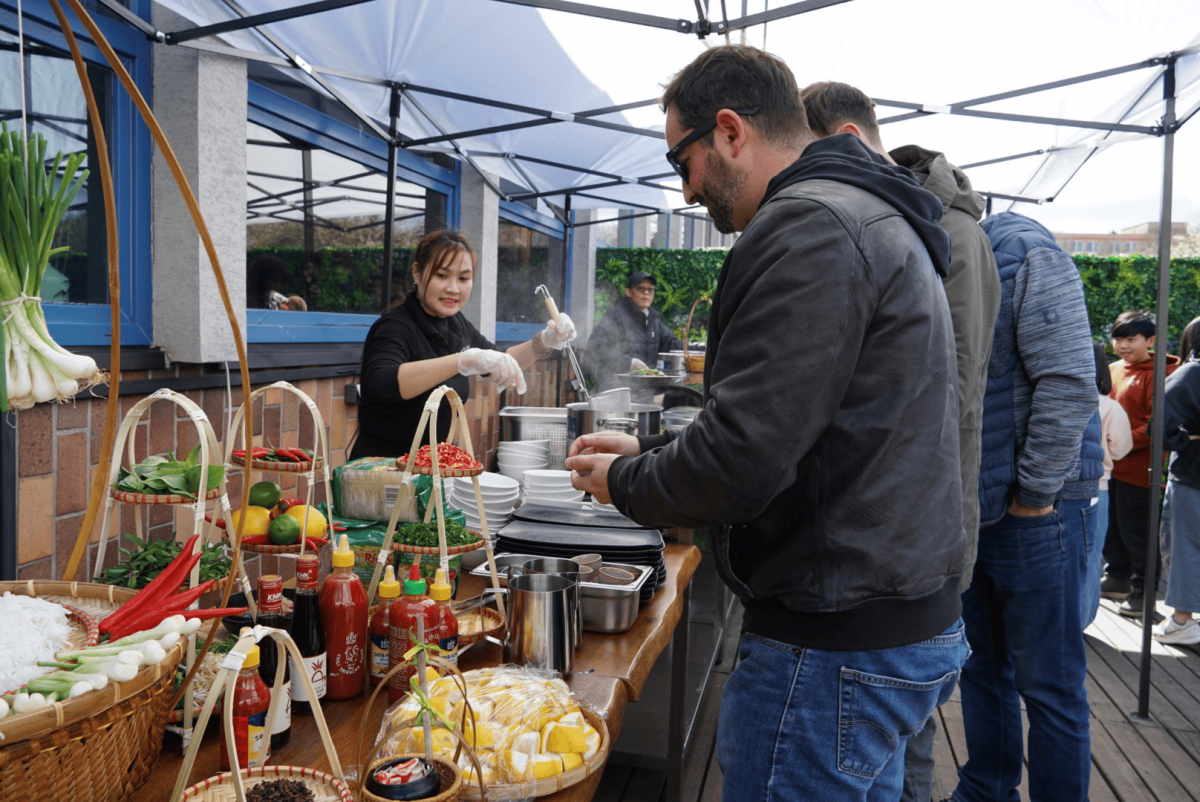
Vietnamese Pho draws foreign food lovers.
Mr. Lam said: “Last year, around Vietnam’s National Day, we brought Pho to Vienna, where many UN agencies and other international organizations are based. We organized a kind of ‘Pho diplomacy’, inviting diplomats and politicians to taste Pho. It created a very positive image and opened up opportunities for more cultural and diplomatic events. This year, cultural diplomacy, and food diplomacy in particular, is one of the major goals of our activities
Since 2023, WE LOVE PHO has been promoting Pho through seminars, trade fairs, food and cultural festivals, and community events across Europe. Its members have introduced Pho at music festivals, including events attended by tens of thousands of people. The network has also taken part in the Pho Festival in Ninh Binh and connected with Vietnamese restaurants and local communities. WE LOVE PHO has also created a map of many of the Vietnamese restaurants and Pho places in Europe.
“We started by using technology to identify Vietnamese food businesses and restaurants in Europe. But we wanted to make it more than just a list of addresses, so we created a living map, which allows each location to take part in activities and connect with the wider Pho community,” Mr. Lam said.
As WE LOVE PHO looks to the future, one challenge is how to preserve the identity of Pho while allowing it to adapt to different countries. Nguyen Anh Quan, an overseas Vietnamese in Ukraine and a member of WE LOVE PHO, says the ingredients available and the local food culture shape the way Pho is prepared in each country.
Mr. Quan said: “When cooking Pho overseas, there are two main challenges: the ingredients available and the local food culture. People can follow traditional recipes, but sometimes they have to adapt them to local ingredients, local tastes, and their own cooking skills. Some people get creative and make fusion Pho. I’ve tried different versions made by Vietnamese people overseas. Personally, I’m a fan of anything that tastes good. If a fusion version is delicious, I’m very interested. But if it doesn’t taste good, then I’ll pass.”

The “Pho Cultural Roadshow Europe 2026” is announced at a press conference, Hanoi, May 14, 2026 (Photo: welovepho.org)
The Pho Roadshow Europe 2026 is a joint initiative to promote Pho by WE LOVE PHO and the Ninh Bình Culinary Culture Association. The network is coordinating logistics, connecting with local communities and partners, and organizing activities in multiple locations throughout Europe. The Ninh Binh Culinary Culture Association’s team of 8 experienced culinary artisans, including Ms. Le Thi Thiet, are demonstrating traditional cooking techniques, preparing and serving Pho, and sharing their expertise with people at each destination.
“This is our first Pho Roadshow Europe, with 7 stops. We’ll start in Prague, where we’ll meet young Vietnamese people and introduce traditional Pho and other regional Vietnamese dishes. Then we’ll go to Poland, where we’ll exchange culinary tips and share recipes from Hanoi, Nam Dinh, and other regions. In Slovakia, we’ll attend a major Vietnamese cultural festival, prepare giant pots of Pho, and make a ten-meter-long Pho roll representing the three regions of Vietnam.”

Ms. Le Thi Thiet ̣̣̣̣(in the middle) at Pho Cultural Roadshow Europe 2026 in Slovakia (Photo: welovepho.org)
Ms. Thiet added: “Our fourth stop is Hungary, where we’ll take part in a Vietnamese food week and work with young chefs. In Austria, we’ll present Vietnamese heritage dishes at a cultural program hosted by the Vietnamese Embassy. Then we’ll head to Berlin, where we’ll work with the Vietnamese community and Dong Xuan Market to showcase Hanoi’s culinary culture. The final stop will be a gathering where we’ll recreate a traditional northern, central, and southern Vietnamese family meal for Vietnamese people living abroad.”
This year, Vietnam is preparing a dossier seeking UNESCO recognition for Pho, with Hanoi taking the lead in the process. Today, Pho is enjoyed in cities around the world, thanks to the Vietnamese communities, chefs, cultural organizations, and individuals who have promoted it. These ambassadors of Pho have helped a humble bowl of noodles cross international borders, and have brought a taste of Vietnam to the world.
Dining and Cooking