

WALCOTT and FARGO, N.D. — When searching for authentic Italian cuisine, Fargo is not the first place that comes to mind. But Spaghetti Western in downtown Fargo is trying to change that. Customers fill the restaurant each day, eagerly awaiting their dishes to transport them from the prairie winds of Fargo to a sunny, quiet Italian village.
When Fabrizio Di Gianni and Brighid Maguire opened Spaghetti Western, they wanted to showcase dishes with real ingredients. That’s why all their beef is sourced locally from North Dakota, from a farm family that has been in agriculture for generations:
Nohava Ranch.
When President Donald Trump shared
his plan to import 300,000 metric tons of ground beef from unknown countries,
it alarmed some American consumers. Some switched to farmers markets and other direct marketing outlets, besides grocery stores, in a search for homegrown, American beef.
It’s a trend that’s already been building and is moving more ranchers to consider moving into a direct-to-consumer model. A
Beef Checkoff research paper from 2024
stresses that consumers are increasingly interested in sustainability, with a 2022 Kearney study finding that Google searches about the carbon footprint of beef had increased by 18% over five years. That presents opportunities for producers to sell locally to a discerning public.
Nohava Ranch has been selling their North Dakota beef to hungry customers since 2024.
Bryan Nohava was raised on his family’s ranch in northwest Iowa, where they raise
Scottish Highland
and Longhorn crossbred cattle. Nohava’s father always dreamed of selling direct to consumers but was never sure where to start. When Bryan Nohava met his wife, Lexi, during their time at North Dakota State University, his father’s dream became a reality.
“He just wasn’t quite tech-savvy, I would say, or didn’t really understand the website, the marketing, all that kind of jazz, right? And us younger generation, that’s where Lexi and I kind of came into play,” Bryan Nohava said.

Nohava Ranch has shipped their beef to every state in the lower 48. Photo taken July 13, 2026, in Walcott, North Dakota.
Emily Beal / Agweek
Lexi Nohava also grew up in agriculture. Her family’s farmstead in eastern North Dakota has been in the family for six generations, and now the pair continues the legacy by raising cattle and selling beef directly to consumers. The North Dakota ranch acts as a sister ranch to the Iowa operation, with half the cattle occupying each.
Nohava Ranch ships out its homegrown, North Dakotan beef every Tuesday and has shipped to all 48 contiguous states.
“Shipping direct to consumer has been really great to just connect with families nationwide. I know there’s a lot of parts of the country that don’t have direct access to fresh beef like we do, and so just to give them that accessibility, I think it has really just really helped out a lot of families,” Lexi Nohava said.
California and upstate New York are some of Nohava Ranch’s biggest customers. Lexi Nohava noted it is a bit harder to source local beef in those areas.
Besides cuts of meat such as steak, ground beef, steak tips and other tasty options, Nohava Ranch also offers subscription boxes. The subscription boxes are shipped directly to the customer’s doorstep every 30 to 45 days.
Scottish Highland x Longhorn cross
While
Scottish Highland
and Longhorn cattle are not a popular cross in the U.S., it is one that just makes sense for the Nohavas. Scottish Highland cattle are excellent foragers, making them a nice choice on pasture. In addition, they are a natural choice for North Dakota’s brutal climate, as the breed is able to withstand harsh, cold weather conditions.

The Scottish Highland Longhorn crosses are not super popular in the U.S., but have performed well for Nohava Ranch. Photo taken July 13, 2026, in Walcott, North Dakota.
Emily Beal / Agweek
“They’re able to be on a pasture that’s, you know, full of shrubbery and trees, and since they’re such diverse eaters, it actually affects their meat taste as well. So the final product taste just has a richer depth of flavor with that kind of variety of diet,” Lexi Nohava said.
On the Longhorn side of the genetics, they are excellent mothers and can have a more aggressive demeanor when with their calf. This helps ward off predators that may be wanting to attack or kill calves. The Longhorn genetics are also brought in to help fight mastitis, as they possess natural genetics that are said to significantly reduce mastitis susceptibility.
However, the majority of the genetics in the herd lean more toward Scottish Highland cattle.
The proof is in the pasta
One evening the Nohavas were celebrating Bryan’s birthday at one of their favorite restaurants,
Spaghetti Western.
The Nohavas met Di Gianni and Maguire that evening and asked the restaurant owners where they source their beef. That’s when a truly organic partnership arose.
“They dropped some samples, and we instantly realized the potential of their product, the quality of their product. So it was just natural to switch all of our beef products to theirs,” Di Gianni said.
Di Gianni grew up in northern Italy and began working in the restaurant industry in his teens. Following the couple’s move to Fargo, they opened Spaghetti Western. Maguire’s parents live in a cowboy town, as she described, in Wyoming.
“One day we were walking around and just jokingly looked up and said, ‘Wouldn’t it be funny to have a restaurant named Spaghetti Western where we make pasta?’” Maguire said.
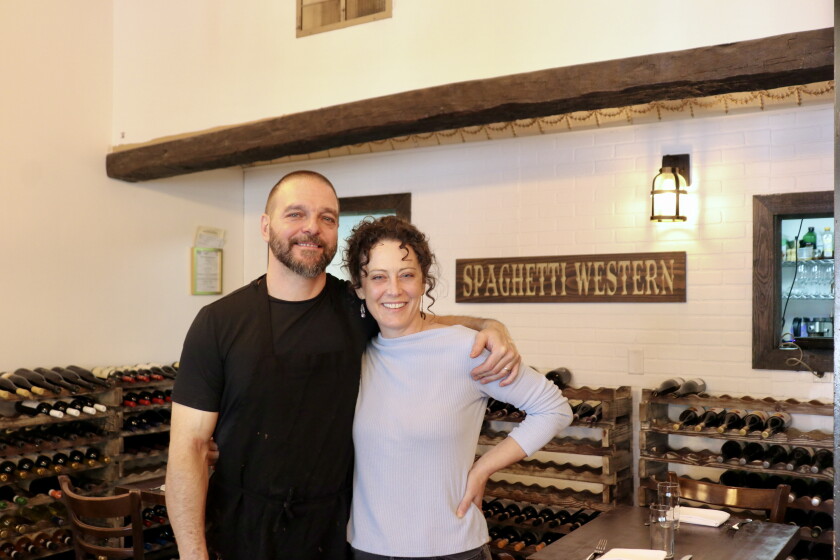
Fabrizio Di Gianni and Brighid Maguire opened Spaghetti Western in 2025. Photo taken Aug. 27, 2026, in Fargo, North Dakota.
Emily Beal / Agweek
The name is also an ode to Di Gianni’s love as well as his father’s for old spaghetti western films.
The customers often remark about the food’s freshness. For the Nohavas, it has been rewarding to see their homegrown beef grace the plates of Spaghetti Western’s dishes.
“They care about quality, and we care about quality, and it was an easy match for each other,” Bryan Nohava said.
By sourcing their beef locally, Spaghetti Western is able to stay connected to their Italian roots.
“Having the farmer bring us the meat directly has been so amazing and rewarding. In Italy, a lot of the meat is very, very local, and I think that’s why the food is so good, and it makes our food taste even more authentic to have it come straight from the farm,” Maguire said.

The partnership between Nohava Ranch and Spaghetti Western made sense for both parties involved. Photo taken Aug. 27, 2026, in Fargo, North Dakota.
Emily Beal / Agweek
Dining and Cooking