

 Apart from paying high rent, restaurants operated by Chinese nationals do not meet local flavours which is one of the reasons for them to close down. ( file photo)
As China-based food and beverage brands flood the Malaysian market, local restaurateurs face an unprecedented competitive wave.
Industry players from both sides agree that local establishments and China-based chains each hold distinct advantages and vulnerabilities. Rather than engaging in a destructive fight, operators should adopt an open mindset—allowing a diverse dining ecosystem to enrich Malaysia’s unique culinary culture.
Gao Hao Yun, president of the Malaysia-China Restaurant Industry Association, urges local restaurants to avoid personal hostilties or confrontational posturing. Instead, they should observe market shifts, adapt to evolving consumer and talent demands, build strong teams, and sharpen their brand identities to remain resilient in the long run.
Chong Kam Fai, president of the Pan Malaysia Koo Soo Restaurants and Chefs Association, concurs that competition serves as a catalyst for industry-wide upgrades. The key, he emphasises, lies in how operators sharpen their own core competencies.
Chong adds that local restaurateurs understand domestic regulations far better than foreign operators.
In this regard, the Pan Malaysia Koo Soo Restaurants and Chefs Association can act as a bridge, offering compliance guidance and local market insights to operators from China.
 Gao Hao Yun, president of the Malaysia-China Restaurant Industry Association, who has been in Malaysia for more than 15 years.
Gao Hao Yun: China holds a 5-year lead in systemised talent and management
Chinese eateries maintain a clear edge in talent cultivation and corporate administration. Gao candidly admits that the gap between China and Malaysia in this area remains substantial.
“China is at least five years ahead. Operators in China have honed their skills in a massive, hyper-competitive market over many years,” he said.
He explains that operators from China excel at breaking down operational steps with precise efficiency.
While many Malaysian Chinese restaurants still rely on traditional corporate structures—owner, head chef, sous chef, floor staff—China-based chains have built modular, standardised systems.
In these turnkey setups, front-line turnover does not disrupt restaurant operations or compromise taste consistency, enabling rapid brand scaling.
 Bak Kut Teh – a local dish.
Local cuisine remains irreplaceable
Conversely, Malaysia holds its own irreplaceable strengths: localised flavours refined over decades that residents know and love, which foreign chains cannot easily replicate.
Chong offers an example: “In Malaysia, we cook with whatever local ingredients are available. Take Mapo Tofu—local versions rarely use Sichuan peppercorn oil. While chefs from China might consider the Malaysian version inauthentic, local diners genuinely prefer the local flavour,” he said.
Chong adds that while China-based chains excel in management efficiency, standardised workflows and brand systems, extreme standardisation carries risks—such as standardised food and poor adaptability to local tastes.
 Chong Kam Fai, president of the Pan Malaysia Koo Soo Restaurants and Chefs Association
Menu strategy: curated focus vs. infinite variety
A stark contrast between China-based chains and local Malaysian Chinese restaurants lies in menu design. China-based menus are lean, often featuring just 20 to 30 curated dishes touted as signatures. Local Malaysian menus regularly offer 50 to 100 or more items, aiming to cover every culinary preference under one roof.
Gao emphasises that Chinese menus are deliberately thin.
“By focusing on 30 to 40 items, kitchen teams ensure every dish meets high quality standards. Breaking down the menu at the system level makes technical quality control vastly easier. In contrast, traditional Malaysian Chinese restaurants often carry 80 to 120 dishes—requiring kitchen staff to memorise exhaustive menus,” he said.
However, Chong counters that variety is essential in the local market.
“In Malaysia, menu diversity is non-negotiable—that is the beauty of our multicultural society. Without variety, a restaurant will quickly close,” he said.
Chong explains that Malaysia’s multiracial demographic demands a wide spectrum of tastes, ranging from sweet and sour to spicy and bitter with distinct regional flavours. Historical experience shows that single-concept outlets face uphill battles in Malaysia; even Michelin-starred specialised concepts often struggle to survive long-term.
“Chinese restaurants bring systemisation and regional variety, while local operators bring deep ground-level experience,” Chong says.
“If both sides integrate based on mutual understanding, new hybrid dining concepts can emerge. But this fusion cannot be superficial—it requires time,” he said.
Local contractors and regulatory compliance
Gao acknowledges that many operators from China hire interior design teams from China—using familiar crews to execute specialised layouts. Consequently, local Malaysian contractors often miss out on basic construction work.
Chong notes that while using preferred crews is a commercial choice, restaurant designs must strictly comply with local council regulations. Hiring local contractors remains the safest route.
He cites signage rules as a common oversight among operators from China who often do not realise that Malay wording (Bahasa Melayu) must be larger than Chinese characters on commercial signboards.
“If foreign operators align with local norms, they gain a distinct advantage. Disregarding local culture and regulatory frameworks will ultimately cost them,” he said.
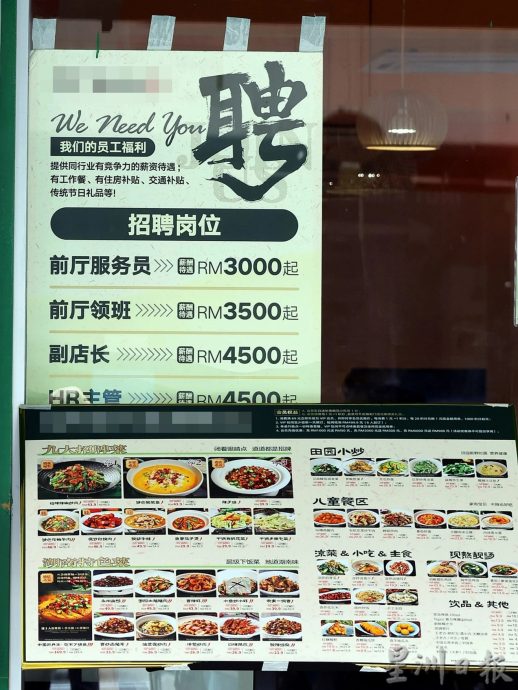 Chinese restaurants operated by Chinese nationals offer a higher salary than local restaurants to attract local workers.
The talent tug-of-war: Poaching or talent retention?
Restaurant chains from China offering higher salaries to recruit workers have sparked frustration among some local restaurant owners, who complain of escalating labour shortages.
“This comes down to whether an employer can afford to retain talent. We are helping Malaysia retain skilled professionals. If a worker’s capability commands RM5,000, paying them RM2,500 is unfair,” he said.
Restaurant chains from China invest in talent development, which ultimately benefits the nation.
In the past, many talented young Malaysian Chinese left for Singapore or Australia due to low domestic pay, he said.
“If you face a labour shortage while capping pay at RM2,500, is that fair? Raise the offer to RM4,500 and staff will stay. Business owners must adopt an open, growth-oriented mindset that inspires young workers instead of fostering a culture of resignation,” he said.
Tiered labour impact
Chong views the labour impact as multi-layered: front-of-house service staff move frequently for better pay and benefits, whereas core kitchen personnel—such as head chefs and primary wok cooks—remain relatively stable.
“Head chefs and senior kitchen staff in local restaurants already earn competitive salaries—often exceeding RM10,000 for head chefs and RM8,000 to RM9,000 for seniors,” Chong explains.
“With strong team relationships and familiar working environments, these core staff are not easily enticed away by salary increases alone.”
Embracing automation on the dining floor
To counter aggressive wage competition for front-of-house roles, Chong advises local operators to leverage modern technology—such as AI ordering systems, mobile app ordering, and automated service tools—to streamline operations and reduce reliance on floor staff.
Price wars and illicit seasoning imports
As competition intensifies, price wars may become unavoidable. Gao challenges local operators who resist change while blaming foreign operators.
“If a price war breaks out, can complacent operators survive? If a competitor sells a bowl of noodles for RM9.90 while you insist on RM13.80 under identical raw material, rent, and labour costs, how do you compete?”
Beyond high competition, Gao raises a critical issue yet to be fully addressed by authorities: the influx of smuggled Chinese seasonings.
Under legitimate import procedures—accounting for market pricing, shipping, and national taxes—Chinese seasonings sold in Malaysia should be 5% to 8% higher than retail prices in China. However, Gao’s market research revealed that certain seasonings sell cheaper in Malaysia than in China.
“Under what circumstances does a merchant sell at a loss?” Gao asks. “Are unethical distributors importing near-expiry, expired, or unlabelled goods through illicit customs channels? What does this mean for food safety?” he asked.
Gao stresses that he is not disparaging the market, but calling on authorities to step in before the situation deteriorates—ensuring legal compliance, protecting the reputation of Chinese culinary brands, and safeguarding public health.
Evolving business models: from franchising to joint ventures
The operating model for China-based F&B operators in Malaysia has shifted from master franchising to direct joint ventures (JV).
Gao notes that while hotpot and tea chains from China expanded rapidly through franchising in 2022—supported by hands-on setup guidance from headquarters in China—franchise models eventually encountered management consistency and quality control issues.
As a result, brands increasingly favour joint ventures.
“The local partner provides capital and local regulatory expertise, while the Chinese brand manages daily operations. This structure ensures full legal compliance and smooth administrative approvals, ” he said.
More : Culinary storm Part 1 – China’s culinary wave hits Malaysia: How local operators are adapting to the surge
Dining and Cooking