
While sustainability and locally produced veggies, grains and meats are fantastic, and everyone has an opinion on restaurant tips and fees, rising prices and the minimum wage, the real goal for most people of taking a seat in a restaurant is to enjoy themselves, to be excited by a menu and to tuck in to what’s on their plate.
Longtime Denver restaurateurs Frank and Jacqueline Bonanno have been at the center of the conversation about each of those subjects. That’s why their latest, and one of their most interesting, projects is so refreshing. It’s all about excitement, having fun and trying new and unexpected flavor combinations: specifically, Italian-infused Japanese food.
 Train seat-like booths line the wall on the left while a grand bar holds up the space on the right at Rōmyō, a new Denver restaurant featuring Japanese/Italian cuisine. (Joey Pusateri / Courtesy of Rōmyō)
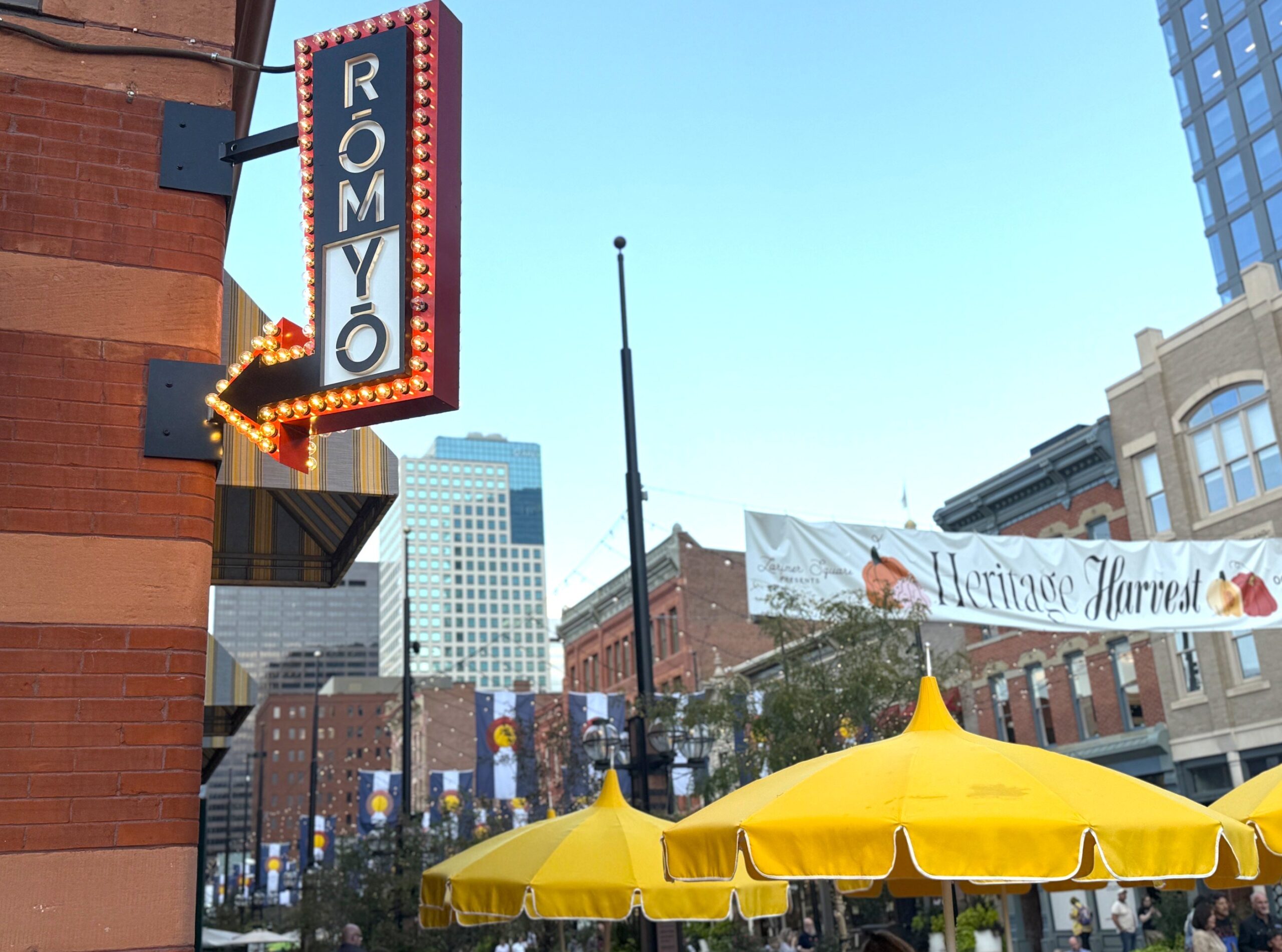
In Japan, this style of cooking, which uses Japanese ingredients in what would otherwise be traditional Italian food, is called itameshi. In Denver, it comes in the form of Rōmyō, which opened in mid-September at 1401 Larimer St. The name combines Rome and Tokyo. And if you’re able to grab one of the booths that line the edges of the space, you can pretend to do it from inside a train car, watching the Japanese or Italian countrysides go by on screens that act as “windows.”
But Rōmyō doesn’t serve typical fusion dishes — think tikka masala pizza or sushi burritos. Rather, each is a thoughtful attempt to use pieces of one cuisine to complement parts of another. Take the chawanmushi, a Japanese steamed egg custard, which is traditionally served with dashi, an umami-rich broth made from a dried kelp called kombu. At Rōmyō, Italian parmesan cheese is used to provide the umami instead of the kombu in the dashi.
“Parmesan is richer yet, and it draws out the savory side of the egg, enhancing the dashi to give it that smooth, velvety mouthfeel, and, I think, a good amount of funk,” Frank Bonanno explained in a note to The Denver Post.
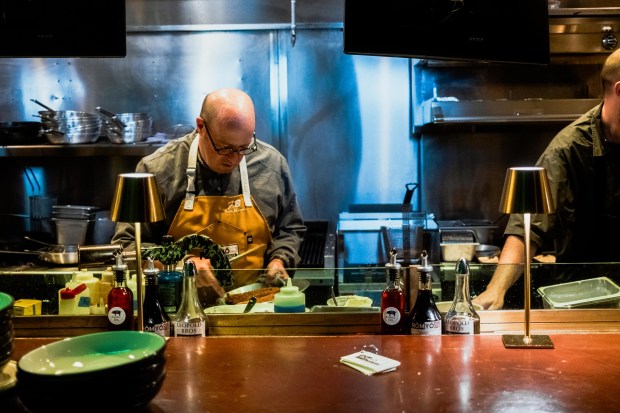 Frank Bonanno in the kitchen at Rōmyō, which opened in the fall of 2026 in Denver’s Larimer Square. (Joey Pusateri / Provided by Rōmyō)
There’s also the Chitarra alla Sake, which he said provides “the clearest Italian to Japanese ingredient swap on the menu.” In this dish, Rōmyō replaces the traditional vodka in this red-sauce pasta dish from Abruzzo with sake.
“But really, the nuance carries through every line of the menu,” Bonanno added. “Truffles replace mushrooms in the dashi of the Fusilli Longhi; bonito flakes for anchovy in the Chicken Katsu Piccata; Ibérico Pork in the Saltimbocca. I have Colorado ingredients in there, too, right down to traditional soy sauce aged in Leopold Brothers’ whiskey barrels.”
Some of the dishes will no doubt evolve as Bonanno works them through.
Bonanno isn’t a stranger to playing with multiple cuisines. He began his run in Denver in 2001 with French standard-bearer Mizuna, and followed it up with Luca and Osteria Marco, both upscale Italian concepts; Bones, a now-closed French-inspired noodle bar; Vesper Lounge, which serves Mediterranean small plates; and French 75, another French bistro that closed in 2004. He has also run a Nashville-style chicken shack, a gourmet sandwich shop, a barbecue house, Milk Market (a food hall with multiple concepts), and Green Russell, a late and lamented cocktail bar that closed in Larimer Square in 2022.
Rōmyō borrows ideas from some of those restaurants, but it is its own thing entirely. Other dishes on the wide-ranging menu include a spicy tuna roll with crispy sushi rice, olive and avocado that comes across like Italian arancini; porchetta ramen; udon carbonara with guanciale, garlic, ginger, parm and an egg yolk custard; Iberico pork saltimbocca made with prosciutto and a plum sage sauce; and Katsu alla Piccata, a Japanese-style chicken cutlet with a bonito-caper emulsion.
 The Dip, at Rōmyō restaurant in Denver, is made with roasted Wagyu beef layered on a Kewpie mayonnaise-smeared milk bread, with herbed soy dipping sauce. (Jonathan Shikes, The Denver Post)
One standout is the French dip, borrowed from French 75. At Rōmyō, though, the bread is a sturdier version of Japanese-style milk bread baked in-house daily. In between is roasted Wagyu beef and Kewpie mayonnaise. The au jus is made with soy sauce.
Feeling less adventurous? There are plenty of more straightforward steaks, sushi and salads as well.
The lively, 80-seat space and its open kitchen — formerly home to Ted’s Montana Grill (which closed in 2023) — along with the pillared bar, wall of liquor, chandelier and 9-foot giraffe sculpture in the entryway make the space feel upscale without being uptight.
But it’s the charming (some might say gimmicky) train booth-style seats that tie everything together with the cuisine.
“Frank and I were sitting on the Rōmyō floor, drinking champagne to celebrate the signed lease, and those booths looked like trains to me,” Jacqueline Bonanno told The Denver Post. Inherited from Ted’s, they were “so beautifully constructed, I wanted to keep what I could.
“The idea was that there would be one ‘train’ travelling through Japan, and another through Italy — and they would converge in this sort of fantastical atrium where anything is possible,” she added. “That kind of pulled the whole concept together, marrying the design to the food.”
Subscribe to our new food newsletter, Stuffed, to get Denver food and drink news sent straight to your inbox.
Dining and Cooking