
Rigatoni with sausage ragù at Fiorella
Where the old country meets Philly: The 15 best, most intriguing Italian restaurants to eat at right now.
Ambra
Modern Italian
The caviar-topped lobster scrippelle ’mbusse in chicken brodo may be more refined than the humble bowl of comforting crepe and chicken-broth soup chef Chris D’Ambro’s mom made for Christmas, funerals, and sick days. But the dish is as rich as his fond memories. The tasting menu at Ambra is filled with these moments: childhood summers jumping into the pool to clean the crab pasta sauce off his face and winter birthdays punctuated with braciole, all elevated to the level at which they are cherished.
Chef’s Choice: You’ll know it’s summer when you see D’Ambro’s favorite dish, the crab pasta, on the menu.
705 South 4th Street.

Fiorella
Fiorella
Various Regions
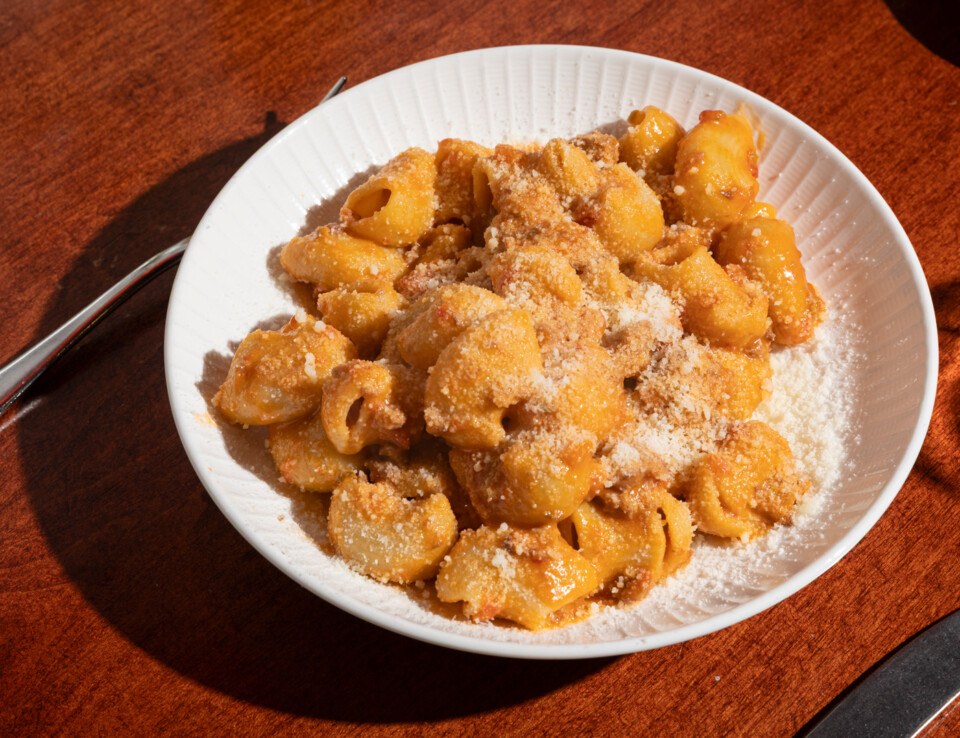
From the gutsy rigatoni with sausage ragù to the neon sign bathing the interior in a warm, antique glow, the vintage South Philly heritage is unmistakable at Marc Vetri’s Fiorella, but most of the pastas have a contemporary experimental streak: naked lamb ravioli topped with tangy peperonata, sweet corn caramelle with huitlacoche. Are those strawberries on the brown-buttered gnocchi?
Chef’s Choice: “Rigatoni with Fiorella sausage ragù is a no-brainer,” says Vetri. “I eat it three times a week.”
817 Christian Street.

Bomb Bomb captures the spirit of South Philly Italian.
The Baldino Trio: Zeppoli, Bomb Bomb, and Palizzi Social Club
Various Regions
No one personifies this new wave of Philadelphia Italian cuisine more than Joey Baldino, owner of Zeppoli, Bomb Bomb, and Palizzi Social Club. But there’s one thing that he won’t touch — Sunday gravy.
“That’s special,” he tells me. “That’s reserved for the family. And also, no one makes it better than someone’s mom or someone’s grandmother, so how could I replicate that?”
In terms of red sauce history and Philadelphia Italian American cultural preservationists, Baldino is like a museum curator — an expert at cataloging and presenting an edible vision of the past, made for the present moment — but he knows that even he can’t compete with anyone’s grandmother. So instead he does greens and beans, raviolo Vasto, and Italian party food at Palizzi; old-world Sicilian like grilled swordfish with lemon and Trapanese pesto at Zeppoli; and, alongside Max Hachey, a brilliant seafood tasting menu at Bomb Bomb that perfectly captures the pulse of classic South Philly Italian American cuisine, served in a room that feels like it’s been preserved in amber since Frank was pals with Dino.
Each place is telling its own story, preserving its own piece of history and place. That red gravy we all know? That’s just one small piece of the Italian American culinary experience, no more or less valid and important than the panzanella Catania with its capers and white anchovies Baldino serves at Zeppoli, or the red-and-white-checkered plastic tablecloths at Bomb Bomb. Historical monographs could be written about the rough, kitchen-table comforts of Palizzi’s brasciole or escarole with white beans as juxtaposed with the pesce spada at Zeppoli, done so perfectly and cleanly with its drizzle of olive oil and touch of lemon. And Baldino embodies both of those impulses in his menus: both the rustic, regional, and traditional and the polished, the fine. The result is a style that is distinct, unique, deeply Italian. And, for that matter, deeply Philadelphian.
618 Collings Avenue, Collingswood; 1026 Wolf Street; 1408 South 12th Street.

Davide Lubrano Lavadera at Pizzata
Pizzata
Roman
Don’t tell Davide Lubrano Lavadera’s Neapolitan paesani, but “somewhere along the way, I fell in love with Roman pizza,” says the chef-partner at Pizzata in Fitler Square and East Passyunk. “It’s the hardest style to execute and keeps you humble.” Served as whole pies and al taglio, they possess a lightness and crunch that could launch an ASMR channel.
Chef’s Choice: Roman pie Amatriciana: red sauce, fresh mozzarella, red chili flakes, onions, pecorino, and pancetta.
240 South 22nd Street; 1700 Passyunk Avenue.
A Mano
Modern Italian
For 10 years, A Mano has been a haven for the kind of handcrafted, elegantly rustic food that doesn’t fit comfortably into the traditional pantheon of Philly Italian restaurants. It’s not red sauce and meatballs, not faux marble, not a neighborhood joint or a tweezer-y and sterile fine-dining destination. Instead, it is that rarer, more nuanced kind of spot where roasted peaches come tucked alongside the soft potato gnocchi and the salmon is speckled with capers and golden raisins; where French technique, wide regional ingredients, and a dedication to craft make for plates that are both refined and comfortingly rough-edged at the same time.
Chef’s Choice: Chef Townsend Wentz says the braised pork shank with Taleggio polenta will always be his favorite dish to cook. “We call it the curtain closer because it shows up and people just go, ‘Wow!’”
2244 Fairmount Avenue.

From left: The dining room at Elma; Elma’s lumache pasta with ragù Genovese.
Elma
Modern Italian
It was on a trip to Cinque Terre when chef James Nardone encountered the lumache pasta with ragù Genovese he now has on the menu at Elma. The snail-shell-shaped pasta is the perfect vessel for generous forkfuls of meaty sauce, which has a Calabrian chili heat that builds with every bite. The food here “tastes like it’s cooked by someone with attitude,” as Nardone puts it. That bold personality is a combination of both sides of his Italian family. “My docile, romantic side is Abruzzese, and then my psycho side comes from my Calabrese blood,” he says.
Chef’s Choice: The meatball — made with veal, beef, and pork — is a menu staple. The recipe is inspired by Nardone’s grandmother, Elma, and the ones he always orders at Villa di Roma in the Italian Market.
431 East Girard Avenue.
Irwin’s
Sicilian
The jaw-dropping city views. Those patio seats. The juxtaposition of eating prosciutto with melon and plates of trofie in Sicilian tomato pesto inside an old technical school in East Passyunk with decades of graffiti still on the walls. All of those are good reasons to spend an evening at Irwin’s. But an even better reason is to experience the competing influences of super-traditional Sicilian cuisine (the caponata recipe is 100 years old); ingredients and flavors taken from the Spanish, Middle Eastern, and North African cultures that shaped it; and the kitchen’s modern approach to plating and design. Chef Michael Vincent Ferreri calls it “modern Sicilian” because that’s what diners understand, but really Irwin’s is presenting a version of Sicilian cuisine that is both ancient and global.
Chef’s Choice: “I love that people get so blown away by the simple things,” Ferreri says, so his go-to is a classic bucatini alla Nerano, with a creamy, comforting sauce made almost completely from a soft zucchini puree.
800 Mifflin Street.

Pork belly with long hots at Osteria
Osteria
Northern Italian
The wood-fired oven in chef Jeff Michaud’s kitchen might give Osteria its smoke and rustic heart, but its sense of style (and flavor) is a complex mix of Northern Italian traditions and East Coast approachability. From the Jersey corn crema and shaved summer truffles that dress the postage-stamp francobolli ravioli and the charred long hots served alongside the pork belly to the blistered crusts on the pizzas, the Iberico pork with its shishitos and hazelnuts, and the intensely sugary grape tomatoes that add a spike of sweetness to the seared swordfish, Osteria is a place where the old and the new, the local and the traditional, all blend together perfectly.
Chef’s Choice: Unsurprisingly, Michaud’s pick for a favorite dish is the Piedmont-style francobolli ravioli — a longtime fan favorite. For years, it has been done with a mushroom filling; the corn crema and summer truffle version with Robiola fresca from the summer menu was the first change he’s made to that dish in more than a decade.
640 North Broad Street.
Gran Caffè L’Aquila
Various Regions
Arrosticini — juicy charred lamb skewers devoured on street corners across Italy’s Abruzzo region — are a mainstay at Gran Caffè L’Aquila, along with an impeccable Roman carbonara made simply with pecorino romano, guanciale, eggs, and black pepper. But at the lively Rittenhouse restaurant, a rotating section of the menu also spotlights a different Italian town each week, from Lake Garda’s bigoli pasta to fileja from Tropea on the Calabrian coast. “Italy doesn’t have a national cuisine,” says co-owner Riccardo Longo. “It is built on the cuisines of many cities within the 20 regions.” Longo and Stefano Biasini opened the restaurant in 2014 after Biasini’s original cafe, on the main piazza in L’Aquila, Abruzzo, was damaged in the 2009 earthquake, carrying its spirit to Philadelphia with a mission to explore Italian cooking one city at a time.
Chef’s Choice: Sugo della Domenica — Sunday gravy with veal braciole, spicy sausage, and wild boar meatballs tossed with fusilli, reflecting Longo’s family roots in Campania’s Cilento.
1716 Chestnut Street.

Emilia’s tortellini in brodo is Meri Medoway’s love letter to (and from) Modena.
Emilia
Emilia-Romagna
Back in 2013, Meri Medoway spent six months living in Modena, a medieval hillside village in Northern Italy, best known these days for very fast cars and its vinegar.
This was long before she became a chef, before she’d ever stood a shift in a kitchen. She was just a student then — a senior at American University with most of her credits behind her, doing a semester abroad, traveling, and picking up a few electives along the way. The problem was, she was the only one from her class in Modena. She had no friends in town, no one she knew among the students. At least not until she met Federico — a local, and roughly her age.
They became friends. He would bring Meri to his parents’ house and they would eat big, sprawling meals. “His parents would cook dinner for us all the time,” she says. “I mean, imagine it. It was so perfect — getting to eat in this little house, all this food.”
Medoway eventually returned to the States and graduated, but she and Federico stayed in touch. She went back to Modena, occasionally, to visit the family — and there was always food. As the years passed, she went on to a career as a cook, then a chef — a lot of it spent working with chef Greg Vernick at Vernick Food + Wine. When Vernick decided he was going to open Emilia on Frankford Avenue in Kensington last year, he brought Medoway with him as chef de cuisine. She, in turn, brought her love for Italy — and Modena’s Emilia-Romagna region in particular — with her.
Medoway also brought a recipe for tortellini in brodo — one of the dishes Federico’s family had made for her. She’d just visited last May and, as usual, “I showed up and they’d made all my favorites,” she says. Everything she’d loved most over the years. And one of the things was this dish of tiny tortellini stuffed with ground pork, mortadella, and prosciutto, set floating “in basically just the best chicken soup you’ve ever had,” as Medoway says — a chicken stock full of aromatic herbs and, for her, powerful memories.
“It’s very simple,” she says, “but very warm and comforting. Very minimal, but all about the prep and the ingredients. It was special because of the family, and the history I had with them.”
She asked for the recipe; Federico’s family wrote it all down and mailed it to her once she was back in Philly. And that recipe ended up on the opening menu at Emilia — handwritten in Modena for a chef in an Italian restaurant half a world away.
2406 Frankford Avenue.

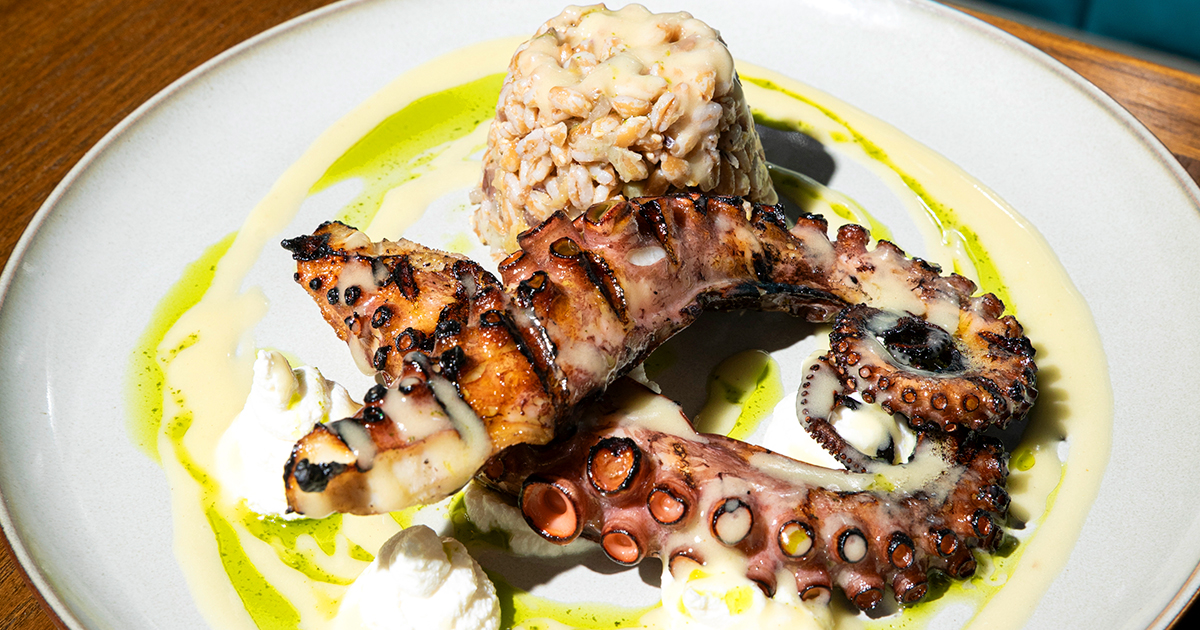
The octopus at L’anima
L’anima
Roman
Rome-born chef Gianluca Demontis’s L’anima is a neighborhood spot that draws on Italian simplicity. Here, the entire family (dogs included) can relax on the spacious all-season patio and share a pinsa, a crispy flatbread style of pizza, and nonna-proportioned bowls of house-made pasta that favor a few simple ingredients cooked to perfection. A crowd favorite: the cacio e pepe, made with thick, chewy tonnarelli pasta smothered in tangy pecorino romano and dusted with black pepper.
Chef’s Choice: Demontis is especially proud of the restaurant’s seafood dishes that bring out the true essence of Rome, like a grilled branzino with shrimp and spinach, and a grilled octopus with farro salad.
1001 South 17th Street.
Scampi
Various Regions
Each week chef Liz Grothe takes you on a culinary trip through regional specialties of the Boot. One week you’ll dine Roman, with dainty squash blossoms dipped in heavy tempura. The next, a fiery Calabrian porchetta offset with delicate scallops and the slight sweetness of apricot offers a wide spectrum of that area’s flavor offerings. It’s part dinner, part history lesson as Grothe walks you through each course’s background or tells a personal story. And Scampi is experimenting with a quirky drink menu featuring plays on spritzers and martinis, like the house espresso martini made with homemade nocino and Ox Coffee from directly across the street, in case you’d rather not tote a bottle of wine along.
Chef’s Choice: One thing is certain, Grothe will always have shrimp on the menu in unexpected ways, like a fazzoletti dish with shrimp nestled in thin squares of pasta, or prawn with garum, a fermented fish sauce used in ancient Rome.
617 South 3rd Street.

Heavy Metal Sausage
Heavy Metal Sausage
Modern Italian
Pennsylvania is the star of this kitchen, where chef Pat Alfiero takes bold liberties on a menu that highlights local ingredients. What’s Italian about Heavy Metal at its core is the commitment to quinto quarto, the tradition of using the whole animal. Here, you can expect dishes like mutton bombetta stuffed with broccoli rabe and roasted fennel, and tangy pork ragù smothering house-made spaghettone, spaghetti’s zaftig sister.
Chef’s Choice: While the menu changes with the season, Alfiero has a fondness for dishes that are as eclectic as his shop and the Philadelphia farms he sources from, like the pork belly made with sweet corbaci peppers and blueberry sauce.
1527 West Porter Street.
Published as “Tour d’Italia” in the November 2026 issue of Philadelphia magazine.
Dining and Cooking