

 Photo Courtesy of La Villa
Today’s new wave of Czech cooking is rooted as deeply in history as in innovation. Centuries under the Habsburg Empire and close cultural ties with France brought refined sauces, pastry techniques, and restaurant traditions into Czech kitchens, especially in Prague’s elite restaurants, up to the early 20th century. Yet the following decades of war and repression under the USSR had their impact on the nation’s food culture, flattening and fusing it, so that what was eaten in Moscow was eaten in Hungary, in Slovakia, in Czechia.
 Photo Courtesy of Śtangl
Modern Czech chefs are now rediscovering that forgotten heritage, pairing classical French discipline with local ingredients, regional recipes, and seasonal produce. Across the country, chefs are reviving dishes once lost, producing along the way a new and elegant contemporary cuisine. These are some of Czechia’s restaurants rewarded with a Michelin Star for their efforts.
 Photo Courtesy of Śtangl
The open kitchen at Štangl typifies the changing nature of Czech cuisine. In Prague’s once manufacturing-heavy Karlín District, a crop of urban creatives has sprung up like so many mushrooms. There, over the exposed ranges and sinks, the chefs, including the namesake Martin Štangl, fiddle and fuss over foams and pastries. The room, with its industrial feel, has the air of a performance space.
 Photo Courtesy of Entée
Yet the hard factory edge does not infuse the menu, which draws heavily on the countryside. Smoked eel arrives on a chunk of gneissic rock; potato tartlets are presented on a bed of woodchips; a sour soup is sprinkled with pickled conifer. (Besides its Michelin star, the restaurant has been awarded a Michelin green star for its local sourcing of ingredients). At the side of the room, a hydroponic vault brims with leafy greens, and, within a dry ager, various carcasses hang in wait for the plate. Each dish is paired with compliment of natural Czech wines, or a concoction of mocktails. And a rarity in restaurants of this calibre, Štangl serves a three-course breakfast every Saturday.
 Photo Courtesy of Papilio
Not far from Prague, in the village of Vysoky Újezd, Czechia’s only two-Michelin-starred restaurant is found in a former stable. Yet for all the modern spectacles found at Papilio—another open kitchen, the pageantry of the kitchen staff at work, glossy white interior—the focus of Chef Jan Knedla’s culinary repertoire is history, and the resurrection of lost recipes and flavors. Inspired years ago by recipes found in a grandmother’s 19th-century cookbooks, Knedla worked backwards, searching out flavour profiles and ingredient combinations that had been flattened and obscured during the communist era. Today, the Papilio menu shifts with the seasons, and is organized around whatever Knedla’s klatch of farmers and hunters can supply him with: venison, guinea fowl, badger, snails, pickled apple, horseradish, thin slivers of truffle, and dark, molassasy bread. And everywhere are mushrooms: boletes and chanterelles, blewits and collies.
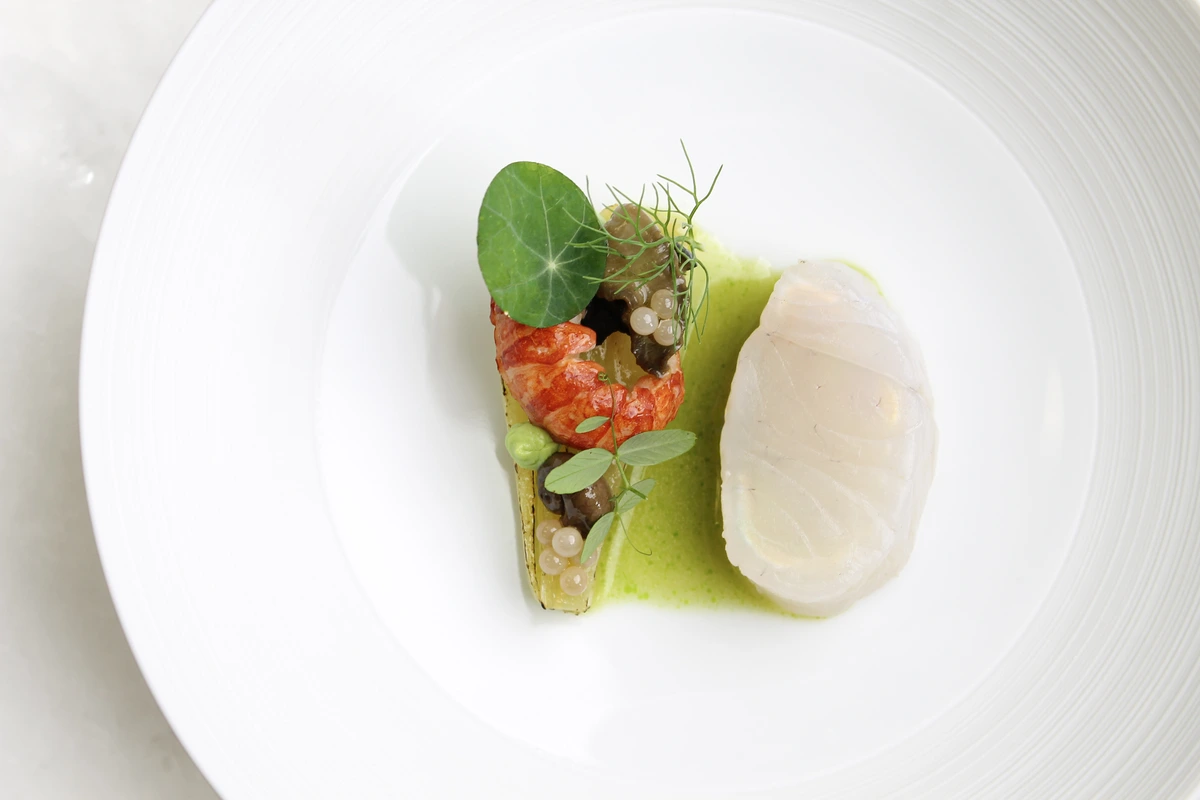 Photo Courtesy of Papilio
Further east, in the foothills of the Jeseníky mountains, is Olomouc, Czechia’s “Little Prague.” While this regional city lacks the capital’s grand theatrical beauty (though its astrological clock blessedly ticks away without crowds), it has a thriving regional food scene: tangy tvarůžky cheese, sweet Hanácké koláče pasteries, and smoky Hanácká kyselica. Entrée carries forward that regional association with a more refined edge, focusing on stripped-down recipes that, over six, seven, or nine courses, elevate nuanced flavours: sea buckthorn, yuzu, rabbit, sturgeon, and pork crackling. Entrée’s interior is striking, a hive of living foliage and sculptural lighting. Chef Přemek Forejt is well-known within Czechia, having competed in the country’s version of MasterChef in 2019.
 Photo Courtesy of La Villa
La Villa represents possibly the sharpest turn towards French cuisine in Czechia’s current dining scene. On the outskirts of Zlín (a functionalist city designed with practical intentions by industrialist Tomáš Bat’a and inseparable from his shoe empire), La Villa occupies an elegant manse built in 1941 for a Bat’a company executive, surrounded by greenery and birdsong and statuary from painter and sculptor Miloslav Chlupáč.
 Photo Courtesy of La Villa
There is a shifting identity to the restaurant, which swings between a relaxed bistro during the day, to an elegant fine-dining destination with artistic tasting menus and wine pairings inspired by French “art de vivre.” Regardless, the impression is of fine dining, and chef Július Löffler and his team invoke the French classics: Quiche Lorraine, Fois gras, Veal entrecôte, Vol-au-vent, Éclair, fruit tartlets, Paris-Brest. The wine club boasts an impressive array of international bottles. The French vintners at Hospices de Beaune produce a Pinot Noir especially for the restaurant, with the proceeds from that particular vintage donated to charity.
 Photo Courtesy of Essens
South Moravia provides a different atmosphere altogether. Vineyards spread across a landscape slung with rivers and lakes. The hills largely produce whites—commonly sweet pálavas and muscats and Rieslings, but there are also good, strong reds: Pinot Noirs, Frankovkas and Saint Laurent, that blend well with grilled meat. Set within the restored neoclassical Château de Frontiere, all pale stone and columns on the former border between Moravia and Austria, ESSENS restaurant leans into its winey surroundings, beginning its meal with a glass of premier champagne, and going on to provide the best pairings for each sumptuous dish of Pohořelice catfish, Périgord truffle, plums, and poppy. The menu at ESSENS is in constant flux, and is never published beforehand, and may never be the same twice. A bold move by Chef Otto Vašák, but freed by the constraints of consistency, the kitchen is able to focus on perfection.
 Photo Courtesy of Essens
Vašák delivered South Moravia’s first Michelin star, although the man could be called a horticulturist as much as a chef, meticulously tending a garden that delivers to ESSENS its vegetables and fruits. Indeed, far from being “the land that vegetables forgot,” as critic Anthony Bourdain dubbed Czechia, Vašák, along with these other chefs, has proved that the future of Czech cuisine has grown here all along.
Dining and Cooking