
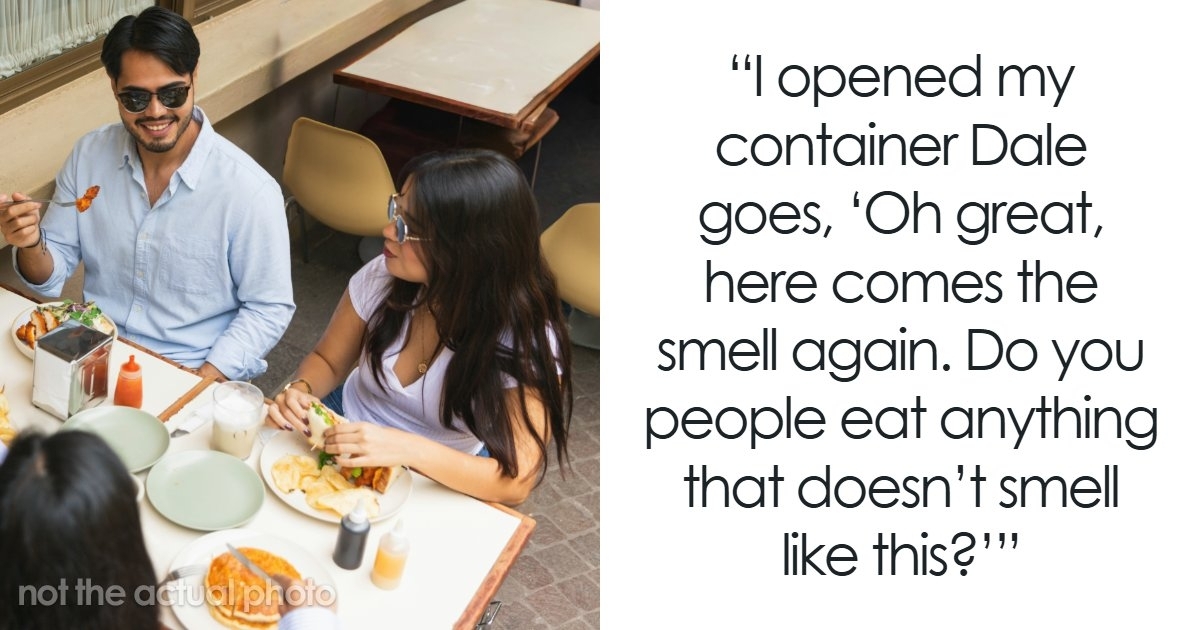
There are always some unspoken office rules, like don’t microwave fish or refill the water in the coffee machine. However, some folks can’t quite tell the difference between their very specific preferences and normal behavior.A woman turned to the internet for a second opinion after calling out her coworker for making unpleasant comments about her lunch for nearly a year. As it turns out his main objection was that it was Thai food and this somehow upset him. People online weighed in and later she shared what happened next.There are some norms one expects in an office
 Claudio Alba/Unsplash (not the actual photo)So one woman decided to say something after hearing constant comments about her lunch


 Vincent Y/Unsplash (not the actual photo)


 There are some ground rules at a workplaceEvery office runs on a rulebook nobody ever wrote down. Don’t microwave fish. Wash your own mug. Some of these are so widely shared that Global News opened a piece on lunch etiquette by calling the fish rule the first commandment of workplace manners, citing a survey of the worst smelling lunches. Curry made that list too, landing sixth, so Dale didn’t invent the idea that strong smells bother people. A separate survey of American workers found that 52 percent consider cooking fragrant food at the office offensive.
What turns a concern into an actual rule is how evenly it gets applied. A real etiquette standard covers everyone who breaks it, which is why the fish and egg eaters in that break room matter so much to this story. When the explanation for singling out one lunch is that the others are “normal,” the standard has quietly shifted from strong smells to unfamiliar smells. Those are two very different rules. Only the first is about the air in the room, while the second is about the person holding the container.
Etiquette also comes with a sequence, and advice drawn from that survey is to start with a polite word and involve a supervisor only if nothing changes. Most people never get even that far. A Canadian survey of office workers found that only 15 percent had spoken directly to the colleague they believed made a kitchen mistake, while others left notes, sent all staff emails, or said nothing at all. Against that backdrop, near daily commentary delivered in front of an audience sits at the far end of the spectrum. Headway/Unsplash (not the actual photo)But the man’s actions suggest he had other issuesThe “normal food” argument deserves a closer look, because it turns up far beyond break rooms. Immigrant kids have long been teased for lunches classmates called too ethnic, a pattern familiar enough to have its own name, the lunchbox moment. Atlas Obscura traces that experience back through decades of American school lunch history. The setting changes when people grow up, but the logic often stays similar: familiar means normal, and anything else needs an explanation. When “normal” quietly means “what I grew up eating,” a Thai lunch will fail the test every time, and it is fair to ask how much of that reaction is about the food and how much is about where the person eating it comes from.
Jokes have unwritten rules too. A joke usually works when the person on the receiving end can laugh as well, and when the speaker would make it about anyone else’s lunch. Once a punchline needs “you people,” the subject has moved from a smell to a group. Some experts say the phrase can be read as a bias comment even when it was meant as an innocent quip, and here it arrived after a long run of remarks aimed at one coworker’s cuisine. The same source cautions that not every clumsy remark is prejudice, which is fair. But a clumsy remark usually stops after the first awkward silence, and this one kept coming back.
There is also a point where habits stop being merely habits. The EEOC’s guidance says the law does not prohibit simple teasing or isolated incidents that are not very serious, but harassment becomes illegal when it is frequent or severe enough to create a hostile work environment, and derogatory remarks about someone’s national origin or ethnicity can count. Frequency is the important word there. One crack about a smell is an awkward moment. Comments at nearly every lunch, topped off with “you people,” read differently. Whether any workplace crosses that line depends on the details.
Rules can be stretched in the other direction too. Questioning a coworker repeatedly in front of colleagues departs from the usual custom of raising things privately first. It made one onlooker stop laughing, but it also handed Dale a story about a difficult colleague.
The healthiest version of any unwritten rule is one that could be posted on the fridge for everyone without embarrassment. If it only ever seems to apply to one person’s lunch, it was probably never about etiquette. A simple test works for most break room disputes. Would the comment be made about a tuna sandwich? If not, the smell may not be the real issue, and some readers will say what is left looks a lot like a bit of racism dressed up as etiquette.
 Ant Rozetsky/Unsplash (not the actual photo)She responded to some of the comments


 Most sided with her and a few suggested she escalate


 Some readers agreed with the coworker


 logan jeffrey/Unsplash (not the actual photo)Later, she came through with an update


 Curated Lifestyle/Unsplash (not the actual photo)


 She answered some more comments

 Netizens told her to report him


 Christina/Unsplash (not the actual photo)After reading the comments, she came back with another update


 People agreed with her actions


 Some readers also gave their own examples

 Want to make sense of complicated human dynamics? Visit our Family Dynamics Hub for expert-backed guides on toxic behavior, setting boundaries, and emotional healing.
Dining and Cooking