

The Local newsletter is your free, daily guide to life in Colorado. For locals, by locals.
The first time I heard the term “sober bar professional,” I thought it sounded like an oxymoron. No less than a veterinarian who’s allergic to animals or an airline pilot with acrophobia—or, to compare it to my own profession, a food writer who’s a picky eater—a bartender who doesn’t drink alcohol would seem to be at a considerable disadvantage when it comes to performing, well, the vast majority of the tasks the job entails, from building a balanced cocktail to selecting wine pairings for a tasting menu.
After recently meeting and interviewing four such folks in the Denver restaurant industry, however, I’m not so sure.

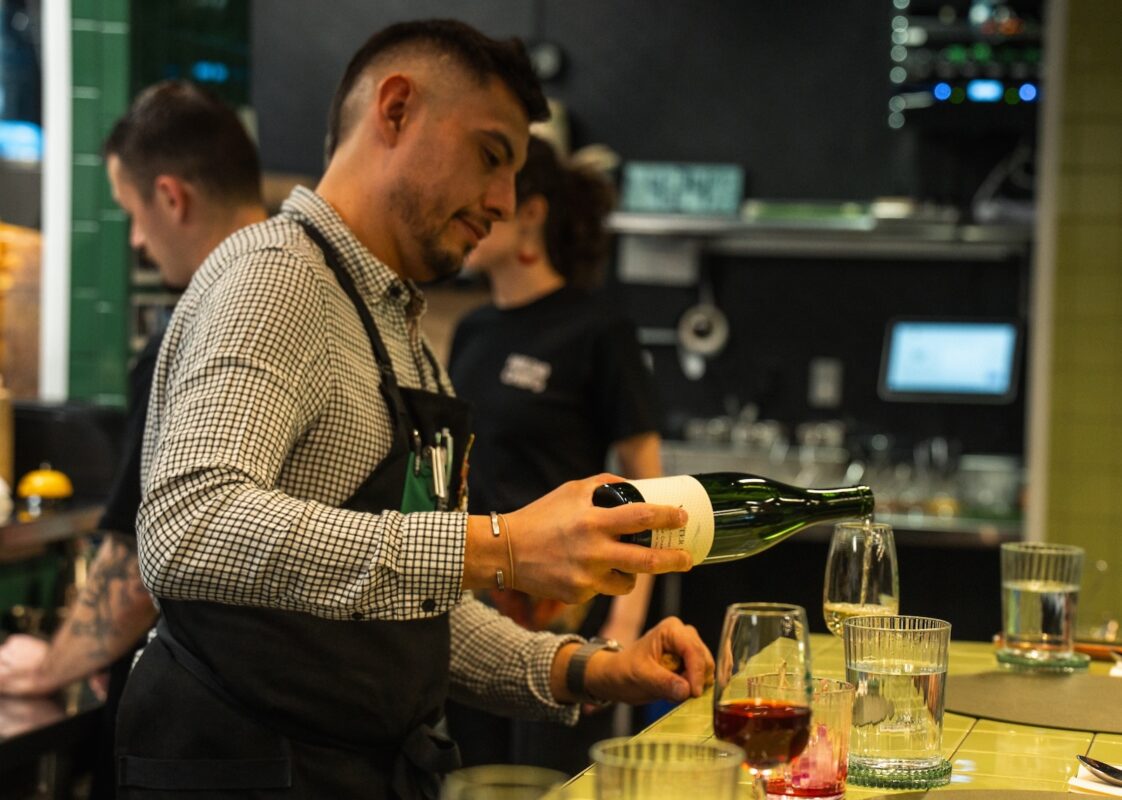
The idea for this story came to me over a recent dinner at Más Chido, the chef’s counter inside Molino Chido, where beverage director and assistant general manager Javier Portillo (who’s also the beverage director at Hop Alley) served as my jovial and highly knowledgeable wine pairing guide. My dining companion wasn’t partaking, which prompted Portillo to confide that he’d been sober for more than two years—adding that he thought his mixology techniques had improved as a result, because his ego was less invested in the feedback he received.
 Molino Chido beverage director Javier Portillo. Photo by Jeff Fierberg
The comment stuck with me, so I followed up to learn more. Portillo told me his sobriety began with what he called a hiatus from drinking to improve his mental health. “The initial challenge was not knowing how a cocktail would develop while you’re drinking it—sugar levels, acid levels, maybe it’s too spirit-forward, maybe there’s not enough booze,” he says.
Though experience had allowed him to “build a Rolodex of flavor profiles” in his head, he realized, sense memory alone wasn’t going to cut it. “The nose on wine and spirits is often very different than the actual palate,” he adds. “So I had to rely on my colleagues, and the most beautiful thing happened: I started seeing how talented the people around me were. I was able to trust others. And now, when a guest says, ‘This is one of the best cocktails I’ve ever had,’ it’s not only my reward, it’s a reward for everybody behind the bar.”
Yacht Club bartender Charley Zimmerman agrees. The industry veteran of 20 years says that her near decade of sobriety has only enhanced her “think-on-your-feet creativity” on the job. “I found that my ability to run programs and design menus and create cocktails increased tenfold—probably because I took a lot more care and attention than I used to,” she says. “It wasn’t so much about, What do I feel like drinking in this moment? but How do I create an experience for people to come in and enjoy?”
Sobriety also helped Zimmerman manage some of the less savory aspects of working in hospitality. “I would consider myself to be an alcoholic; I was definitely drinking on-shift,” she says of the life she left behind in small-town Maine. “And when you do that, you have a pretty short fuse. Your ability to handle stress and conflict is not very good—and customers can be problematic sometimes…. But learning how to respond to things versus react to things has been a big part of my sobriety: It’s much easier to deal with them when you have a clear head. It’s always a work in progress, but I have a lot more patience.”
 Improper City bartender Austin Hay. Photo courtesy of Improper City
Like Zimmerman, Improper City general manager Austin Hay is poignantly frank about his journey. His motivation to quit drinking about 18 months ago was becoming a parent, “but being behind the bar is a struggle,” he says. “Every day I am touching that bottle of whiskey, I want to pour myself a shot and shoot it back.”
What helps him maintain sobriety? For one thing, supportive co-workers. “My team backs me up every single day,” Hay says, by lending a hand through more challenging moments, like closing time. When they’re socializing off-duty, they’ll pour him a shot of Pathfinder, a zero-proof spirit alternative, so he doesn’t feel left out. Hay is also a fan of local producer Haykin Family Cider’s nonalcoholic sparkler: “It’s got the crisp Champagne notes that Martinelli’s will never have,” he says. “We use that to spruce up a lot of NA cocktails here.”
When I called up Peach Crease Club bar prep lead Michael Berry, he also told me that the recent boom in alcohol-free products has been a godsend. Although his 13-year commitment to sobriety is linked to a diagnosis of Type 1 diabetes, he admits that abstaining presents psychological obstacles even now. “The challenge for me still is fitting in,” he says. “Peach Crease is a dry house [meaning staff is not allowed to drink during shifts], but everybody likes to go out after work for drinks, and it’s hard sometimes.”
 Peach Crease Club bartender Michael Berry. Photo by Shawn Campbell
But thanks to the growing moderation movement and wider availability of interesting booze-free drinks, Berry now feels more comfortable joining them. “[I can] go out and try all the nonalcoholic cocktails and see how everybody’s being creative with them,” he says. “I love learning about everything.”
Such curiosity—not only about the tools of the trade, but also about the people who produce and consume them—is essential for a bar professional, and Portillo is no less enthusiastic about continuing his education than he was when he was drinking. “I always love chatting with people and always love talking shop,” he says. “There’s not a day that I don’t talk to somebody about a spirit or a cocktail or something I’m doing behind the bar that I don’t learn something.”
Zimmerman, for one, has learned that she can now have a taste of beverages that pique her curiosity without falling off the wagon. “I have no desire to get drunk anymore,” she says. “So I’ve been testing the waters to see how it feels for me to have a sip of sherry or vermouth—and not more than that. Everyone’s sobriety looks different, and it’s good for people to know that, while it’s a decision that I haven’t come to lightly, after nine years in therapy, it’s one I feel very comfortable with.”
By his own estimation, Hay may not be at that place yet—but the place he’s in is good. “I’ve never been more clear-minded. I’m able to run the business better and to have a better relationship with my son, my wife, and my friends, which has been awesome,” he says.
As for Berry, he’s using his experience to hone another vital bartending skill: listening to people’s problems and giving advice. “What makes me feel good is when I have co-workers or even guests come to me because I’m sober and ask for guidance,” Berry says. “Being able to share my insights with people and help them is a triumph for me.”
Do sober beverage pros face challenges, both logistical and psychological, on a daily basis? Absolutely. But as a result, they have acquired new skills and developed new coping mechanisms that make them perhaps even better suited to their chosen careers than when they imbibed—which is a triumph for the Denver drinking scene as a whole.
Read More: 15 of the Best Places to Order Mocktails and Low-ABV Drinks in Denver

Dining and Cooking