

 Janz Van folds over an empanada in the kitchen at Townline Luxury Lanes and MIXX 360 in Malden. (Jesse Costa/WBUR)
Janz Van of Janz Kitchen didn’t know that selling her homemade empanadas was illegal — until she heard from the City of Malden Inspectional Services Department.
“ I saw a lot of people, they’re selling it on Marketplace. So I just thought that I can do it,” said Van.
Traducido en español por El Planeta, Boston’s Latino daily.
A quick search on Facebook Marketplace for empanadas reveals hundreds of home chefs across Greater Boston.
However, the majority of these chefs are operating outside of Massachusetts home kitchens laws. Food that includes meat, dairy or requires time or temperature controls for safety — like Van’s meat-filled Ilocos empanadas — are not permitted to be sold from residential kitchens.
Low-risk foods like baked goods and jams can be sold, though it’s up to each city and town to adopt these licenses. Several cities like Boston and Cambridge adopted ordinances around the pandemic. Malden does not allow the sale of any food from residential kitchens.
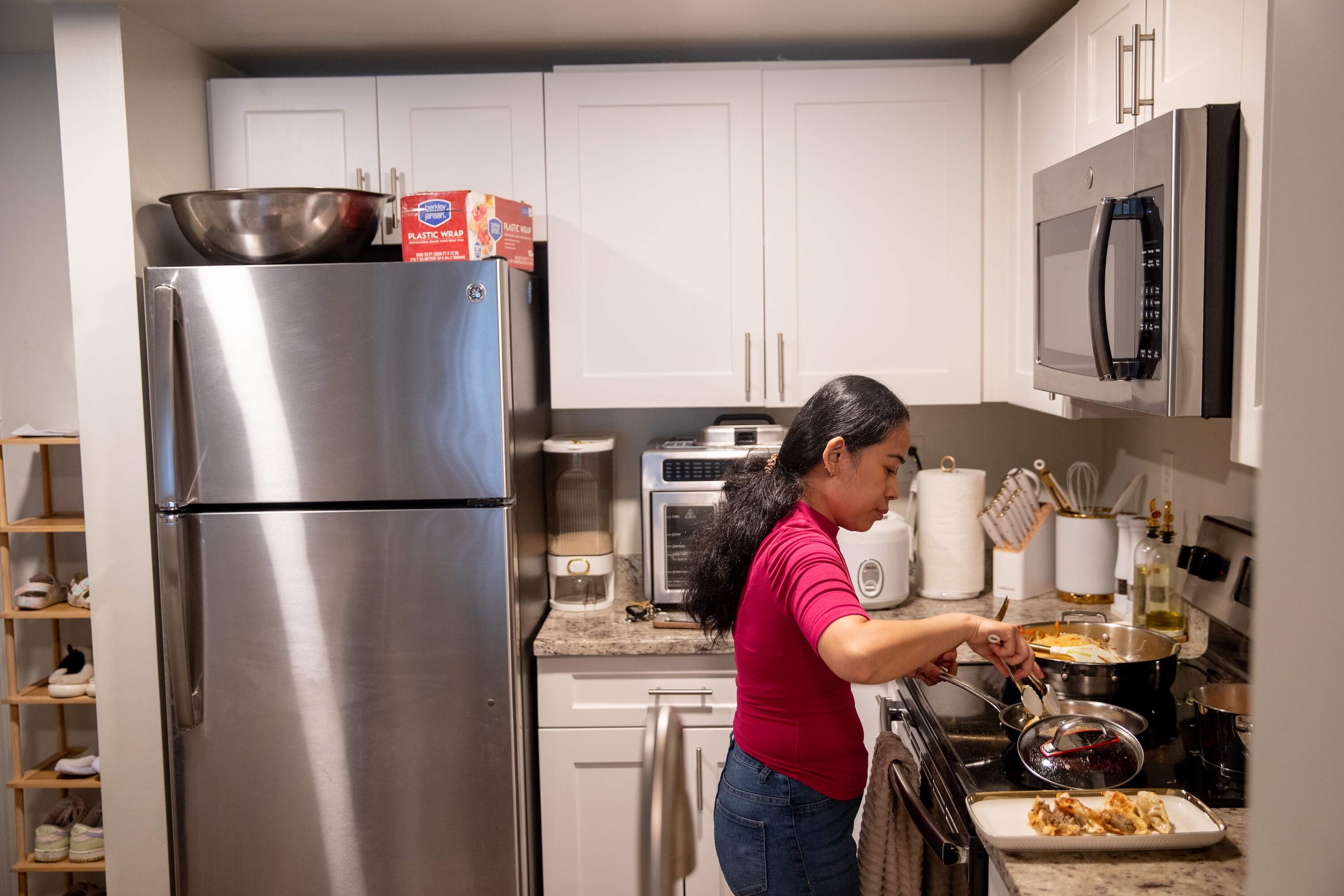 Janz Van prepares dinner for her daughter at her apartment kitchen in Malden. Van cooked and sold her made-to-order Ilocos empanadas from a previous apartment kitchen before she was forced to cease operations by the Malden Inspectional Services Department. Massachusetts doesn’t have a permitting process for perishable foods sold from residential kitchens. (Artemisia Luk/WBUR)
“Massachusetts often is on the side of ‘let’s be really strict on the regulatory side,’” said Emily Broad Leib, director of the Food Law and Policy Clinic at Harvard Law School, who has worked on home kitchen legislation across several states.
Every state lets chefs produce cottage foods in their home with varying degrees of oversight, and a growing number of states also allow perishable dishes, including California, Wyoming and Arizona.
“In every single state that’s allowed this, no state has gone backwards,” said Leib. “The value is being made clear to them, whether that’s more money circulating in the local economies, more people employed and able to pay for other things.”
In March Janz Van needed extra money to pay the security deposit of her next apartment. As a newly single mom with a four-year-old, and a family to support in the Phillipines, Van’s job as a hotel line cook in the Seaport wasn’t generating enough income.
Van, who is originally from the Philippines, noticed that Filipino Ilocos empanadas and their distinct orange shell were becoming popular on social media but hard to come by around Boston. She decided to advertise her empanadas on Facebook Marketplace and Tiktok.
Her instinct was correct. By April, she was making nearly 150 made-to-order empanadas a day on spare Fridays and Saturdays.
“They’re unreal, according to social media,” said food influencer Mark Lewis in a video review of Van’s empanadas. The video amassed more than 300,000 views.
But with more success, also came more attention — including from the Massachusetts Department of Public Health Food Protection Program, which alerted the Malden Inspectional Services Department. Van was forced to cease operations.
Van is in the minority. Local inspectional departments seem to be responding to one-off complaints, rather than seeking out violations themselves.
Since 2023, the Boston Inspectional Services Department has identified only three residential kitchen violations.
“Typically the department is notified of possible violators via anonymous calls, emails or submissions through 311,” said Lisa Timberlake, spokesperson of the Boston Inspectional Services Department. She says that staff occasionally initiate inspections after happening upon a menu posted on social media.
 Lisa Tran opens a container of emapanadas she ordered and traveled from Weymouth to pick up at Townline Luxury Lanes in Malden. (Jesse Costa/WBUR)
Lisa Tran of Weymouth, one of Van’s customers, regularly buys local Vietnamese food through Facebook Marketplace and community groups.
“ They sell really hard-to-make food,” said Tran. “Or it takes long hours to make. I definitely would prefer to support these folks.”
The motivations of home chefs vary widely; it’s a way to share homemade cultural foods harder to find in restaurants, a means to make ends meet, a creative endeavor and a low-barrier path to establishing a business.
Jermaine McNeill is an underground home chef who launched All Forked Up Catering from his kitchen in 2017 in order to supplement his income. He received a business license in 2019. He works as a housing inspector for the City of Boston and lives in Dorchester.
“Where I live in Massachusetts, it’s not enough for me to survive on simply my job paycheck,” he said. “So I have to have other streams of income.”
McNeill said he earns around $500 to $1,000 each month through his Caribbean-inspired dishes. Clients find him through word of mouth and social media.
He has looked into legal pathways such as renting commissary kitchens, but says that the “pickings are very slim.”
“In Boston, you have to be affiliated with CommonWealth Kitchen,” he said, referring to the incubator and shared kitchen space in Dorchester. “You have to be affiliated with a church, if you’re lucky enough, a friend who owns a restaurant that doesn’t mind sharing their kitchen space with you.”
 Korean Momma customers open their ube cheesecake outside Shojo Cambridge in May. Without a brick-and-mortar location, the business has a pop-up model—customers preorder cheesecakes online and pick up their cheesecake at designated locations. (Artemisia Luk/WBUR)
Korean Momma owners Duly Lee and Su Jean Park found local commissary kitchen options to be expensive for their part-time schedule. After quietly selling their cheesecakes from an apartment in Cambridge, they felt lucky to find an affordable commercial kitchen space through a community member, totaling around $1,000 to $2000 per month.
“The rental rate is far below market than any other commissary kitchen,” said Lee. They are now entertaining brick-and-mortar options.
Van experienced a similar stroke of luck after word of her shutdown spread. The owners of MIXX360 Nightlife in Malden offered Van free use of a commercial kitchen in their bowling alley basement. Van made empanadas for the bowling alley customers and her online customers through June.
 A video screen promoting “Malden’s Viral Empanadas” with a photograph of Janz Van on the Townline Luxury Lanes sign on Broadway. (Jesse Costa/WBUR)
 Janz Van, rear, and her stepdaughter Sreypech Tham churn out empanadas in the bowling alley kitchen. (Jesse Costa/WBUR)
Soon after, the owner of Stock Pot Malden, a commissary kitchen, read about Van’s story and offered her part-time kitchen space for their lowest rate, $1,000 a month. She’ll resume her business there starting September.
But most home chefs don’t have the same community support as Van.
In 2022, Melvin Johnson, an Attleboro home chef who sold meals for keto diets, researched food laws in states like California and wanted to expand opportunities for home chefs in Massachusetts.
Johnson reached out to state Sen. Bill Driscoll. And Driscoll proposed a bill that would issue home kitchen licenses for ready-to-eat foods sold on online marketplaces, like Van’s empanadas. It would task the state’s Department of Public Health with regulation and funding.
The bill will be refiled in January 2027, and the next public hearing will be held next year.
“ I think it just still raises questions,” said Driscoll. “We still need to do some more educating and advocating around how it would work and the benefits of it…But if enough people raise their voice in support of it, it gets that much closer.”
 Janz Van holds her four-year-old daughter as she falls asleep in Van’s arms on Monday, Aug. 17, 2026. From 5 a.m. to 2 p.m., Van works as a hotel line cook in the Seaport, while her daughter is cared for by Van’s ex-husband, who works at night. (Artemisia Luk/WBUR)
If the bill passes, Van said she’d opt to cook and sell her empanadas from home. She said it would save time and money, and she wouldn’t have to share kitchen space. It also offers more flexibility than her other side hustles, like cleaning and babysitting in Back Bay.
“ I can spend time with my kid,” she said.
In the meantime, Van is making do without her home kitchen.
And Massachusetts chefs are continuing to promote their homemade meals — just enough to avoid the wrong attention.
Dining and Cooking