

Rénald Exume, 54, is originally from the Artibonite region in central Haiti. Now, he lives in Salida, working as a handyman, selling Haitian food from home, studying for his high school diploma and learning the welding trade.
To his knowledge, he’s the only Haitian guy in town.
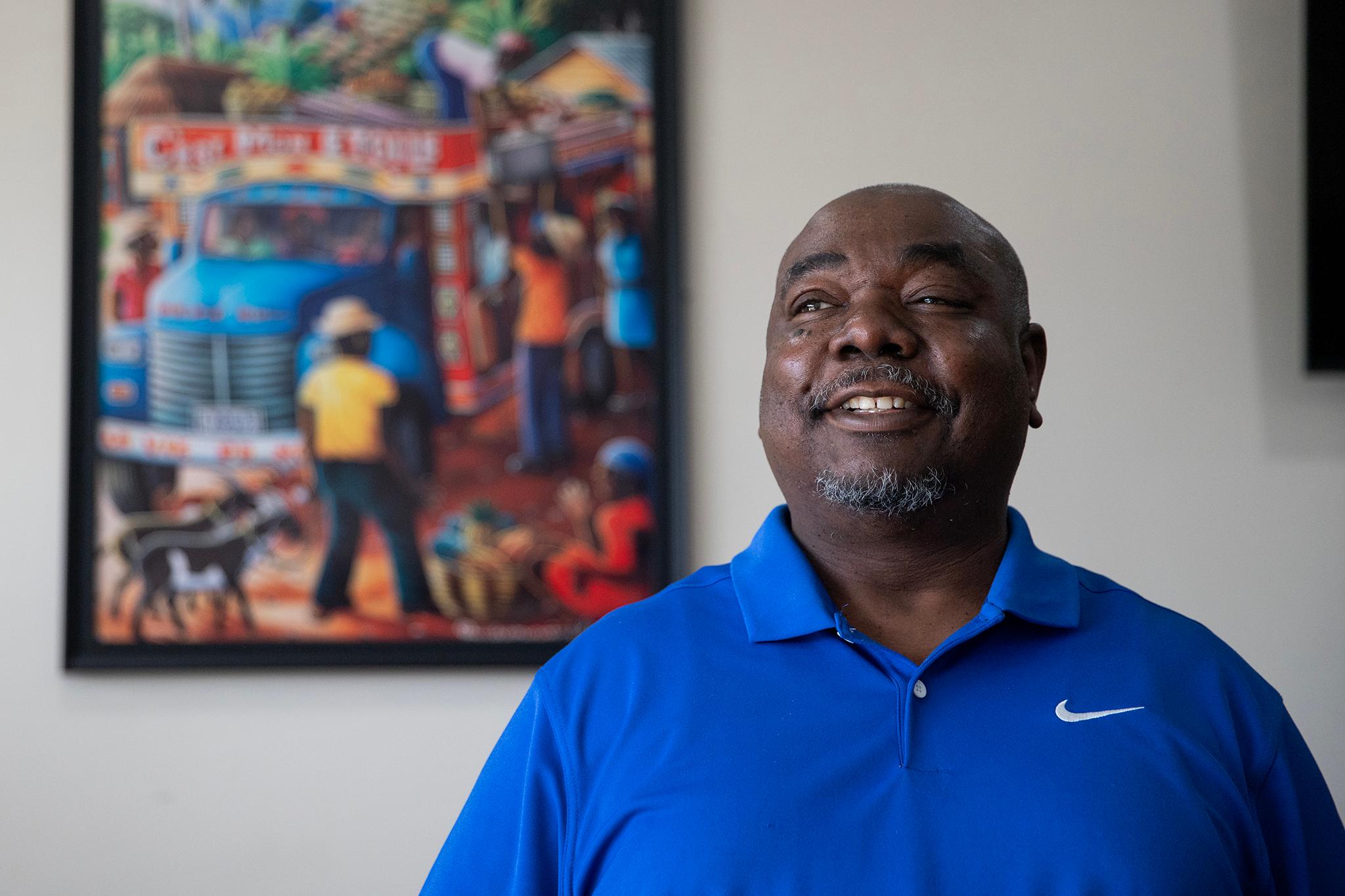
Sitting at a table with his wife Sarah Green at Mama Josie Cafe Creole in South Aurora recently after handling some business in the Denver metro, he is singing along to some Haitian music playing in the small, tidy dining room. It’s their third trip to the restaurant and he’s tucking into a platter of Haitian vegetables cooked with bones, rice and plantains.
“I feel like I’m in Haiti,” he said, sliding his head back in reverie of his country 2,400 miles from Colorado, one of approximately six in the world that shares an island with another governed country or region – in Haiti’s case, the Dominican Republic.
Besides a stereo playing Haitian music, there are fake tropical plants like those seen in Haiti, some distinctive Haitian artwork of brightly colored figures using Haiti’s public transportation system of buses called tap-taps, and vivid blue paint on the walls.
Exume and Green are some of the people who make Mama Josie’s a regular stop once they discover it. It’s owned by Josie and Emmanuel Jean, a Haitian 50-plus couple who decided to give restaurant-running a try, finding a sunny space with a wall of windows in a retail mini-strip on South Chambers Street near Quincy Ave.
About this series
To discover origin stories, influences, plans, signature dishes and highlights of some lesser-known gastronomic cuisines in the foodie wonderland of Aurora, CPR News spent a few months trolling dozens of restaurants, both on and off South Havana Street, and their menus, to identify a few serving cuisine from smaller countries not commonly known for their gastronomy.
We visited places whose cuisines are unique – Uruguayan, Aztec Mexican, Haitian, Syrian and Sudanese – to find out more about flavors, ingredients and influences on cuisines from those parts of the world. We will share stories stemming from these restaurants, most of them small, easy to miss, existing under the radar, with limited promotional budgets, and packed with juicy bites and stories from their respective homes.
Haitian specialties adapted for Colorado
Specialities at Mama Josie include skin-on or skin-off goat meat with a rub of Caribbean spices, kalalou (okra marinated with roasted red pepper), and lalo, which is meal of jute leaves mixed with spinach and stewed with meat bones.
Finding jute leaves is easy in Haiti, particularly in Exume’s region in Haiti’s Central Plateau, but in Colorado, not so much. So the Jeans find the dark green, sturdy leaves with a rustic pop of flavor in Asian grocery stores around Aurora and Denver.
Getting baby goats for some dishes has become difficult after a store in Greeley was impacted amidst strikes at the meatpacking plant there.
 McKenzie Lange/CPR NewsOwner Emmanuel Jean smiles for a portrait at Mama Josie Cafe Creole in Aurora on May 12, 2026.
“We cannot have it to order because the store they have in Greeley, they close it down,” said Emmanuel Jean, whose wife is the Mama Josie for whom the eatery is named.
Besides goat and the lalo, which he says is the restaurant’s most popular offering, they serve Haiti’s own version of beans and rice, most often red, black, white or Miami beans served like a double-thick soup over white or black rice. There’s also a hibiscus juice, cod fish patty, a handful of desserts and a super-sweet sparkly soda imported from Haiti called champagne.
Getting started
During a recent visit, co-owner Emmanuel Jean fell into easy conversation. He said he left Haiti in 1999. He came to Colorado after his brother, who was living in Canada, suggested he try out life in America. His brother wanted some company, since he didn’t have any family there. Rather than him going to Canada, they met half-way, and now both live in Colorado.
“When I come here, I fall in love with Colorado,” Jean said, sitting at a table doing some paperwork one afternoon between peak serving times. “So when you look at the mountain, every morning when I wake up, I see the mountain. I feel like home. I say, ‘Wow, I love this place.’”
Having studied food science in the South American country of Colombia, Jean became a food inspector. Now working for the USDA, he visits different plants, like the one in Greeley, to conduct inspections. Nearly two years ago, his wife Josie, who works full-time as an overnight nurse, wanted to open a restaurant. He decided to promote her dream while taking a back seat. “I help my wife,” he said. “Setting up, stuff like that. That’s what I help her with.”
Mama Josie, who sent her husband in her place for a scheduled interview, said hi over the phone but had a lot of things going on: Besides running the restaurant, she catches up on sleep after working as a nurse, and they have two daughters starting their careers in health science and social work in Colorado.
When Jean called her on the phone, risking waking her up, she answered right away and said she’s glad she took the chance. Mama Josie became known for her catering, which is what led to them deciding to roll the dice on running a brick and mortar restaurant.
The idea stemmed from other people requesting she cook for them at events.
“I have some friends and family who used to ask me to be like a pastry chef, sometimes cook when they have a party at church, and then I say, ‘OK, let me extend to the public,’” she said.
They say business has been OK, but it took a hit when some Haitian customers working in Colorado – some at the plant in Greeley – lost their jobs and had to leave the area.
“A lot of them, with the political thing, lost their work permit, stuff like that. Some of them move back,” Jean said.
Outside of Haitian transplants, like Exume whose home is three hours away, other repeat customers are Americans who have worked, volunteered or spent time in Haiti.
“There’s one, who live in Trinidad and every month, she come here. She was an American missionary,” Jean said. Once she got familiar with Haitian food, she wanted to keep eating it but could not find it closer to home.
“This lady, she live in Wyoming,” Jean said of another regular. “She come almost every Sunday to get the Soup Joumou.”
 McKenzie Lange/CPR NewsA plate of rice with beans, chicken in sauce and plantains at Mama Josies Cafe Creole in Aurora on May 12, 2026.
Soup Joumou, a pumpkin soup with an orange broth and chunky root vegetables often eaten to celebrate New Year’s Day, is one of the foods prepared ahead of time, then served from behind a counter, cafe-style.
Pre-preparation in Haitian cuisine is often needed because many recipes involve a complex set of spices. Some foods are marinated in epis, a Haitian-created seasoning paste with oil, peppers, thyme, parsley and garlic. Other meals require multiple cooking cycles, such as hot plantains that are sliced, fried, smashed flat, salted generously, then fried again.
What makes Haiti’s plantain different, as served at Mama Josie, is the hot, thick, discs are eaten dressed with pikliz, a spicy sauce of green cabbage, carrots and vinegar (similar to kimchi, but with more finely grated cabbage). To eat the plantain Haitian-style means you pile the pikliz on top of the plantain, then slide the hot-cold combination into your mouth before any of the cabbage slices fall off.
Because of the length of time needed in preparing some Haitian foods, they don’t offer the same options every day. The menu notes the days various dishes are available, a practice common in other Haitian restaurants in cities like Boston, Brooklyn and Miami where there are large Haitian immigrant communities.
Exume, at his home in Salida, does something similar: To keep connected to his roots and make some extra money, he prepares Haitian foods on selected days. Then he and Green send out an email to their customer base.
“One of the ways is earning a little income, we’ve done Haitian food Mondays,” Green said. “He just cooks a bunch of Haitian foods from the house and people put in orders and just come to the house. They bring their containers and they fill up everything.”
Customers show up with their own take-out containers and decide how much they want. The price is then set based on the personal quantity requested. That’s how food is sold on the streets of Haiti from vendors who fry it on the spot and sell it from tables at busy intersections, which Exume calls “our Haitian fast food.”
One of the items he sells is called akra, a fritter made of grated malanga root and then stuffed.
“You have to grind and then mix with a little white flour, then put it in oil to fry it, and you can mix it with meat like chicken, goat, the cow, whatever,” he said.
For both the Jeans and Exume, food preparation and consumption is a key part of their days, keeping them tied to their home country, which is now in crisis.
Haiti at a glance
The first Black country in the world to overthrow its colonizers, it has since operated on economic life support as the poorest country in the Western hemisphere, a circumstance often described as an outcome of economic warfare from France in retaliation for the self-liberation of the tiny country of about 12 million.
Political and gang strife, coupled with poverty and a 7.5 magnitude earthquake 16 years ago that killed about a quarter million people, has caused many to flee, with some receiving temporary protective status in the U.S., a safeguard now in jeopardy under the Trump administration.
It has left people like Exume in a state of perpetual, low-grade stress that shows up on his face and in his voice when he talks about Haiti. A few months ago, an attack by a gang in his home in Haiti’s central plateau left thousands displaced and between a dozen and 70 people dead, based on varying reports. The attack occurred in a region where not many job options are available.
“The most, biggest wish they would like to find a job and then to make some money and then to get back and do something … then they can hire people … that’s the dream of most Haitians,” said Exume.
At one point Green, who said they got married recently in a courthouse and are still finalizing all of their paperwork, took his elbow and asked, “Are you OK?” as his face visually contorted, reminiscing. Green, his wife of one year, is a social worker who has spent time on the island – working with Haitians who labored in the Dominican Republic’s sugar canes – and is currently learning Haitian Kreyol.
But being in the restaurant gives the couple a bit of space from thinking about challenges faced by Haitians. He sings along with some of the music that’s playing from speakers in the dining room. For him, it appears that being in the restaurant allows challenges for Haitians, both on the island and in the diaspora, to momentarily quiet.
 McKenzie Lange/CPR NewsChef Jameson Casimir prepares a plate at Mama Josies Cafe Creole in Aurora on May 12, 2026.
It’s all part of the goals of the restaurant owners. Jean, who organizes a Haitian picnic some summers in Aurora’s Del Mar Park, said he always makes conversation with diners, those there for the first time, or those, like Exume and Green, who travel hours and come repeatedly.
“Of course, when somebody come here, we make them feel at home, because our goal is to make people feel good.,” he said.
That’s especially important now, he said, because some Haitian people who are in the U.S. now, depending on their document status, cannot travel back and forth freely. “So,” said Jean, gesturing around the room at the Haitian paintings and fake plants while Haitian music plays from two speakers: ‘I tell people who cannot travel to Haiti – we got the palm tree, we got the banana trees, and then we got those paintings … we bring a piece of Haiti here for you.”
Dining and Cooking