
Digital subscribers can listen to this article.
Subscribe today for unlimited access to Texas Monthly. Already a subscriber? Log in.
In 2018, Elemi, a small restaurant in downtown El Paso, revolutionized Mexican food in Texas. It built itself on a foundation of using local ingredients, such as beef from New Mexico and produce from across the region, and nixtamalizing heirloom corn from across the border. Owner-chef Emiliano Marentes and his wife and co-owner, Kristal Marentes, juxtaposed ancestral Mexican food with creativity: Take, for example, the duck al pastor taco, gauzy curtains of chicharrón de pescado (crispy fish skin) nestled in dark blue corn tortillas, and deep red rabbit pibil with charred edges. The dining room required reservations for its handful of tables, while the bar was first come, first served. Elemi quickly placed itself among the best Mexican restaurants in the U.S.
In 2024, the Marenteses relocated Elemi to Horizon City, just outside El Paso, to get a bit more space. In the new building, they could use bigger nixtamalization tanks and a full-size molino (located below a portrait of revolutionary general Emiliano Zapata) rather than a five-gallon pot and a countertop mill in a closet-size kitchen. They decided to take walk-ins only. The menu exploded with new options, including a refreshing and eye-catching appetizer of swirled garlands of thinly sliced cucumber soaked in lime juice and chile de árbol oil and sprinkled with a salt made with chicatanas (edible Mexican ants). The bar options grew too. The stress of the new space bore down on the Marenteses’ shoulders, but Elemi kept to its high standards and continued to earn accolades, including a second semifinalist nod from the James Beard Awards.
This past January, Elemi got a little sister, Taquería Elemi, a casual restaurant whose tacos are rooted in Mexican street culture. On my visits during its first month, standout menu items included the chorizo verde huarache appetizer, vibrant and pungent with green chiles, cilantro, and oregano, and the birria de setas (mushrooms) taco, served alongside a peppy chile-cascabel-and-mushroom broth. It was a pleasant reminder that birria doesn’t necessarily need to be made with meat. The tortillas were thin—similar to the ones preferred by taquerias across Mexico—and made from a specific “street taco” masa harina produced by Los Angeles–based Masienda. The paper plates on which the tacos were served were thick. It was clear the Marenteses and the taqueria’s head chef, Angel Castañeda, weren’t messing around. In May, I named it one of the 25 best new taco joints in Texas.
Then, on August 13, The New York Times named Taquería Elemi one of the 41 best Mexican restaurants in the country, admitting what Texas Monthly readers and El Pasoans have known all along: “El Paso has long been one of the country’s great taco towns.” I popped into the taqueria in late August to see how the restaurant had developed since my initial visit and its rise in national profile under the leadership of Castañeda.
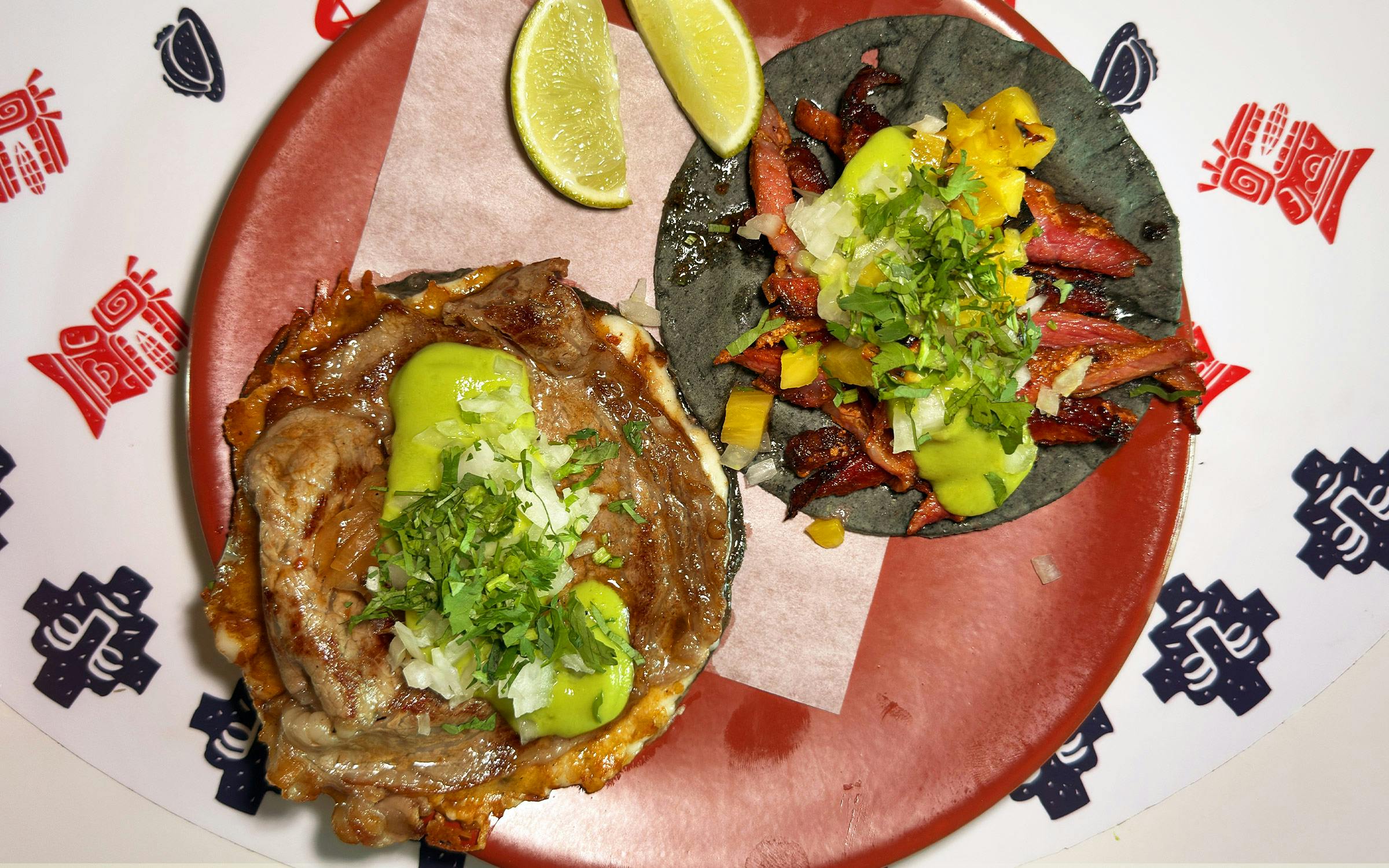
I arrived for lunch and saw the trompo fired up and its meat ready to be sliced. I was surprised, since trompo tacos are traditionally an evening and late-night snack. When I ordered the al pastor taco, the meat rested on a thicker nixtamalized tortilla, like the one at Elemi. Bits of pineapple and a smooth salsa verde—as thin as satin and as pungent as a garden—were capped by a flurry of chopped cilantro. The paper plate was gone, substituted with a ceramic dish. “The guys [Castañeda, along with taqueros David Flores and Brandon Peña] wanted plates, so moved to using plates,” Emiliano told me. It’s just one of the tweaks he and his team have made.
 A selection of tacos fromTaqueria Elemi from early this year.Photograph by José R. Ralat
The pieces of pork were thick and arched, cut from the knobby, cascading edges of the meat on the trompo and charred from a pit stop on the griddle. The taco was still juicy and great, but nothing like the taco al pastor Taquería Elemi initially offered. Originally, the meat was sliced in long, lacquered strands and served on a thinner tortilla.
“When we barely started, it was kind of complicated to just get the actual shape and the actual thickness of the meat [right],” Castañeda says. “Even the marination process, it was kind of complicated because you don’t want to overdo it.” He was concerned about oversalting the meat and giving it a harsh flavor. At the time, he and his team used frozen pork shoulder, believing it to be easier to work with, but that didn’t last long.
After a sales boost from the World Cup (customers watching games at the Tin Man bar next door filled up on Taquería Elemi’s tacos) and the New York Times mention, the taqueros needed to cook the meat on the trompo faster to meet demand. So they ditched the frozen meat to work with fully thawed pork shoulder. It’s sliced thick, marinated, stacked on the espada (the vertical shaft of the trompo), and left to sit overnight. This method allows juices from the pork and looser parts of the adobo (marinade) to slide down, covering every patch of meat and offering customers an extra punch of flavor. On weekdays, the meat on the trompo weighs about thirty to forty pounds. But on the weekends, when the restaurant expects to serve more customers, the cooks stack the trompo with an amount nearly twice as heavy.
On my most recent visit, I also tried the ribeye taco, an homage to the cachetada, invented at Tacos Atarantados in Monterrey. The meat was a thin, curved slice of beef that curled at one edge, and the costra, made from quesillo, was dark brown in spots from the griddle. It glistened like a beacon for a consummate taco aficionado.
The sheen from the beef and cheese hinted at a healthy amount of grasa. In Spanish, “grasa” means “grease” or “fat,” but it doesn’t have the stomach-churning connotations it does in English. Rather, it’s somewhere between juice and a delicate layer of liquid fat that acts like a protective shield. Grasa keeps the flavors locked in, the taco hot, and the meat succulent. It also increases the joy a great taco imparts to the diner. It shouldn’t overwhelm the palate or leave a weight in one’s gut.
Castañeda watches for customers’ reactions as they eat his tacos, like any good taquero does. “The thing that gives me more satisfaction with everything now is the faces of the people when they see that a taco is not that simple,” he says. “People understand the culture of the taco.”
He’s thoughtful, and he takes precise care with the specials, such as the taco de reliquia. Its name references a Mexican feast organized and hosted by families, often in northern Mexican states, to honor a saint who blessed them with a favor. In Castañeda’s father’s hometown, outside Torreón, the festivities venerated Saint Jude, the patron saint of lost causes.
They celebrated with potlucks, which were full of traditional northern guisados, such as asado de puerco, rice dishes, and fideo. Castañeda’s favorite was the asado de puerco, which he replicates for his taco de reliquia, which is also filled with fideo and refried beans. “That’s what I am,” he says. “I am the beans that my mom made. I’m my grandma’s asado. I am also the fideo.”
The taco de reliquia is an embrace of his calling. Castañeda started working in fine-dining kitchens and only became a taquero when he needed a job. The Marenteses hired him to work at the original downtown location of Elemi. “Even though I wanted to be something else, even though I tried to grow as a cook and as a chef, this is what represents me,” he explains. It seems like it was the right move. In September the taco shop landed on another list, the Times’ prestigious fifty best restaurants in America. Luckily for us and for Taqueria Elemi, Castañeda has turned out to be one damn fine taquero.
Taqueria Elemi
7729 Paseo del Norte, El Paso
Hours: Sunday 12–9, Tuesday–Saturday 12–10
Phone: No phone
Read Next
Dining and Cooking