
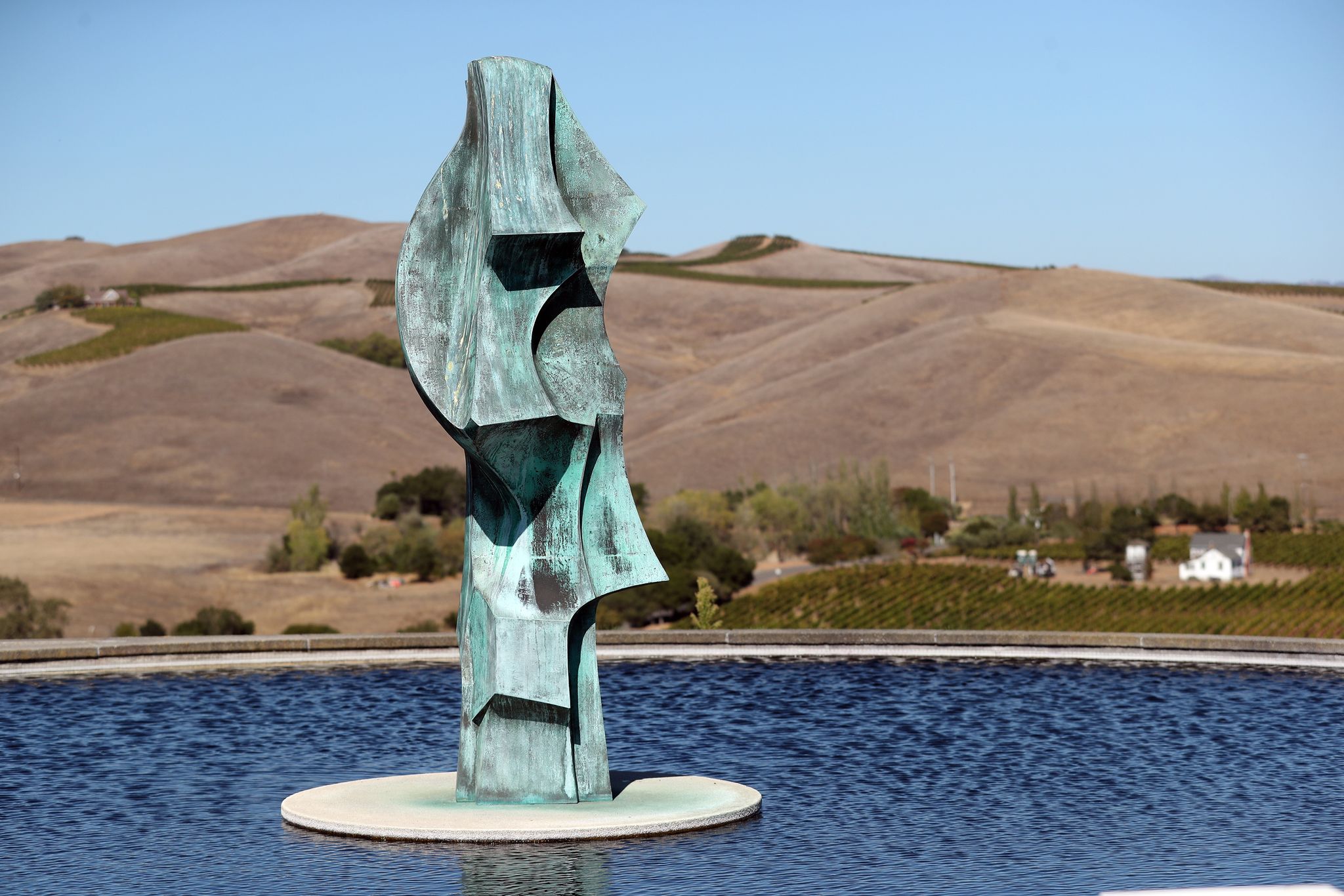
Artesa Winery, pictured in 2020, is now Artesa Estate under the new ownership of the prolific California vintner Jean-Charles Boisset.
Scott Strazzante/The Chronicle
Jean-Charles Boisset — the owner of Napa Valley’s Raymond Vineyards, Elizabeth Spencer Winery and the Oakville Grocery, as well as Sonoma County’s Buena Vista and DeLoach, and others — just made one of his most noteworthy purchases yet.
The Frenchman, known for his extravagant design style, has acquired one of California’s most architecturally striking estates: Napa’s Artesa Winery. Founded in 1991 by Spain’s oldest wine company, Raventós Codorníu, Artesa — located in Carneros, Napa’s coolest and southernmost wine region — is also one of just a handful of Napa wineries producing Spanish varietals like Albariño and Tempranillo.
Boisset told the Chronicle that he courted Raventós Codorníu for 13 years and even traveled to Spain multiple times to make the deal. In a press release, Boisset credited his “Burgundian sensibilities” and upbringing among the grand cru vineyards of Burgundy’s Côte de Nuits with drawing him to Carneros, where Pinot Noir and Chardonnay likewise thrive. It’s his first winery in the sub-region. “We’ve been talking for years. They knew we wanted it,” Boisset told the Chronicle regarding his pursuit of Artesa, emphasizing that this was not “a distress sale.”
Article continues below this ad
Jean-Charles Boisset said he courted the winery’s owners for 13 years before finally getting the chance to purchase it.
Provided by Alexander Rubin/Artesa Estate
The acquisition included the 350-acre Carneros property, along with 155 acres of vineyards in Carneros and the Mt. Veeder region. A purchase price was not disclosed. As of Wednesday, Artesa Winery is now Artesa Estate, where visitors can taste the existing Artesa inventory (mainly Chardonnay, Pinot Noir and the Spanish wines) alongside sparkling wines from Boisset’s JCB Collection brand.
“Artesa has played a significant role in the history of Raventós Codorníu, and it is one of the most successful wineries in our portfolio,” Sergio Fuster, CEO of the Raventós Codorníu Group, said in the press release. “We are convinced that Boisset is the ideal custodian to guide the winery through its next phase of development.”
The winery is best known for its avant-garde architecture that blends into the Wine Country landscape. When guests arrive at Artesa, they walk up several flights of stairs, passing fountains as they go. Finally, they arrive at a grassy plateau featuring an enormous cerulean pool with even more fountains and a striking sculpture created by Napa artist Gordon Huether. The winery, designed by renowned Barcelona architect Domingo Triay, is like a bunker built into a hill. Except for the entrance and a pyramid of windows, the exterior is mostly cloaked in native grass that helps regulate the building’s temperature. The estate also boasts 360-degree views — of vineyards, mountains, the San Pablo Bay and, on a clear day, San Francisco — which Boisset described in the release as “a natural amphitheater at the gateway to Napa Valley.”
Artesa is one of California’s most architecturally striking wineries.
Scott Strazzante/The Chronicle
Artesa was one of the only Napa wineries featured prominently in the 2019 Netflix comedy “Wine Country,” starring Amy Poehler, Tina Fey and Maya Rudolph. The winery is the backdrop for one of the film’s funniest scenes, in which, when asked what a particular wine is called, Poehler states, matter-of-factly, “white wine.”
Article continues below this ad
When Raventós Codorníu purchased the estate, it was originally named Codorníu Napa and focused on sparkling wines. Years later, the company rebranded to Artesa, switching its emphasis to premium still wines. Boisset plans to return to the winery’s early days. He told the Chronicle that Artesa Estate will be a place for “insane sparkling wine” — Carneros’ specialty — though it will also continue to produce Spanish wines and cooler-climate expressions of Bordeaux varieties, like Cabernet Sauvignon and Cabernet Franc, which are not typically associated with the breezy Carneros.
Artesa will also become an even “greater art destination” than it already is, Boisset said, which he believes will in turn attract new generations to wine. “Wine will remain its heart, with artistic expression and sensory experiences offering new ways to discover the estate and its terroir,” the press release said.
Boisset said he hopes the purchase will symbolize his commitment to California wine despite the industry’s ongoing challenges. Napa’s most prolific vintner has not been entirely immune to the downturn, though. At the end of last year, he closed two tasting rooms: Chateau Buena Vista in downtown Napa and the JCB Tasting Salon in Yountville. While the Yountville space will soon become a members club and wine bar (from a different owner), Boisset quickly replaced Chateau Buena Vista with a second tasting room for his Flora Springs brand.
But as most wine companies have downsized throughout the wine crisis, Boisset has invested. Earlier this summer, he and his wife, Gina Gallo, opened a glitzy, refreshed tasting room at the original Flora Springs, which they purchased in 2024. (The mythical-themed renovation features a series of large-scale mosaics made from 5 million colored tiles). Also in 2024, he opened a new JCB tasting room in downtown St. Helena.
Article continues below this ad
Now, he’s added Artesa to his ever-growing portfolio. “My belief in wine is stronger than ever,” he said.
Dining and Cooking