
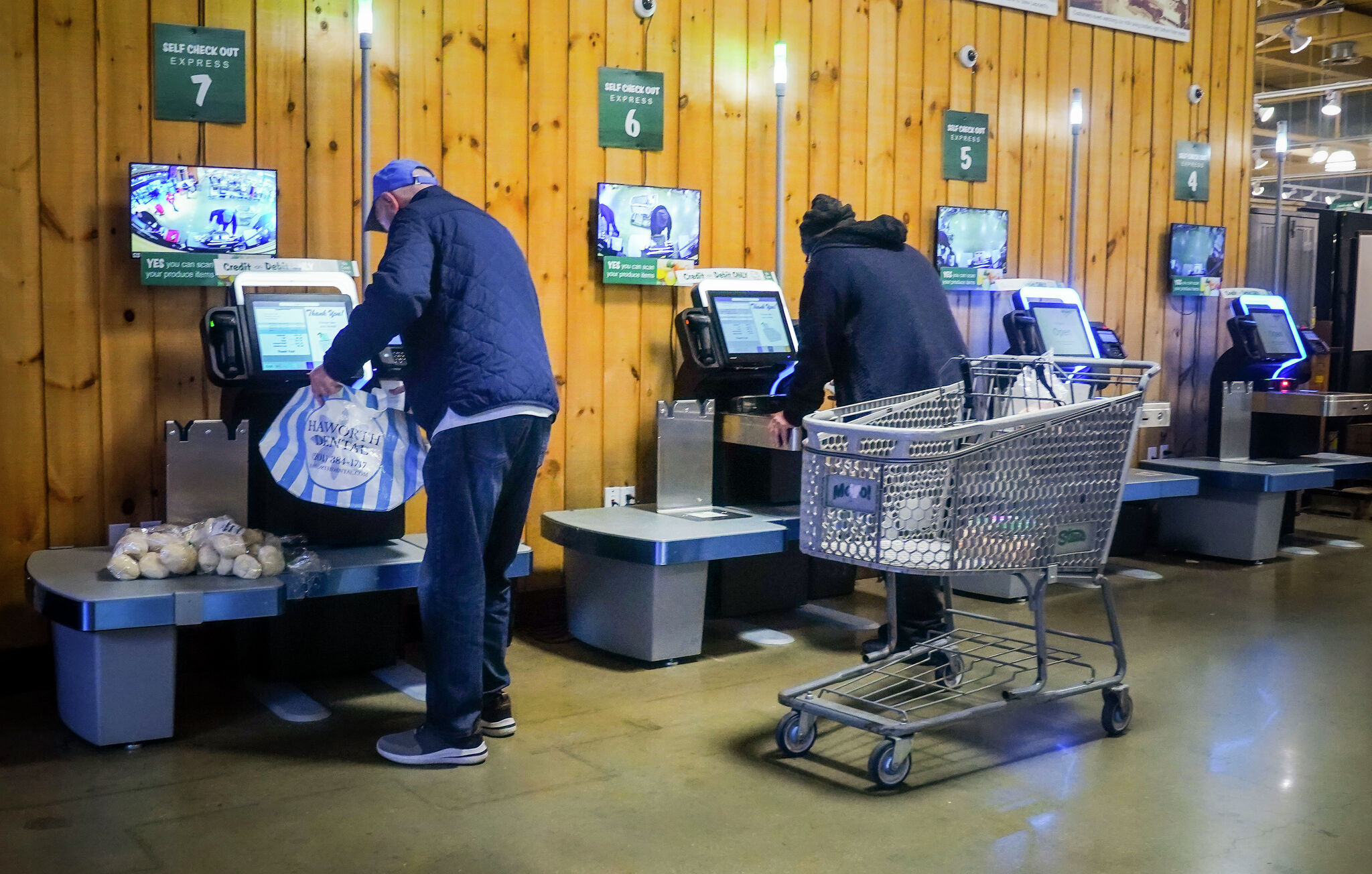
Customers use self-checkout kiosks at Stew Leonard’s grocery store in Paramus, N.J., on Wednesday, Dec. 13, 2023. (AP Photo/Bebeto Matthews)
Bebeto Matthews/AP
An employee assists a customer using a self check-out station to make her purchases at a Stop & Shop in Greenwich in 2017. (File photo)
Matthew Brown / Hearst Connecticut Media
HARTFORD — Stores that sell groceries would be required to have one employee-staffed checkout register for every two self-checkout stations under legislation approved Thursday by majority Democrats in the General Assembly’s Labor and Public Employees Committee.

The party-line vote came after an hourlong debate, during which the committee’s ranking Republicans said the legislation would put more stress on businesses, including pharmacies and convenience stores, at a time when affordability is a major issue.
Article continues below this ad
The bill would also require retailers to have one employee on duty for every two self-checkouts, and limit the total number of self-checkouts to eight per store. The bill, which next heads to the state Senate, would also give employees and customers the power to complain about violations to the Department of Labor. Employees could win amounts equivalent to a day’s wages and possibly bring cases to state Superior Court.
“One of the byproducts is going to be more expensive groceries … if a bill like this were to pass,” said state Rep. Steve Weir of Hebron, another ranking Republican on the committee. “Nowhere else in the country has this legislation. … It has the potential to add costs and those costs get passed on to the consumer.”
The bill is an illustration of the “arrogance” of Democrats who dominate the Senate and the House of Representatives, said state Sen. Rob Sampson of Wolcott, one of the ranking Republicans.
Article continues below this ad
“I think on its face it’s an anti-consumer proposal that will ultimately damage the state of Connecticut and the people who live here, economically,” Sampson said, saying the bill is also aimed at helping worker unions.
“It’s a policy that very clearly is based in arrogance that this legislature, this majority believes that they have the right to tell a private business how to run their operation,” he said. “It’s so blatantly anti-consumer that it shocks the senses.”
Weir questioned state Sen. Julie Kushner, D-Danbury, co-chair of the committee, about the types of stores that might be affected if the bill become law. She agreed that convenience stores, pharmacies and other locations that sell food and have self-checkouts would be included in the legislation.
“I know I have been frustrated at times when there wasn’t enough staff to help checkouts that weren’t working,” Kushner said. Later during the debate, she said the staffing ratio was developed “based on our observations in such situations.”
Article continues below this ad
“We heard a lot of testimony about theft. When there is theft, we also don’t get the sales tax that we would have received on those items,” Kushner said.
In response, Sampson charged that Democrats have steadily increased the cost of doing business in the state by adding layers of regulations and raising the minimum wage. “They have to find alternative routes and that means automation,” he said.
During a public hearing earlier this month, Wayne Pesce, who as president of the Connecticut Food Association represents state grocers and supermarkets, said, “While the bill may be well-intentioned, it is ill-advised and would have unintended consequences, disrupting store operations and raising food prices.”
Fixed ratios on staffing would cut down on convenience for customers and flexibility for store managers, he said.
Article continues below this ad
Pesce’s opposition was echoed by Tim Phelan, president of the Connecticut Retail Network, formerly the Connecticut Retail Merchants Association.
Support for the bill came from unions, including the United Food & Commercial Workers Union Local 919 that represents 6,000 supermarket employees, mostly Stop & Shop employees. Gabriella Holmes, a union representative for the local, said self-checkouts have resulted in increased theft and overworked staff.
“In 2022, Connecticut retailers lost $895 million to shoplifting and the state lost $56.8 million in sales tax revenue,” Holmes told the committee on March 10. “Yet companies continue to expand self-checkout, treating theft as a cost of doing business instead of hiring enough staff to meet customer needs.”
Article continues below this ad
Dining and Cooking