

Two years ago, I ate something that blew my mind. It was a basturma brisket sandwich, a version of Armenian pastrami, and lahmajoun, a flatbread, all prepared inside a tiny ghost kitchen in Glendale.
Even though it was a tiny, unassuming space, I knew I’d tried something extraordinary. When I went back to the office, I told my editor I’d found L.A.’s next best restaurant. The type of food that keeps you thinking about it well after the meal is over.

The legendary basturma brisket sandwich, now discontinued.
She’s learned to follow my instincts, even when they seem slightly overblown, and my resulting piece on Yerod Mas Bakery & Deli reflected my strong belief in what this place could become.
Keep up with LAist.
If you’re enjoying this article, you’ll love our daily newsletter, The LA Report. Each weekday, catch up on the 5 most pressing stories to start your morning in 3 minutes or less.
Over the years, word of its quality spread far and wide. In January it was successful enough to open a brick-and-mortar location nearby. And now it’s just been named one of the 50 best restaurants in the country by the New York Times.
You heard it here first, folks.
The sandwich
Ironically, the basturma brisket sandwich had become notorious for another reason — its price: $38. Large enough to be shared with two people, it featured a thick-cut seasoned brisket and melted Swiss cheese, with house-made pickles and slathered with chaman spread, all served on aish baladi — an Egyptian flatbread similar to pita. It’s based on a recipe from Grigoryan’s Armenian grandmother, who grew up in Egypt.
But when you sell a sandwich for more than $20 in L.A., people start to talk — especially online. Negative attention from Reddit threads and TikTok influencers began to pile up for the small restaurant.
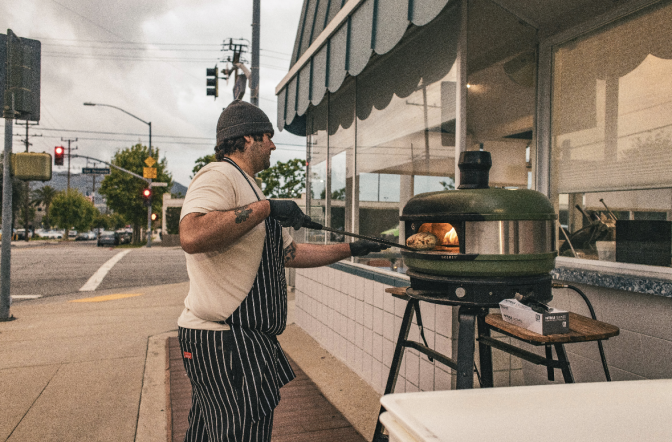
Arthur Grigoryan cooks outside his restaurant Yerord Mas.
(
Robert Haleblian
/
Courtesy Yerord Mas
)
“There was one evening where I only had six tables in my dining room, and four out of the six tables had their tripods out, just recording.”
It was clear that many, mostly influencer types, were there just to comment on the price point and whether it was “worth it,” without much consideration beyond what went into the sandwich. At a certain point, the viral attention no longer felt worth the volume of negative attention tied to the sandwich’s price.
In addition, building the sandwich from scratch was a serious undertaking for a small restaurant.
“Essentially 70% of our labor was just for that sandwich.”

The Chi Kyuftah, available only on weekends, is a steak tartare dish made with bulgur, red onion, pomegranate molasses, Aleppo pepper.
(
Robert Haleblian
/
Courtesy Yeord Mas
)
Grigoryan made the decision to take the sandwich off the menu purely as a business decision — not simply to silence internet trolls.
While talking about the sandwich, it’s apparent Grigoryan has complicated feelings about the place it holds in his restaurant’s story.
“It was a blessing,” he said. “But at the same time, it was also a curse.”
Support local food coverage
Your donation helps LAist highlight neighborhood gems and bring you the latest discoveries, guides, and flavors that make Southern California unique.
The power of vindication
While Grigoryan battled it out online, often publicly reposting on his own Instagram, plenty of others weren’t deterred. Positive reviews from both the L.A. Times and the New York Times came pouring in. It was then that Grigoryan realized he’d been internalizing too much of the negative energy the sandwich attracted online, admitting to himself that he was going too hard on himself.
What’s next
These days, things feel different at the small bakery and deli, with this newfound attention. It feels much more like where they wanted to be when they first opened the restaurant, with the menu now consisting of a handful of rotating dishes, like a hanger steak kebab, the Aleppo-style kebab served with sour cherry sauce, and a seasonal yogurt kofte soup.

The fattoush salad at Yerod Mas, with heirloom tomatoes, watermelon radish, and pita croutons in a lemon-pomegranate vinaigrette.
(
Robert Haleblian
/
Courtesy Yerod Mas
)
The recent attention from the New York Times has clearly increased sales. Grigoryan says the hanger steak kebab sells out regularly, and on good days the restaurant feeds about 120 people a night, not bad for a restaurant that only seats 21 people at a time.
That’s all to say that Grigoryan and Petrosyan seem content where they are. They take pride in what they’ve built independently, with no investors — remaining a mom-and-pop spot that serves culturally significant dishes to their community and the rest of Los Angeles.
Personally, I feel extremely privileged to watch Yerod Mas get the attention they so rightfully deserve, especially having played a part in that. But the reality is, the food is that good. Go try it out for yourselves.
Dining and Cooking