
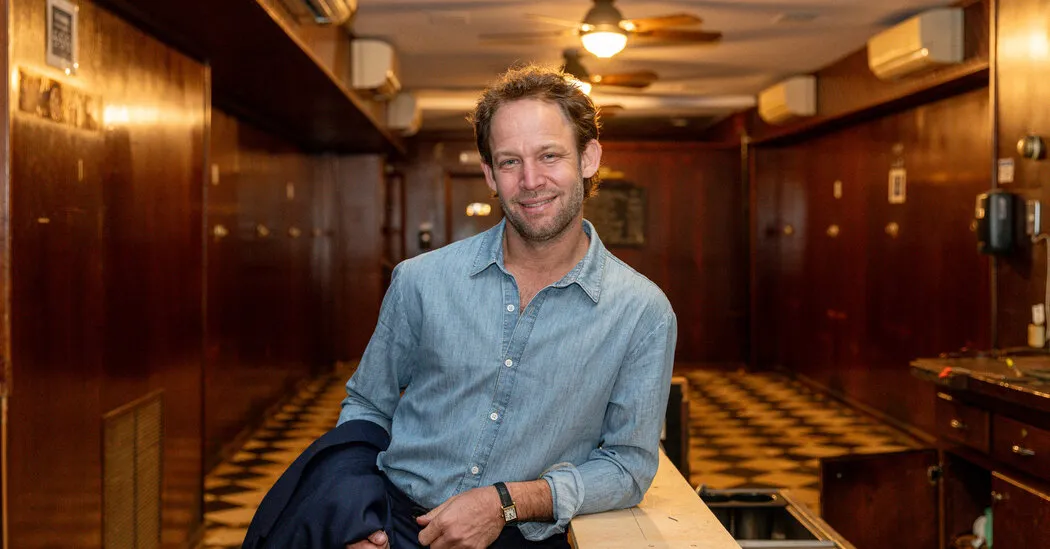
The polished wooden bar top where many thousands of martinis were stirred and drunk during the 76-year run of Donohue’s Steak House has been pried from its supports and hauled away. So have the Formica tables and the booths swaddled in tufted black vinyl. It was hard to tell that, before Donohue’s closed in June, this had been one of the last of the great New York saloons and a second living room for generations of Upper East Siders.
To tell the truth, the room didn’t look much like a restaurant at all.
“When you take the bar out of an iconic space, you’re kind of taking out its soul,” the restaurateur Jon Neidich said Wednesday as he looked around the remains.
This summer, Mr. Neidich’s company, Golden Age Hospitality, signed a lease for the space, beating out about 10 other interested parties. The new restaurant he plans to open there next spring won’t look the same. It won’t be called Donohue’s, either. But Mr. Neidich hopes to rehabilitate and restore the room anyway.
This has become something of a specialty for Golden Age Hospitality. The group currently oversees the pool tables and jukebox at the venerable East Village dive bar Lucy’s; Acme and Elvis, two NoHo restaurants that date back to the heyday of the 1980s Cajun craze; and the former Silver Spurs diner in Greenwich Village, which was just reincarnated as Saint Denis. And next week, Golden Age will reopen Le Petit Journal, a 65-year old jazz club in the Latin Quarter of Paris.
When Donohue’s last owner, Maureen Donohue-Peters, closed up shop, many of the Lexington Avenue restaurant’s regulars said they hoped the new operator would try to preserve the look and feel of the place as much as possible. The booths, the bar and nearly all the other trappings were original, and had been carefully preserved.
She offered to sell all of it to Mr. Neidich, but they could not agree on a price. He said she wanted $750,000. She said that her number was closer to $550,000 or $650,000, but that the negotiations never really got off the ground.
So Ms. Donohue-Peters had it all trucked out to the East End of Long Island, where she lives and operates another restaurant, Donohue’s East. “He didn’t want it, so it went,” she said.
She left behind the checkerboard floor, the burnished wood paneling, the Garland broiler in the kitchen and the chalkboard on which the specials were written every night.
The blackboard’s fate is undecided, but Mr. Neidich said he intends to restore the floor and the paneling. “Aesthetically, my goal is to keep as much as possible of what it was,” he said. “It will be a lot of restoration and some preservation.”
Details that can’t be saved he will try to replace; he said he is already talking to a ceramist about matching the vintage green tiles in the restrooms. He also hopes that he can make use of the broiler, which seared double-cut pork chops and sirloin steaks for seven decades. Ms. Donohue-Peters said the steel rods below the flames are the same ones that have been in place since her father opened the restaurant in 1950.
“That’s where the flavor is,” she said.
Mr. Neidich said the new restaurant was still unnamed. The menu is still a vague notion, although he has been talking to Golden Age Hospitality’s chef, Marjorie Meek-Bradley, about keeping the focus on broiled meats and a few side dishes.
As for the bar, he said he will have woodwork that was salvaged from somewhere else transported and tailored to the space. He hopes it will be “a real drinking bar” where the people mixing cocktails know their regulars’ names and what they like to drink, just as Ms. Donohue-Peters and her bartenders did.
Everybody who knows Ms. Donohue-Peters agrees on one thing: The space on Lexington will not be the same without her. But Mr. Neidich hopes that something of the spirit of the old joint will stick around.
“Not to get too woo-woo, but I believe in the energy of spaces,” he said. “I don’t totally believe in cursed spaces, but I do believe in spaces that had really good runs and have an energy of all the good times that went on in them.”
Dining and Cooking