

As a child growing up in Connecticut, U.S. Sen. Chris Murphy found a sense of belonging at a local grocery store in a piece of cheese from a friendly deli worker.
Now a national political figure and vocal critic of President Donald Trump, Murphy was home in Hartford recently, recalling his weekly grocery store trips as he promoted his legislation to help small grocers, booksellers, and retailers in the battle against retail giants like Amazon and Wal-Mart.
“I remember every weekend going to a small supermarket in Wethersfield, where I grew up just over the line,” Murphy recalled at the Key Food market on Park Street in Hartford.
“My grandmother would bring me with her shopping, every Saturday afternoon. We would go straight to the deli counter because she knew the deli guy. He worked behind the counter for decades. He would hand a free slice of American cheese to me, and I thought that I was the most special guy in the world that my grandmother knew the deli guy and I was getting a free slice of cheese,” he said. “I walked out of that grocery store feeling like I was part of a community, feeling like I belonged to something, feeling like I was special.”
Decades later, the retail situation in the United States has changed drastically with consumers buying items on their cell phones from major companies with annual sales in the billions of dollars.
“Today, the economy looks very, very different than it did 25 or 30 years ago,” said Murphy, who was first elected to the Senate at age 39 and is now 52. “It used to be that people did the majority of their shopping at stores that were owned by people who lived in their community.”
A three-term U.S. senator, Murphy went to the local market to talk about the everyday struggles of small retailers in industries ranging from food to books.
“I’m a neighbor, a patron,” Murphy said inside the Key Food in the city’s Parkville neighborhood. “It means so much to me that one of our great local small businesses would host us.”
Robinson-Patman Act
Murphy’s bill represents a follow-up to work done by President Joe Biden’s administration that has since been shelved by President Donald Trump.
Biden’s administration filed a civil lawsuit by the Federal Trade Commission against PepsiCo Inc. by saying that Pepsi had violated the Robinson-Patman Act, a little known law from the mid-1930s designed to protect small retailers from price discrimination.
“That legislation says something very simple: that any supplier, whether it be Coke or Pepsi, has to give the same price to a small grocery store as they do to the big grocery stores and the big retailers,” Murphy said. “They can’t choose to give a discount to Wal-Mart just because they’re Wal-Mart. Our new legislation strengthens the Robinson-Patman Act to make it more easily enforceable and to crack down on a lot of the ways these big chains and big suppliers are trying to get around the law.”
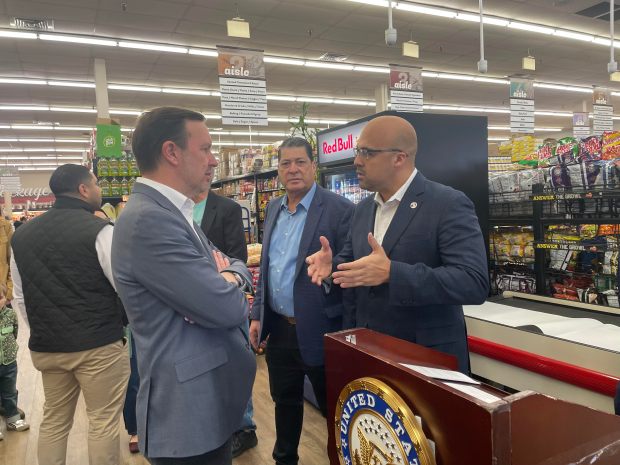 U.S. Sen. Chris Murphy speaks about grocery store pricing at the Key Food supermarket in Hartford on April 6, 2026. He is sponsoring legislation to help small retailers in industries ranging from food to books. He is shown with Anthony Pena, president of the National Supermarket Association and owner of supermarkets in Norwalk and Bridgeport. (Christopher Keating/Hartford Courant)
In a reversal of Biden, the Trump administration has withdrawn the FTC case against Pepsi.
Republican Andrew Ferguson, who had voted against Biden’s lawsuit as an FTC commissioner and now serves as the new FTC chairman under Trump, pushed in 2025 to drop the lawsuit, which he described as a “dubious partisan stunt” that was essentially a waste of time.
“The Biden-Harris FTC rushed to authorize this case just three days before President Trump’s inauguration in a nakedly political effort to commit this administration to pursuing little more than a hunch that Pepsi had violated the law,” Ferguson said in a statement at the time.
PepsiCo said in a statement when the case was dropped that the company “will continue to provide all customers with fair, competitive, and non-discriminatory pricing, discounts and promotional value.”
 Presidents Joe Biden and Donald Trump had sharply different views for the Federal Trade Commission – with Biden filing a lawsuit against Pepsi and Trump’s FTC withdrawing the lawsuit after he took office. In this combination of photos, Biden is shown in Salt Lake City, and Trump is shown in Las Vegas. (Associated Press Photo)
While Murphy is trying to rally support, he admits it is an uphill battle while Trump is in the White House and Republicans control both the U.S. House of Representatives and the Senate.
At the same time, Murphy said he understands the modern conveniences of 2026.
“I get it,” Murphy said. “People appreciate the opportunity to shop at these big chains. I buy stuff on Amazon. I’ve walked through the doors of Wal-Mart when I need something every now and then, but I prefer to shop in local stores. I prefer to go to locally owned restaurants, but they’re disappearing … as Amazon and Wal-Mart and these other giant chains become stronger and stronger.”
Other retailers traveled to the Key Food to chat with Murphy and reporters about their experiences.
Mark Thiede, who runs the Two Wrasslin’ Cats Coffee House in East Haddam, retired as a scientist at Pfizer and opened the eclectic coffee shop 13 years ago.
“We survived COVID, the tariffs even,” he said. “I am not beholden to shareholders, but to the interests of my customers.”
Meg Flynn, co-owner of Black Rock Books, an independent bookseller that opened in Bridgeport in 2023, said she is trying to keep the doors open.
“When a brand new hardcover book costs $35 in our shop but is listed for 30% off elsewhere, how can we compete?” Flynn asked. “Small businesses do not receive the same favorable pricing deals as the larger retailers.”
Flynn added, “Businesses shouldn’t have to be big to be successful. I don’t want to see a day when shops like ours are shuttered and our opportunities to meet our neighbors are limited to stepping outside of our front doors to retrieve the latest package from a mega-corporation, ordered online in a faceless transaction. As any bookworm will tell you, that has dystopia written all over it.”
Christopher Keating can be reached at ckeating@courant.com
Dining and Cooking