
HOUSTON — Aga’s is, in many ways, the kind of restaurant you can find all over the Houston area — a family-run strip-mall joint in the suburbs serving inexpensive food that tastes like the best home cooking.
But there’s nothing typical about the scene at this Indian-Pakistani restaurant. Even as the temperature soared past 90 degrees on a recent Saturday night, hundreds of people milled outside waiting for a table. There were hijabs, Texans jerseys, strollers, designer purses, sleeve tattoos, Air Jordans, workout clothes, scrubs. A host wielding a hand-held microphone called out names like an auctioneer.
Inside the 16,000-square-foot space, barely decorated and (confusingly) piping out spa music, every inch was filled, even the banquet hall — which ceased to be a banquet hall in 2019 because of the demand for tables.
The restaurant serves about 4,000 guests a day. Then there are another 1,600 or so takeout and delivery orders — a total of about half a million per year, according to Aga’s, which says its annual revenue stretches well into eight figures.
In fact, Uber Eats says it delivers more to-go orders for Aga’s than for any other single-location restaurant in the world, a distinction reported last month by Business Insider. Aga’s also takes so many takeout orders directly from customers that the family has turned a storage room into a busy call center.
“You come in here some nights, and it is like people waiting to get into a concert,” said Gilbert Guajardo, an Uber Eats driver who added that “99%” of his delivery orders come from Aga’s.
An Uber Eats spokesperson said that success is particularly notable given that Indian and Pakistani food are not among the three most popular cuisines it delivers, and Houston isn’t a top-three city.
Granted, Uber Eats is just one company, with 31% of the delivery market in the United States, according to 2026 data from the market research form Yipitdata. DoorDash, which has 64%, delivers orders for Aga’s, declined to share details about its sales or ranking, but said it was a “top performing restaurant.”
So what explains that performance?
Sarfraz Maredia, an Uber Eats executive who oversaw operations across the United States, Canada and Latin America from 2021-25, said the restaurant had such consistent food and strong ties to the Houston community that once it invested in delivery, it “resulted in a level of scale you never see for a single-restaurant location.”
Aga’s also reflects the local demographics, said Bao Ong, the Houston Chronicle restaurant critic, who named the restaurant the city’s best last year. The Houston area, one of the most ethnically diverse places in the country, is home to 655,000 South Asian residents, according to the Kinder Institute for Urban Research at Rice University.
“You could make a reasonable argument that there are some Indian restaurants that have slightly better food or more interesting or well-put-together dishes,” Ong said. “But Aga’s just feels very much for the community. It feels like a restaurant made for Houston.”
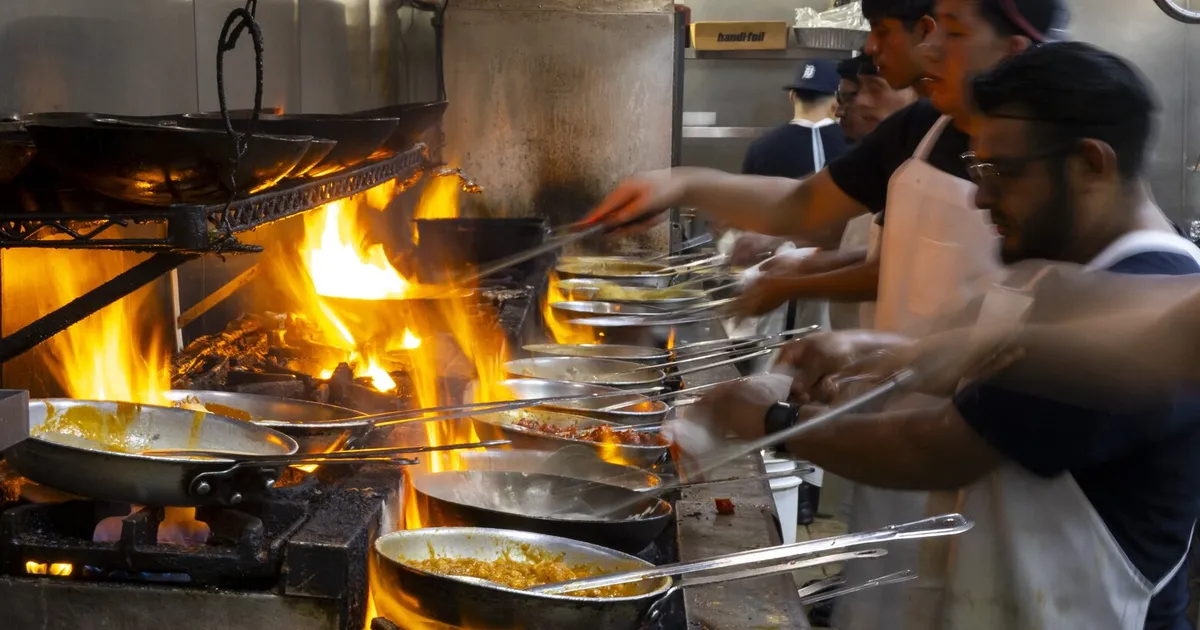
In the crowded kitchen on this Saturday evening, cooks stirred vats of nihari that had simmered since 4 a.m., threaded dozens of kebabs onto skewers and set a jumble of orange-tinted goat chops ablaze on the grill, thickening the air with smoke. Another group stood in the center island, double-knotting takeout bags with the speed of sea-worn deckhands and plopping them onto a winding conveyor belt that led to the dining room.
At a counter near the front of the restaurant, a long line of delivery drivers stared down at their phones. Many deliver only for Aga’s.
“Unless I am sick or take a day off, I am here,” Guajardo said. The delivery business can be fickle, he said, but at Aga’s, the orders come often and people tip well. He has made $50,000 from Aga’s alone in the past two years — and now he’s a regular diner, too, whom servers greet by name.
A little over a decade ago, Aga’s was a struggling Indian restaurant on the brink of closing. The Maredia family — six brothers and sisters (no relation to the Uber Eats executive) — bought the place in 2010, despite having no restaurant experience, because they had recently moved to the city from California and were finding limited business opportunities.
“Just before we bought the restaurant, I had gone there with my family and it was terrible,” said Shaukat Maredia, an owner. The service was slow, the food was inconsistent and the space needed a face-lift. “I remember telling my brother, ‘Are you sure you want to buy this?’”
The siblings replaced the furniture and painted the walls. They added regional specialties from their childhoods in India and Pakistan, like Hyderabadi gosht, made with slow-cooked lamb, and Balti gosht, with its aromatic sauce of tomatoes and garam masala. YouTube and their spouses provided cooking instruction.
“We had no social media, no advertising, nothing,” Karim Maredia, another owner, said. Even people from their local mosque didn’t come at first because the restaurant was in competition with another member’s establishment.
But word-of-mouth brought a steady trickle of customers, and by 2013, Aga’s was making a profit. The turning point, though, was the pandemic. While many restaurants shuttered or scaled down, Aga’s was busier than ever because it had started doing delivery two years earlier.
“It went crazy,” said Afsana Panjwani, an assistant manager who started at Aga’s just before COVID-19. “We had to set up a to-go counter outside because this counter was not enough.”
The restaurant soon expanded its kitchen and hired 20% more staff; today, Aga’s employs 200 people, for an average wage of $20 an hour, Shaukat Maredia said. A handful of them work in the call center, where several phones are constantly ringing.
“We are so used to it now that if we are not getting calls, we are just bored,” said Inara Ladak, a call-center employee who speaks several languages because the customers are so diverse — about 60% South Asian and 40% other ethnicities, according to the Maredias.
They say the volume of orders has given Aga’s a distinct leverage over delivery companies, which restaurateurs typically loathe for their hefty fees. Shaukat Maredia said he was able to persuade DoorDash, Uber Eats and Grubhub to lower their commissions in exchange for the restaurant’s business.
“We get the deals that no one else in the entire world gets,” he said, though he didn’t disclose specifics, saying he had signed nondisclosure agreements. The companies would not confirm his claims, but DoorDash and UberEats recently installed billboards around Houston advertising the restaurant.
So many delivery drivers camp out at Aga’s that the restaurant regularly runs out of parking spaces. Niosveldi Broche and Edelso Espinosa, two drivers sitting outside, said they became friends while waiting for Aga’s deliveries.
But they don’t love the food. “It’s too spicy,” Broche said.
The Maredia family is used to this criticism. “It has to be authentic,” said Shaukat Maredia, with a shrug. “If they don’t like it, they can go where they like.”
For some customers, that refusal to water down flavors is part of the appeal. “When we are trying to impress our friends with our culture, the only thing we can order is Aga’s,” said Sandra Hassan, a regular of 17 years whose husband, Humair Hassan, is South Asian. They order from Aga’s at least three times a week.
Other diners appreciate the restaurant’s attention to detail. “Most deliveries, it comes out of the box leaking, or the food is not fresh or hot,” said Dr. Moe Ahmed, a holistic medicine physician who orders from Aga’s once a week. “They do a really good job at Aga’s.”
The restaurant recently added a to-go location in Katy, Texas, about 30 miles west of Houston, with plans to open a nearby commissary kitchen and more to-go restaurants throughout the state.
When the Maredias first walked around the Katy location, they thought it was too big. Now, just a few months in, they’ve realized it’s too small. They’re in talks with the landlord about expanding into the storefront next door.
This story was originally published at nytimes.com. Read it here.
Dining and Cooking