

Tampa Bay’s food scene is as diverse as the communities that have shaped it, with Cuban, Spanish, Italian and Greek traditions sharing the table with Vietnamese, Nepali, Mexican and Southern cooking. But these influences don’t simply exist side by side. “They’re interacting with one another,” says Dylan Ruhe, general manager at Rocca. “You see chefs taking inspiration from the history of Tampa Bay while also bringing their own experiences and ideas to the table.”
That range comes through in dishes beloved by locals and MICHELIN Guide Inspectors alike. There’s cacio e pepe chawanmushi (a delicate savory egg custard) that bridges Japan and Italy, hand-rolled Greek dolmades made from a century-old family recipe and snapper à la Sài Gòn rooted in a chef’s childhood memories. Add tableside-stretched mozzarella, smoky brisket tacos and sourdough donuts, and there’s plenty to sample.
“There are chefs here who are incredibly serious about their craft, from the ingredients they source to the techniques they use and the way they think about hospitality,” says Ruhe. “You have restaurants that are deeply rooted in tradition, restaurants pushing contemporary ideas, and everything in between.”
Here are the eight must-try dishes of Tampa Bay and where to find them.
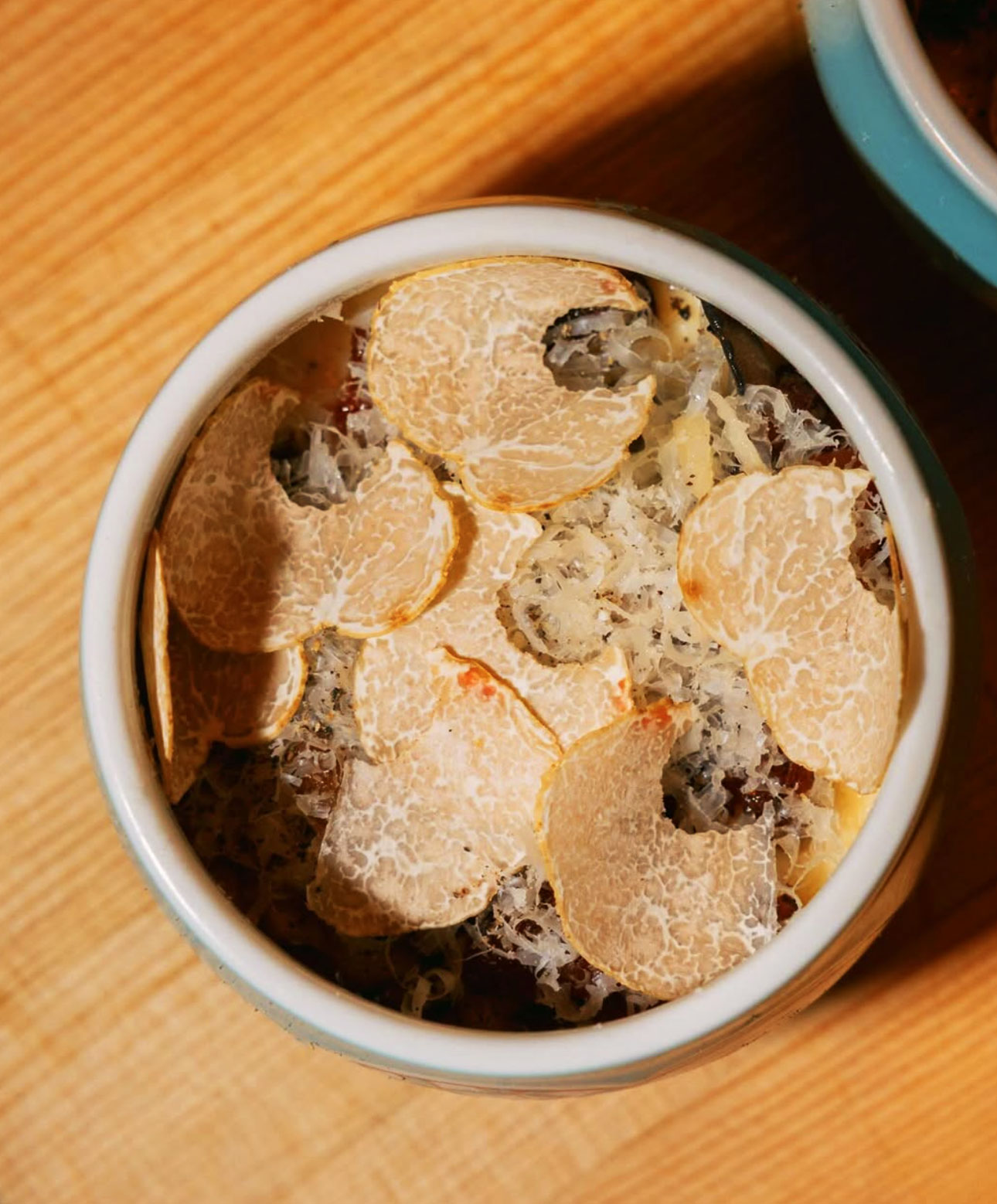
Kinjo starts with a chawanmushi base, typically made with dashi, soy sauce, mirin, egg, bonito flakes, kombu, Parmesan rind and pancetta. © Keir Magoulas/Kinjo
Chawanmushi
KinjoItameshi, a blend of Japanese and Italian cuisines, is the concept behind Kinjo in Hyde Park, where Chef/owner Eric Fralick combines flavors and techniques from both cultures in ways that feel at once unique and familiar. Fralick spent five years training in Japan, where his favorite restaurant was an itameshi spot in Shizuoka City, and was drawn to the idea of bringing Japanese and Italian cooking methods together. At Kinjo, that approach comes through in dishes like cacio e pepe chawanmushi.
The dish starts with a traditional chawanmushi base, typically made with dashi, soy sauce, mirin and eggs, but Fralick also adds bonito flakes, kombu, Parmesan rind and pancetta. “It has that silky chawanmushi texture with a more pronounced depth of flavor,” says Fralick.
Once the mixture is steamed, it’s topped with crispy pancetta, 24-month DOP Parmigiano Reggiano, cracked black pepper and white Italian truffles. The result is familiar yet nuanced, and a fitting representation of a traditional Japanese dish refined with top-tier Italian ingredients.

Gorkhali Kitchen serves their momo with hot chili sauce. © Rajesh Pathak/Gorkhali Kitchen
Chili Momo
GorkhaliJust a short drive from downtown Tampa, Gorkhali Kitchen offers a taste of Nepali and Himalayan cuisine. A visit here calls for momo, the iconic Nepali dumplings made with flour-and-water wrappers and stuffed with a variety of fillings, including meat, vegetables, tofu or cheese.
One of the restaurant’s most popular dishes, momo are served steamed, fried or as kothey momo, which are pan-fried for a crispy finish. The chilli momo are filled with chicken or vegetables, then fried and tossed with bell peppers, onions, a house-made spice blend and chili sauce. “Our chilli momo is a top customer favorite,” says co-owner Menora Panthi, “especially for guests who enjoy medium-spicy food.”
“Our goal is to bring authentic Nepali and Himalayan flavors to Tampa,” says Panthi. “At Gorkhali Kitchen, we are not just serving food; we are sharing a taste of Nepal, our culture and the warmth of Nepali hospitality.”

Psomi’s dolmades are made from scratch daily from a100-year-old recipe that’s been passed down three generations. © Psomi
Dolmades
Psomi Situated in North Hyde Park, Psomi is a daytime bakery and eatery owned and run by second-generation Greek American Chef-owner Christina Theofilos Stimatz. The menu features an array of Greek dishes, including dolmades, made fresh with a blend of grass-fed beef and rice, then hand rolled and wrapped in grape leaves imported from Greece.
“Most restaurants serve dolmades out of a can,” says Theofilos. “Ours are made from scratch daily and [from] a 100-year-old recipe that has been passed down three generations.”
The dolmades arrive in a house-made broth that’s bright and bold — and so flavorful that diners often ask for a spoon to finish it like soup. “You can taste the freshness,” says Theofilos. “When [dolmades are] made with the right ingredients and love, they are so special, and they’re even more special because they are a true family recipe.”

Restaurant BT’s gulf snapper fillet is infused with lemongrass, shallots, garlic and curry. © Angel Webb/Restaurant BT
Snapper à la Sài Gòn
Restaurant BT An updated take on classic French-Vietnamese cuisine defines Restaurant BT in South Tampa. Many dishes draw on Chef BT Nguyen’s Vietnamese heritage, with bright, aromatic flavors, while others reflect her classic French training and time spent abroad.
The must-have dish is snapper à la Sài Gòn, one of Nguyen’s signatures. “This was inspired by childhood memories of watching and helping my nanny prepare the dish,” she says. It’s made with a Gulf snapper fillet infused with lemongrass, shallots, garlic and curry. The fish is served on crunchy shredded purple and green cabbage, carrots, Vietnamese herbs and cucumber slices, then topped with crushed roasted peanuts and shallots for texture.
The driving force behind the dish is lemongrass, Nguyen’s favorite ingredient, which she grows on her small farm. “As a driving force behind the dish, it reflects my philosophy of sourcing fresh, wild-caught Gulf seafood in Florida, while marrying it with traditional ingredients,” says Nguyen.

The mozzarella is served with basil, tomatoes, cracked pepper, sea salt, Aceto Balsamico di Modena and extra-virgin olive oil. © Melissa Santell/Rocca
Tableside Mozzarella Cart
Rocca At Rocca in Tampa Heights, Chef and owner Bryce Bonsack serves rustic yet refined Italian cooking informed by time spent living in Monforte d’Alba, Italy.
One of Rocca’s biggest draws is the tableside mozzarella cart. “It’s about taking something that normally happens quietly in the kitchen and putting it directly in front of the guest so they can experience the craft, texture, temperature, and, most importantly, the people behind it,” says General Manager Dylan Ruhe.
The mozzarella process begins well before the cart leaves the kitchen. The curds are portioned, then mashed to order with salt before the cheese is worked, stretched and formed tableside.
“It has a little theater to it, but it is theater with a purpose. Any opportunity to have a dish prepared tableside creates a moment, but mozzarella gives us something particularly dramatic to work with,” says Ruhe. “There is a buildup to watching a full pound of cheese come out of the bowl, stretch between your hands, change shape, change texture and eventually become the mozzarella that is placed in front of you.”
The freshly made mozzarella is served simply with locally grown basil, seasonal tomatoes, cracked pepper, Maldon sea salt, Aceto Balsamico di Modena and Raineri Ligurian extra-virgin olive oil.
“We don’t want to hide the good stuff. We want to bring it closer. Food tastes better when you understand where it came from, who made it and why they cared enough to do it the right way,” Ruhe says.

At Streetlight Taco, braised brisket is layered over the cheese and finished with cilantro, onion and almond-pecan salsa macha. © Streetlight Taco
Brisket Taco
Streetlight Taco Streetlight Taco in South Tampa serves an array of tacos, tostadas, salsas, sides and more, but a customer favorite is the brisket taco, which takes its cues from Mexico’s suadero and costra tacos.
The kitchen starts by melting cheese on the flat top with a spoonful of puerco bean purée, or Mexican refried beans. As the cheese turns crisp and golden, a flour tortilla is placed on top, then flipped so the crispy cheese forms the base of the taco. Braised brisket is layered over the cheese and finished with cilantro, onion and almond-pecan salsa macha.
It’s the salsa macha that sets this brisket taco apart. “While peanuts are the traditional nut used in salsa macha, ours uses almonds and pecans, giving it a distinct flavor and texture,” says Chef Michael Brannock.
The attention to ingredients extends to the tortillas and beans. “We mill our own masa in-house using heirloom corn varietals from Mexico, and the beans we use throughout the restaurant are also heirloom varieties from Mexico. We also rub our flour tortillas with lard before cooking, which adds an extra layer of flavor and richness,” says Brannock.

The donuts at SuperNatural Food & Wine are fried and dusted with a signature cinnamon-sugar mixture. © Wesley Roderick/Supernatural Food & Wine
Sourdonuts
SuperNatural Food & Wine Nestled in a tiny space in downtown Tampa, with a few seats outside and a small counter inside, Supernatural Food & Wine is all about sandwiches. But for those craving something sweet instead of savory, the fresh cinnamon-sugar sourdonuts are worth a trip on their own.
“Although it is called a donut, basically everyone says that it’s in a league of its own,” says Madeline Baker, marketing manager and part-time donut maker. “People who typically don’t like donuts always claim to love them. I think the flavor of the dough, the bite of that outer crust, and the multifaceted (teensy bit salty) magical dust is what does it.”
The donuts are made daily, using a sourdough process that begins with a starter fermented for 24 hours. The dough is then rolled, shaped and left to proof in the refrigerator overnight before being fried and dusted with a signature cinnamon-sugar mixture.
“The end product is unforgettable, especially when it is hot and fresh,” says Baker.

The Akaushi Wagyu beef brisket melds the technique of central Texas barbecue with the flavors of pitmaster Danny Hernandez’s Cuban heritage. © The Brisket Shoppe
Akaushi Wagyu Beef Brisket
The Brisket Shoppe At The Brisket Shoppe, located in downtown Tampa, owner and pitmaster Danny Hernandez blends Texas-style barbecue with Cuban flair, a style dubbed “Tampeño.” A major draw is the hand-selected Akaushi Wagyu beef brisket.
“It’s slow-smoked over Florida oak in 1,000-gallon offset smokers — a 14-hour process that begins every day at 4 AM,” says Hernandez. “We season it simply with salt and pepper, unadulterated, respecting the craft of central Texas barbecue, where there’s no power, no gas — just fire, oak and time. The result is a brisket that’s rich, tender and unmistakably ours.”
The brisket brings together two traditions: the patience and technique of central Texas barbecue and the bold, vibrant flavors of Hernandez’s Cuban heritage. Side dishes such as dirty brisket rice, maduros (fried sweet plantains) and collard greens simmered with ham hocks follow suit.
“It’s more than a plate of barbecue — from the moment you step into The Brisket Shoppe, it’s an experience unlike any other,” says Hernandez. “You can taste it in every bite: the smoke of central Texas tradition meeting the warmth of Cuban flavor, plantains and dirty rice sitting right alongside a brisket that took 14 hours to become what it is. When you dine with us, we’re sharing a piece of our family, our craft and our community.”
Hero image: Collage – © Wesley Roderick/Supernatural Food & Wine | © Keir Magoulas/Kinjo | © Melissa Santell/Rocca | © Rajesh Pathak/Gorkhali Kitchen | © Angel Webb/Restaurant BT

Written by
Kate Heddings
Kate Heddings is a food editor and writer based in New York City. She also contributes to Food & Wine and BBC Travel.
Dining and Cooking