

Richer operations are thriving, small ones are struggling and those in between are hustling harder than ever
THE wine world has stumbled its way through a rough few years. Consumption worldwide has dropped as health warnings swirled. Inflation and tariffs are presenting unexpected challenges, while climate change continues to plague growers everywhere.
With all these forces lined up against them, you might imagine wine shops hunkering down to cut their losses. Instead, K&L Wine Merchants, a retailer with four stores in California, did the opposite, expanding into New York City with a store on Madison Avenue in late May.
So far, for K&L, things have gone better than expected. “I’m more bullish now on New York City than I was coming in,” said CEO Brian Zucker.
The view looks entirely different from behind the counter at Ardor Natural Wines in Portland, Oregon. This small speciality shop opened in 2017, capitalising on a thirst for what was then a new and novel side to wine.
The store did well at first, said owner Victor Martinez, especially in 2019, which he called the peak of natural wine culture, and through the Covid-19 pandemic. Then the bottom dropped out, leaving Martinez somewhat puzzled.
“The culture has turned against drinking, yet smoking is back, drugs are back,” he said. “If this isn’t the bottom, I don’t know how sustainable this is going to be. I’m working to make the landlord money, the government money, but I’m not making any money.”
Going on different paths
The divergent fortunes of these two businesses say a lot about the state of wine retail today.
Small brick-and-mortar shops like Ardor, which serve a largely local clientele, are struggling, while larger, diversified stores with a healthy proportion of ultra-wealthy clients, like K&L, are sailing through.
Aside from its stores, K&L does big business in wine auctions, on its website and in storing and servicing the collections of rich clients while finding rare and expensive wines for them.
SEE ALSO


Zucker calls this strategy “omnichannel”: using any means, physical or digital, to connect with customers.
 K&L Wine Merchants CEO Brian Zucker says “things have gone better than expected” for the company after it expanded into New York City. PHOTO: NYTIMES
“Sales over US$100 a bottle were up more than 40 per cent this year, with 15 per cent more customers buying at that level, and the number spending over US$10,000 with us in that range went up by more than half,” he added. “Our private client group grew several-fold, at an average bottle north of US$300.”
At the same time, Zucker emphasised that K&L has done well at the lower end of the price spectrum, partly because of the slowdown in the California wine business, which has caused an oversupply of unsold wine.
K&L makes deals with the wineries, selling bottles far below the recommended retail price, provided neither the names of the wineries nor the prices are publicised.
In the last year, Zucker said, K&L sold about 114,000 bottles of California wine at half off the winery’s own price or better through K&L Insiders, a free programme that only offers prices once the customer logs in.
“We can’t post them publicly,” he said. “That’s the whole arrangement with the wineries: The prices stay off Google and Wine-Searcher.”
Diversifying beyond the norm
As with the proverbial K-shaped economy, the bigger, wealthier businesses are getting richer; the smaller, less well financed are getting poorer; and those in the middle are not quite sure where they are heading other than that they are hustling more than ever.
“Traditional retail is really hard work,” said Chris Leon, owner of Leon & Son, a wine shop in Brooklyn. “To grow a business just doing that one thing is becoming less and less sustainable.”
To that end, Leon & Son operates a wine club that has built a nationwide clientele. After the pandemic, Leon, sensing that his customers yearned for community, began to offer wine classes and events highlighting visiting winemakers and other luminaries.
Early in 2026, Leon & Son started an online auction business aimed at attracting not just those looking for rare collectible bottles, but anybody looking for a deal. To lower the barrier of entry, Leon & Son charges a 14.5 per cent buyer’s fee rather than the conventional 20 to 25 per cent.
For mid-range stores, creating a sense of community with their clientele is crucial.
In Atlanta, Perrine Prieur Gallardo opened her first store, Perrine’s Wines, in 2010 and now owns three shops in the city. They have become community fixtures, and she said she is working harder than ever to keep them that way.
“We have people who met here and got married and had kids,” she said. “We are part of that, and that is what continues to fuel me.”
She and her staff have increased the number of tastings the store does, creating booklets and other study aids so that people can leave with something in addition to wine.
“They want to be part of this community,” she said. “It just requires more work. You can’t just wait behind a counter. We are just making it today.”
No store embodies the notion of togetherness more than Community Wine and Spirits, which opened three years ago in New York. David Weitzenhoffer, its owner, has worked in many facets of the wine business. Retail was the one thing he hadn’t done.
“As long as I put my store near a subway station, I’m fine,” he said of his initial planning. “As it turned out, I’m nowhere near a subway station. On the flip side, the people around here are stuck with us.”
This isolation has worked in Community’s favour. Weitzenhoffer collaborates with other local businesses, offering gift cards for neighbours. His store is roomy, with plenty of space so that wine is spread out rather than presented as an intimidating wall of bottles.
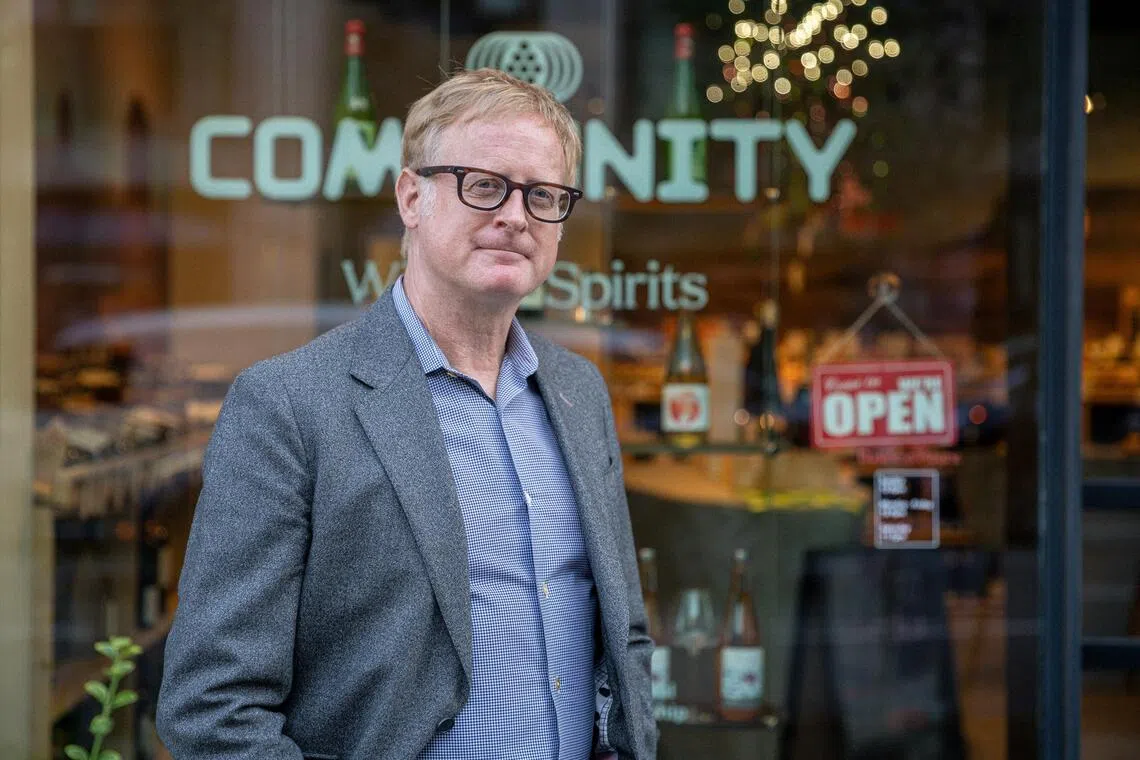 David Weitzenhoffer of Community Wine and Spirits says that his shop is just about to become profitable – after three years in business. PHOTO: NYTIMES
Like other stores, Community works hard to bring people in, with classes and tasting events. The store, Weitzenhoffer said, has become part of the community.
“I run into people in the neighbourhood, they wave and want to talk about the people who work in the store,” he said. “I feel like Mr Rogers walking here from the train. If we set out to be a high-end store solely, we wouldn’t have the populist traffic coming through here.”
The peculiar nature of selling and distributing alcoholic beverages in the US makes things even more complicated for many stores.
After the repeal of Prohibition, the American federal government established a three-tier system and gave the states the power to regulate it as each sees fit.
Under the system, producers and importers cannot sell directly to retailers or consumers. Instead, they must sell to distributors, who sell to retailers and restaurants, which sell to consumers.
Different laws govern each state, which perhaps made more sense in the days when every store’s clientele was primarily local. But the rise of online shopping and interstate shipping gives retailers in more freewheeling states advantages over those based in more restricted states.
In California, for example, importers such as Kermit Lynch and Rare Wine Co have long operated retail shops as well, a mingling of tiers that would not be permitted in some states, like New York.
K&L also acts as an importer in California, buying directly from European producers and selling at its stores in the state. Zucker said that its Madison Avenue shop adheres to New York state’s stricter rules.
Few have exploited the disparities in the system as successfully as Thatcher Baker-Briggs, a former sommelier and restaurant manager who started Thatcher’s Wine in 2019.
At first, he worked with wealthy wine collectors, managing their accumulations. He then began an import business, focusing on high-end, in-demand European wines such as William Kelley, Vincent Dancer and Guffens-Heynen, selling the wines to his wealthy clients and through his website.
In 2024, he opened a retail shop, Thatcher’s Wine, in the Brentwood section of Los Angeles, and expanded his portfolio, selling bottles for US$20 to US$30 as well as for thousands of dollars. More recently, Thatcher’s started distributing in Illinois, Florida and New York, selling its imports to a small number of restaurants.
Thatcher’s Wine, now effectively acting as an importer, distributor and retailer, has grown to a US$25 million business.
“We don’t have a three-tier system in California,” Baker-Briggs said. That presents difficulties for stores in the many states that enforce the system more rigorously.
Leon noted that while they are “competing for the same customers” they’re “operating under different rules”.
While he is scrambling to keep his business growing, he said that he is optimistic for the future. “From where we are sitting, people are still really excited to explore the world of wine,” he added, “and we’re still excited to be working in wine.”
Weitzenhoffer’s store, Community, has just celebrated its third anniversary in Manhattan. He said that it is just now about to start making a profit.
“I’m not paying myself yet,” he said. “But as hard as it is running a small business, it’s one of the most rewarding things I’ve done in my life.” NYTIMES
Dining and Cooking