

On the outskirts of Albuquerque in New Mexico’s Rio Grande Valley, Chef Chris Bethoney and his culinary team shape seasonally driven menus in a rustic yet refined agricultural setting, all with a backdrop of fragrant lavender fields, centuries-old cottonwood trees and dramatic views of the nearby Sandia Mountains. Many of the ingredients he uses at Campo at Los Poblanos, set on the grounds of a Two-MICHELIN-Key historic inn, are sourced directly from the property’s 25 acres of gardens and fields. The rest comes from artisanal growers and producers throughout the state and in other parts of the U.S.’s southwest region.
Los Poblanos in its entirety is more than just a stay with a restaurant. It’s a 360-degree farm-to-table experience, with a working farm, gin distillery, apiary, bar — and of course, restaurant — all contributing to the guest experience.
“It’s a lot of things, but I feel like, for me, it’s the potential that’s there,” says Bethoney. “You have a little bit of land, and not a lot of restaurants have that. I think that it really is a special thing to have a little bit of a farm, a little bit of the distillation process, the beekeepers, the restaurant, the inn — all those things. There’s a lot going on in that space, and I think that’s special.”
Bethoney’s path to becoming Campo’s Executive Chef also has roots in the soil, and for most of his life, growing food and cooking have been intertwined. In addition to cooking with family members as a young child, he asked his parents if he could have a garden.
“I don’t know if we were planting or weeding or whatever it was, but I asked if I could have it, and they said yes. So then, from the next summer on, that was my life,” he says.
By high school, where he was exposed to some culinary arts instruction, he realized he could make a career out of cooking and eventually left New Mexico to attend the Culinary Institute of America in Hyde Park, New York. When a potential chef job at a brewery lured him back to his home state in 2017, a friend working at Los Poblanos invited him to do a stage at Campo.
“Once I saw the property and everything that was going on — the potential — I knew that that’s where I wanted to be,” he says.
Can you share a little about your overall culinary philosophy at Campo? I feel like we’re representing New Mexico, so when we have our menus, I’m trying to showcase as much as I can of what’s going on around us. When I’m talking to my cooks — and we’re thinking of menu items or a little amuse bouche for the night — I tell them to think about local, seasonal and meaningful. Like, think about your idea through those lenses.
“Local” is pretty easy to think about: Do we know where this came from? Is this squash from somebody? “Seasonal” is again pretty obvious: Is this of the season? Right now, we’re getting in blackberries and cucumbers and things like that, and that’s the season we’re in. But then “meaningful” is way more open-ended. It could be meaningful to us personally, or just to this area. We’re not just throwing things together just because we have them.
There’s usually a couple of pastas on the menu, and I’m very mixed up culturally. I don’t think that I have any Italian roots, but that section of the menu is super important to me. And I love making pasta. To serve that in what I consider a New Mexican restaurant for Rio Grande Valley cuisine, it’s meaningful to me because I enjoy pasta but can use local and seasonal ingredients. Right now, it’s a tomato leaf spaghetti. Tomatoes are an important part of my childhood and my memories, and that dish is like a perfect representation of this season and what’s around.
Campo and Los Poblanos Historic Inn & Farm are located on 25 acres of farmland and gardens. What do you use in the restaurant that is grown onsite? One of the most important categories would be herbs because they’re so important to me; my dad’s side being Lebanese, [I grew up] eating things like tabbouli and always having lots of mint, parsley and basil. Even if you only commit one half of a row [in the soil] to a certain herb, you have an insane abundance. That gives us the ability in the kitchen to be as herb forward as we want, and the herbs have a much different flavor profile than if we were just ordering them from a vegetable purveyor.

Chefs picking mullberry’s from the farm and some of the livestock you’ll see roaming around Los Poblanos. © Doug Merriam/Campo at Los Poblanos
Where do you source the ingredients that are not grown on the property? Some of the relationships predate me even being here, but I go to the market every Saturday morning and meet people all the time, buying whatever I can from any number of producers. Sometimes they just come in the back door and say, “Hey, I have this.” [One woman] would just come in and say, “Hey, I have goats. I’m making goat cheese. Would you like to try this out?” And we just worked with her for a couple of years until it was a product that everybody was happy with. She passed that on to somebody else (and all her goats), and now we’re working with her. Everybody seems to know each other in that community.
There’s a team of us that communicates with all these producers all the time, and it takes so much time, but I think it’s cool. It’s fun to always use what’s from around here. And it helps us out, too, because if one farmer doesn’t have something, [and you say], “Hey, do you know anybody growing this or that?”, usually they do know somebody. They introduce us, and so on.
What unique types of foods do you source from the Rio Grande Valley? The easy thing is to say green chilies because that’s what our state is known for. That is important to us, but chilies are no longer unique to this area. The Darlands down in [the village of] Monticello produce a traditional balsamic, following all the same traditions as in Emilia-Romagna and Modena. They are a few hours south of here, and I think it’s one of the best balsamics I’ve ever tasted.

Chef Chris harvesting greens at Los Poblanos. © Doug Merriam/Campo at Los Poblanos
You use beef that’s raised by Native Americans. Why is that important? The majority of our beef comes from the Native American Beef program that’s exclusively through Labatt. That’s a cooperative, so we don’t necessarily know the families that are producing that beef, but it’s around 40 families, and somewhere around 19 tribes, in New Mexico and the Four Corners region [Arizona, Colorado, New Mexico and Utah]. That’s a pretty big program but does produce some very delicious beef.
Those communities were here before us and are now pretty marginalized because of where they’ve been put. So, I think supporting any economy on that land and helping with their future is super important. A lot of the people we work with are Native as well, so it’s just part of who we are in this area. Why would you go to a feedlot in Nebraska or something and support that system when these guys are right here?

The Los Poblanos farm. © Doug Merriam/Campo at Los Poblanos
How do you utilize your ingredients to the fullest and what do you do with your kitchen waste? It’s always been a big part of what I’ve enjoyed doing here, with just preserving things in different ways, whether it’s fermenting them or pickling them or drying them. Not as glamorous but even freezing is super traditional around here. Green chili is grown in one season, and then it’s roasted and harvested and everything, and then people freeze it. So, we’re buying probably $30,000 worth of chili at the peak of the season (at the end of this month and early next month), and then we’ve got to freeze it.
Byproduct utilization is something that I always really liked. With everything that we use, we look at the whole thing, not just with whole animal butchery, which is super sexy. But with our vegetables, we’re doing the same thing. We created a chicken dish, and the sauce was a carrot juice nage [a light, aromatic broth]. It was a really beautiful sauce, and we loved making it. But when you juice the carrots, you have all that pulp, so we just salted it and fermented it, and then just kept adding to it — salt and ferment, salt and ferment — until we had five gallons of it. At that point, we’re like, “hey, what are we gonna do with this stuff?” So, we experimented for a bit. We did a carrot spätzle, then maybe something else until we landed on a carrot cavatelli dish that was on the menu for five years.
If it’s going to be waste, it’s going into the compost. Most of that stuff that’s leaving the table — and onion skins, all that stuff — it’s still going into the compost, so we’re not really wasting anything.
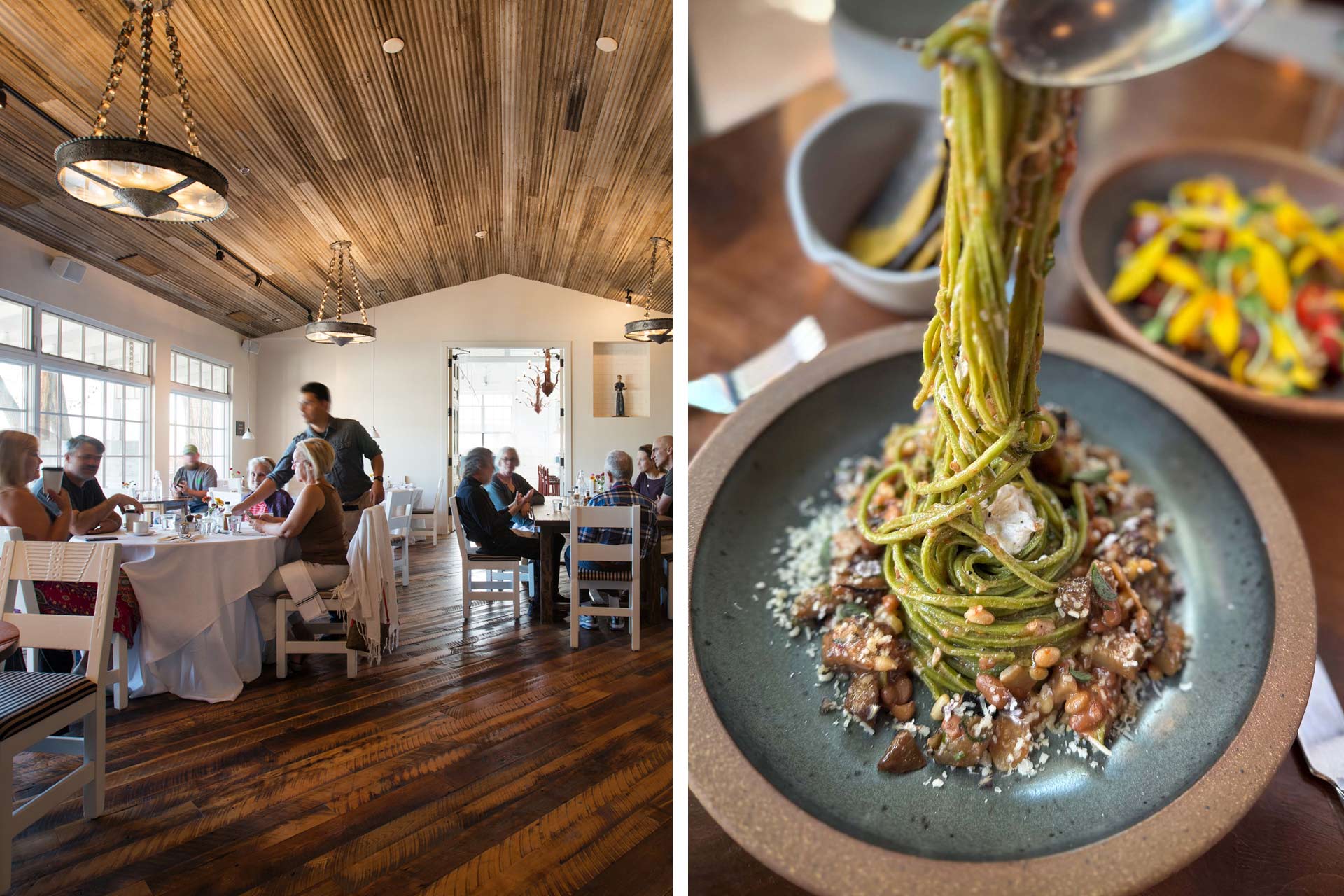
When you sit down for a meal at Campo at Los Poblanos you will get dishes that use every ingredient to the fullest. An example of this would be Chef Chris Bethoney’s favorite dish to make, pasta. He will take the vegetables from the farm and infuse them into the pasta dough. © Kate Russell | Amy Carrara/Campo at Los Poblanos
What kinds of foods can diners expect to find on the menu? What’s your favorite dish right now and why? At dinner, the menu is pretty diverse culturally. Like I said, I’m very mixed up culturally, and that’s representative on the menu. You’ll see typical New Mexican things. You’ll see your green chili, beans, corn, squash in almost every season, plus pasta, steaks, things like that.
My favorites right now are the tomato dishes. I always do a raw tomato preparation and a pasta preparation. Right now, it’s just tomatoes and sunflower, and we’re using a really good cold-pressed sunflower oil from Smude’s, and then the seeds, sprouts and petals as well — just a bunch of sunflower components, tomatoes, a little bit of that balsamic I mentioned, and basil from here, and that’s it. That’s probably my favorite, along with the pasta, with the tomato leaves in the dough and super fresh tomato sauce that’s not really cooked down. It’s just made to order with blended up raw tomatoes.
Why is it important for Los Poblanos and Campo to offer immersive experiences around food to its guests? It’s important because people like to get engaged, but it’s also an educational thing. We could teach people what’s going on around here, what’s going well, what’s going bad. What kinds of challenges the farmers have to deal with. I think the farm tours are the coolest for me, because you hear about all the things that — as a diner or person at a grocery store or a chef or whatever — you don’t think about. So, I think it just helps you get connected, like when you take a tour anywhere. Any tour I’ve ever done, I feel more connected with that winery or that farm or that chocolate maker or whatever it is. After that tour, you get to understand it more in depth.
The Chef’s Table is only for four people. All the servers are basically the cooks in the kitchen, so they’re running all the courses and describing them and answering questions. Basically, the point of it is to showcase what’s going on around us, what people around us are producing, what the seasons are, what’s coming off our own property, things we’re doing in the kitchen, and just trying to show them as many of those things as we can across that menu.
And then you get the opportunity to tell the guest that’s eating your food anything you want about it: Where everything came from if that’s what they’re interested in. Why we did it. What processes we used. These beets are ash roasted, and you point right behind you at the open hearth where they were on the right side under these coals and ashes a couple hours ago, and then now here they are. You get to tell them anything and everything, and typically those diners are more engaged than other diners.

The Chef’s Table at Campo is only for four people. All the servers are basically the cooks in the kitchen, so they’re running all the courses. It showcases what’s being produced, what’s seasonal, what’s coming off the property, what the chefs are doing in the kitchen, and showing the guests many of those things across the menu. © Doug Merriam/Campo at Los Poblanos
Hero image: Chef Chris Bethoney showing off the freshly picked produce to be used for the menu. © Doug Merriam/Campo at Los Poblanos
Thumb image: © Doug Merriam/Campo at Los Poblanos

Written by
Anne Banas
Anne Banas is the Head of Editorial for The MICHELIN Guide, North America.
Dining and Cooking