
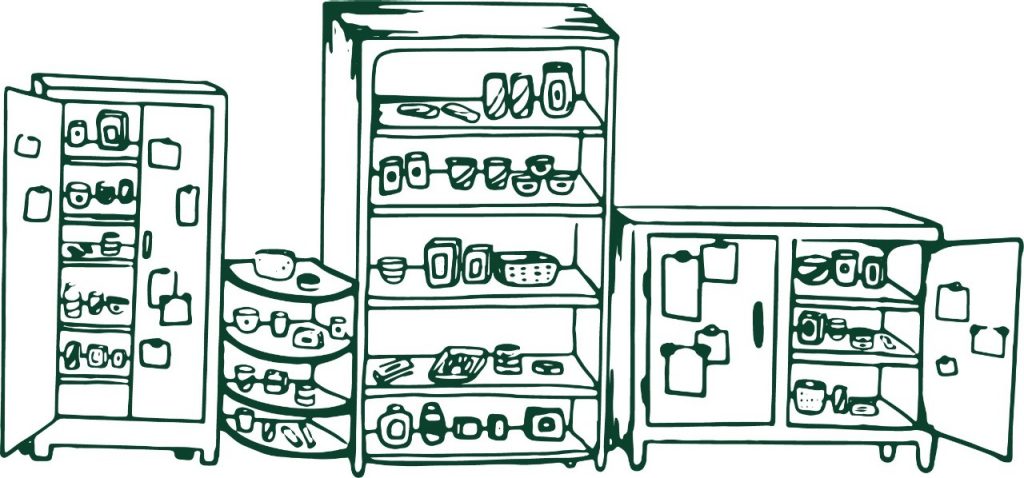
Ranging from small baskets of grab-and-go snacks to fully stocked pantries, food share cabinets emerged as a decentralized model to broaden food access support across the university’s campuses, with each cabinet tailored to its building’s population.
This challenge directly seeded the Food Share Coalition, formally established by VT Food Access. Though the coalition is decentralized, the VT Food Access team heavily supports the over two dozen food share cabinets, located in Blacksburg and at Academic Building One in Alexandria. Everything from answering questions, restocking five to eight kits per week, creating template materials, and responding to emerging needs. “We also provide biweekly office hours, biweekly onboarding sessions, and convene the coalition twice a semester for whole-coalition meetings,” said Largen.
Sharing means caring
“The Food Share Coalition operates on a sharing-economy philosophy — open to all without eligibility requirements, trusting users to take what they need, whether for hunger or just a snack between classes,” said Anna Zeide, founding director of the Food Studies Program in the College of Liberal Arts and Human Sciences.
Zeide and food science Professor Courtney Irene Powell Thomas co-lead the coordinated food share cabinet network in their college, a department-based stocking rotation shared among each of the departments housed in Major Williams Hall. “Each department is responsible for stocking the cabinet for one assigned month, either via physical goods or virtual payments,” said Zeide.
The initial stocking kit is provided by The Market and is replenishable up to six times per semester. Though the cabinets are primarily easy-prep meal focused, signage is in place to direct students with greater needs toward The Market.
Cabinet shelving is intentionally tiered: top shelves for grab-and-go snacks, bottom shelves for take-home items like canned soup. Top shelves generally see the most usage. Some cabinets also offer toiletries and hygenie products.
Dining and Cooking