

Digital subscribers can listen to this article.
Subscribe today for unlimited access to Texas Monthly. Already a subscriber? Log in.
Last Saturday morning, about a dozen women and a handful of obliging partners stood in line in Joy Wilson’s backyard. They had traveled from surrounding towns and cities to taste Wilson’s selection of buttery sweets and savory pastries, some of which they’d been cooking in their own homes for years using recipes from her blog, Joy the Baker, or one of her three cookbooks. I admired their fortitude. It was sweltering—one of those heavy, late-summer mornings that makes you rethink whatever poor luck or flawed choices brought you to Texas. But no one chatting and laughing in the line seemed to have any regrets. Nor, she told me later, is Wilson rethinking her own recent move to Bellville, she said. The small town an hour west of Houston is the ideal setting for the next phase of the Internet-famous baker’s life and career—one where she hopes to be far less online.
“I want diversity in my community,” Wilson, 45, said. That happens best when people with different life experiences, who might even disagree about politics, have places to connect. Maybe over a biscuit jammer. “What if we created that for each other?” Wilson pondered.
When we arrived at Wilson’s monthly bake sale, my friend Abby, who had driven from Austin with me, quickly hopped in line, eager to get her box of baked goods before they sold out. Abby has been following Joy the Baker for years, and when she heard that I was going to Bakehouse Texas—the Lone Star redux of the space Wilson started while living in New Orleans—she selflessly volunteered to drive. The day before we left, she texted me Wilson’s recipe for Everybody’s After-School Cookies. “Making these for my kids today in honor of our trip tomorrow,” she wrote.
That’s the kind of enthusiasm Wilson elicits from her longtime followers. When she started posting recipes in 2008, lifestyle and cooking blogs were a new thing, and hers was one of the first to get Internet-celebrity big. Politics were easy to ignore, social media was a playground, and the cynical fortunes of the influencer economy were still years away. At the time she lived in Los Angeles, where she grew up, and like many older millennials, she treated the Internet like a creative space. With a blog, the real-life baker who reported to work at 4 a.m. could share her talent on her own terms. And if she wanted to tell a fun story about her life to go with it, why not?
Denizens of the Internet in 2026 know exactly why not. But trolls, doxxing, cancellation—things Wilson is all too familiar with now—weren’t looming over her back then. She invited her growing audience into her life in a way that was comfortable and authentic for her. People felt—and feel—like they know her. “They do know me,” Wilson said. Joy the Baker is not a character she plays, and she doesn’t have it in her to be an influencer, she said. She’s on Instagram, but her middle-child personality isn’t strategic enough to plan her posts around paid content and product endorsements beyond those she genuinely likes and uses. “She’s a free spirit,” her mom, Patty, told me. Free to the point that a mother might worry over all her cross-country moves, penchant for riding motorcycles, and sharing with strangers. “I just have to give her to God.”
Wilson is determined to stay free, though she admits she’s more careful these days about what she shares, having learned the hard way what the Internet can do when it turns on you. “I’m a little more buttoned up,” she said.
A growing fanbase followed her move to New Orleans in 2014. There, she bought a double shotgun house in the Bywater Historic District, and she started teaching baking classes and hosting events in her home. It was also there, in 2019, that she met Houstonian Will Jorgensen at a Halloween party, where he was dressed as “the good” from The Good, The Bad, and The Ugly and Wilson was dressed as Tom Cruise’s character in Risky Business.
“She brought brownies,” Jorgensen said.
The couple moved to Bellville in 2024 and purchased one of the town’s grand-but-needy Victorian houses—one that leans conspicuously—and converted a portion of the detached garage into a miniature bakery storefront. Wilson understands something important about old houses in small towns. “It’s not really my house,” she said, whisking through the kitchen with a tray of cookie dough in softball-sized scoops. “It belongs to the town. I’m just taking care of it.”
Wilson and Jorgensen married in a surprise front-porch ceremony on Thanksgiving Day 2024. They welcomed a baby earlier this year, and because I am a thorough reporter, I made sure to hold the five-month-old myself. If Wilson’s buttery-soft scone was a baby, it would be him.
Her fans, including the ones lined up outside, know all these stories. Allison Crawford, 35, had driven in from Houston with women from her Bible study. “I’ve followed her blog for a long time,” Crawford said. She liked Wilson’s relatability as much as she liked the recipes. As a single woman in her thirties, Crawford said, she found encouragement in seeing another woman, who had married and had kids later, “having such a full life.”
“Where’s your Bible study?” asked the woman standing in line behind Crawford, a young mom with immaculate eye makeup somehow still in place, pushing a powder-pink stroller.
“Oh! Are you from Houston?” Crawford asked.
“I’m not, but she is,” the young mom said, pointing to her friend. “And she’s looking for a Bible study.”
The friend nodded. “I just moved.”
Those kinds of connections appeared to be happening all over the backyard, right up to the front of the line, where Wilson was packaging up her quickly dwindling supply in Baker-Miller-pink boxes. “You’re back!” one Bellville local exclaimed, celebrating the Bakehouse’s return after Wilson’s maternity leave. “I’ve missed you!” Wilson replied. Her veterinarian, who had not known Wilson was any kind of famous, was also in line, keen to try cookies made by the mom of Graham, Wilson’s hound dog. To whoever looked like they were about to swoon from the heat, Wilson gestured toward the back door of the main house and told them to go inside and cool off. “There’s laundry everywhere, so you’re family now,” she told them.
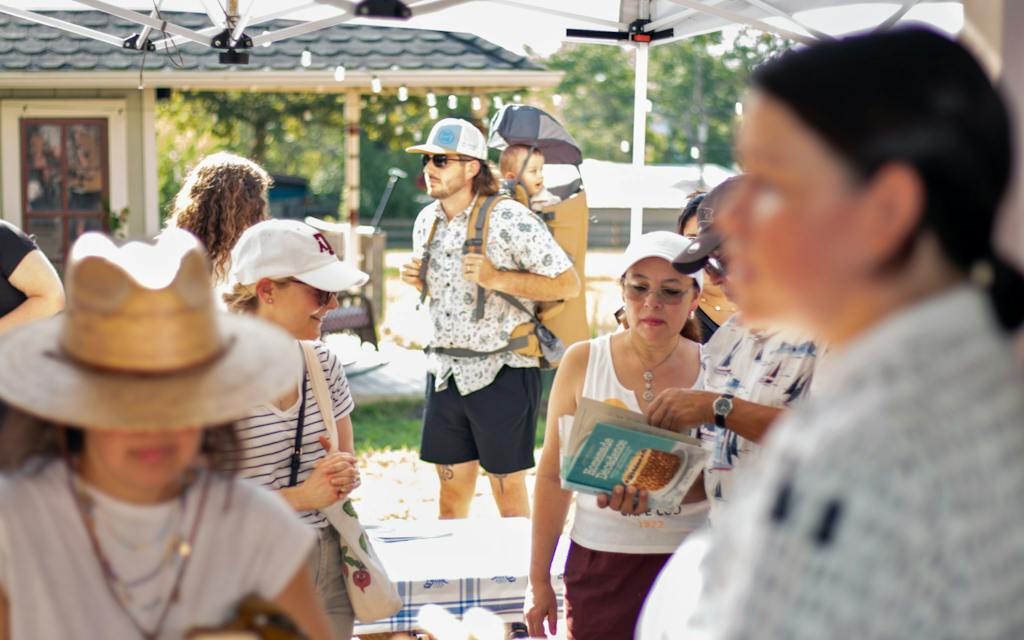 A Bakehouse event hosted by Joy Wilson (in the foreground) at her Bellville home in early September.Reid Bader
Inside, past the laundry room, groups of friends had deposited themselves around the various living spaces. Two silver-haired locals in crisp, collared shirts chatted on a loveseat in the parlor. At the kitchen island, a pair of sisters from Tomball chatted with Wilson’s Angeleno mother about her potential move to Texas. At the ten-foot dining table with inlays carved to look like croissants, a group of friends sat around their open bakery boxes, laughing riotously. They had met up in Bellville that morning, driving in from San Marcos, Georgetown, Round Rock, and Houston in pairs and trios. They planned to explore the booths lining the town square for Bellville’s Market Day.
I asked if they were fans or if Bellville was just a convenient location. They were fans—big fans. One of them had kept pastries from the December Bakehouse event in her freezer for months, slowly rationing them whenever she needed a treat. She’d finished the last one just weeks before. She was dividing today’s haul into containers to ration until next month.
“I’m jealous you got here in time for the scones!” I said, peeking into her box.
A pocket knife appeared from nowhere and the woman cut a generous slice of her precious scone—probably an entire day’s ration—and offered it to me.
“I couldn’t!” I said, having just heard what I’d heard.
“You must!”
I did.
It took exactly 45 minutes for Wilson to sell out of her famous chocolate chip cookies. Five minutes later, the cheddar-scallion scones were gone, followed by the biscuit jammers, brown-butter cornbread cookies, and olive oil polenta cakes with raspberry. By the end of the hour, Wilson put a handwritten Sold Out sign by the backyard gate. A couple from Austin pulled up moments too late but joined the party inside anyway. They stayed and chatted for a while before leaving to explore the farmers market at the park (first Saturdays are big in Bellville).
All of this—the lingering, the chatter, the reunions—is what Wilson wants. She wants to become even more connected to Bellville’s other first Saturday events, and she hopes the world of online culinary creation is headed toward more in-person happenings. Bakehouse Texas is not “simple or profitable,” Wilson said, “but I love it.” In small towns, bakers, chefs, and makers can more likely afford the space and time to be active parts of their communities. She sees the cottage bakery offering a kind of third space for people to do exactly what they did in her living room: chat and have a cookie; hang out with friends; look one another in the eye; get off the Internet.
The atmosphere Wilson generates in her Rifle Paper Co. apron is light and fluffy, but her desire to see communities unplug is urgent. As one of its earliest conveners, she’s watched online culture change: first in 2016 with the election of Donald Trump, then in 2020, when the pandemic left people to handle the turmoil of America’s racial reckoning in isolation and online echo chambers. “The Internet didn’t come back from that,” she said. In 2016, a large segment of her audience was angry she wasn’t supporting Donald Trump and let her know about it. In 2020, another group criticised her for talking about being biracial, when her “white-passing” features granted her privilege. It was intense, she said, but nothing compared to what was coming in 2026.
During last winter’s immigration enforcement surge on Minneapolis, Wilson was feeling anguished for the families trapped in their homes, afraid to go outside. She posted information about how to donate to food banks that were delivering groceries to those families. Almost immediately, on a different social media platform, her sister, Lauren, from whom she’d been estranged for years, posted on Threads, “You should know: my sister, joy the baker, is MAGA.”
She didn’t think much of the post at first. But as she soon found out, outing celebrities as either MAGA or leftists leads to supercharged engagement on Facebook and Instagram, and an army of trolls pulled Wilson into the frenzy. Her sister’s original post was nothing compared to what the social media algorithms did by amplifying it, Wilson said. “They did me dirty.” It was a “machine” she said, different from even the most heated discussions in 2016 and 2020. Bots, anonymous accounts, and death threats flooded her pages.
Around 20,000 of her more than half a million Instagram followers left, but that wasn’t what bothered Wilson—she’s happy to lose followers who don’t care enough to question the rumors. She was more bothered by people’s disconnection from the human on the other end of their rage. The same Internet that allowed her to reach families who folded her recipes into their holidays became a place where people retreated from their actual families into digital enclaves that rewarded extremes.
What Wilson did in response tracks perfectly with the person whose efforts I’d been observing all day. “I’ve been on the Internet long enough to know that I’m not going to say anything that can satisfy the people who need to be satisfied,” Wilson told me. “I do things on my own terms.” In late January, she blogged an essay not as a defense of her politics—though in it, she denies being MAGA or voting for Trump—but as a letter to her sister, telling her how hurt she was. “You stopped speaking to me. But you didn’t stop speaking about me,” Wilson wrote.
I will admit that all day I’d been wondering if Wilson was going to talk politics with me. Moving to Bellville had been proof enough for many that she voted red—though I am well-acquainted with the community enough to know it also has a liberal delegation. I’d listened for clues from her husband, mother, and in-laws and only managed to glean how much they love that squishy baby and old house. The chatter I overheard from fans who had gathered from far and wide signaled every inch of the political spectrum. When we sat down to talk, I wondered if Wilson would be celebrity savvy and dodge the conversation so as not to hurt her brand. Halfway through the interview, I thought it was more likely she’d refuse to give anyone the satisfaction of explaining herself or justifying her voting record.
But while contrarianism and authenticity are easily confused, they are not the same. “I want to be known, and I’m not afraid to be misunderstood,” she said. She is willing to be unequivocal when there’s a policy or candidate she believes in. She even agreed to let me put it on the Internet: “I’m really excited about James Talarico.” If anyone wants to talk politics, she said, she “respectfully dares” them to come over for coffee and cookies.
Read Next
Dining and Cooking