
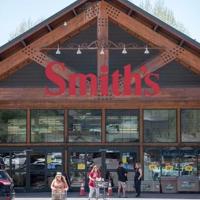
JACKSON — A Jackson man recently reported Smith’s to police and the Federal Trade Commission following an experience in which he overpaid for items he purchased Sept. 27 at the grocery store.
Kevin Cochary, 69, found that nearly 80% of the items he purchased that evening didn’t align with the advertised price. A message at the bottom of his receipt stating the store was having a “communication issue” isn’t sufficient, Cochary said.
“I looked at that, and I realized something like 32 out of the 41 items I had purchased didn’t register the advertised price, which was also the shelf price,” Cochary said. “$47.81 they had taken from my credit card, which I consider theft.”
Cochary, a retired chief park ranger since 2016, said he shops two to three times a week at Smith’s, a subsidiary of grocery giant Kroger. He’s always been a meticulous person, but now that he’s retired, he’s responsible for his household’s shopping and diligently checks his receipts.
He noticed the issue after he looked down into his cart after paying for his 41 items around 7 p.m. that night. He found two additional packages of bratwurst in his cart that hadn’t been rung up, so he initiated a second transaction. When the cashier handed him his receipt for the two bratwurst packages, which were on sale, he balked.
“I mentioned it to them, and they said, ‘Oh yeah, we’re having a communications problem with our register,’” Cochary said.
He didn’t know what that meant, but said the cashier was friendly and immediately gave him a $3 refund at the register. Around 11 p.m. that evening, Cochary said, he realized that if the small transaction had an issue, maybe he should look at his larger one for the 41 other items. He took notes on his receipt, comparing what he paid to what the sale flyer advertised.
Cochary provided a copy of his annotated receipt from that evening. In total, the cost was $133.65, but on most items, he found that he had paid between $1 and $2 extra. For other things, such as chicken and avocados, he paid $3, even $5 more. At the bottom of his receipt was a message providing the phone number for customer service, stating: “This location is experiencing a temporary communication issue. Please report any pricing related questions or concerns to Customer Care.”
Cochary reported the incident to the Jackson Police Department the next day. Lt. Russ Ruschill said the officer Cochary initially spoke with confirmed that Cochary should have been charged less; however, due to the disclaimer on the receipt, the officer found that it didn’t reach the elements of criminal theft in Wyoming.
Tina Murray, corporate affairs manager for Kroger in Salt Lake City, said the communications problem on the night in question prevented the register from giving a discount for digital coupons. Cochary received the sale price because of his Smith’s loyalty card but did not receive discounts for the digital coupons he clipped, Murray said.
“On Sept. 27, we experienced technical difficulties at the Jackson store which affected the application of sale prices and clipped digital coupons,” Kroger said in a statement Murray provided.
The company is encouraging any customer who may have been overcharged to contact the customer service representative at the store or call the customer care line at 800-576-4377.
A week after reporting the incident to the police, as well as a number of other agencies such as the Teton County and Prosecuting Attorney’s Office, Wyoming Attorney General’s Office and FTC, Cochary called the Smith’s customer care line. He said the first Kroger representative he spoke with was resistant to refund him in entirety.
“She was trying to give me $20 for almost a $50 mistake,” Cochary said. “That doesn’t seem to be in good faith.”
After she upped her offer to $30, a still-dissatisfied Cochary asked for her supervisor, who eventually provided $50 in store credit as well as 550 fuel points, which the supervisor found Cochary didn’t receive that night. The catch was significant, as fuel points are awarded at quadruple the rate on Fridays if customers have the right coupon, equating to 50 cents off per gallon.
Ruschill said on Oct. 10, Cochary was still dissatisfied, and the two talked that day. Afterward, Ruschill spoke with an assistant manager at Smith’s to learn what was going on. The assistant manager was “forthcoming” about the technical issues that happen at the store, and how frequent they are, Ruschill said.
“I learned that on a daily basis, their cash registers don’t necessarily ring up the correct price,” Ruschill said.
Ruschill paraphrased the manager, who told him that the breakdown could happen in any number of ways.
“There’s a portion of the company that does the ad prices, then there’s whomever programs the registers and point of sale systems, and then another person who puts up sale tags around the store,” Ruschill said. “When you have three systems, you have no system.”
Another Smith’s shopper, Haley Ross, 45, said she also has experienced discrepancies, so much so that it’s become a running joke between her and a neighbor. She’s been a Smith’s member since 2010, has the app and regularly clips coupons ahead of her shopping trips multiple times a week.
“The rough percentage of times that my receipt is incorrect would probably be over 50%,” Ross said. “I check my receipt 95% of the time, and then it’s correct maybe 50%, which is something to be improved upon.”
Normally, she tries to buy fewer items so she can scan and double-check, she said. Earlier this year, about six months ago, Ross said she was overcharged the most she ever has been, with her receipt showing about $20 over. She doesn’t always go back, but for that one she went to the customer service desk, where a staffer refunded her.
“Out of 20 items, maybe 10 were priced incorrectly,” Ross said.
It’s a lot to ask shoppers to check every price at the register, bag their own groceries and then check again, she said.
Ross never has seen a message about a “communications issue” on her receipt, but after reviewing the message, she said that language leaves more to be desired. She holds multiple jobs in Teton County, including communications director for St. John’s Episcopal Church. As someone who works in communications, she said, “I find that that term is just misleading. It’s not really clear.”
Other grocery chains — Safeway, Vons and Albertsons, all owned by Albertsons — have been called out for overcharging customers.
On Oct. 3, the stores agreed to pay nearly $4 million after allegedly overcharging nearly 800,000 customers in California. The judgment will require all three grocers to implement a price accuracy program that allows consumers to be compensated up to $5 if they are overcharged.
Prosecutors said Safeway and Vons stores were supposed to implement that price accuracy policy per a 2014 injunction, but failed to do so.
“There’s probably thousands of people out there that don’t even know this happened to them, and Smith’s probably took $20,000 over one day,” Cochary said. “And I have no idea whether it’s one day or two days or three, or how many stores were involved, if it was just the Smith’s or the overall Kroger chain of stores.”
Kroger’s Murray said she was aware of the problem occurring only on Sept. 27. But she invited customers who have concerns anytime to reach out. In particular, anyone who receives a message on the receipt about a communications issue should check with staff before leaving the store.
Any customer can present a receipt or Smith’s loyalty card, and store staff can review every item rung up at the register and verify whether the correct price was charged, she said.
“Smith’s is always very generous with customers and always willing to accommodate customers if there’s a problem,” she said.
Earlier this year, the FTC sued Kroger to block the company’s attempted acquisition of Albertsons, alleging that the supermarket merger would create an anticompetitive monopoly that would harm workers and consumers.
Lt. Ruschill said that due to the fact that Cochary consented to the payment amount, the disclaimer present on the bottom of the receipt and the fact that Cochary received a refund, no criminal intent was found and therefore no case was opened.
“We’d have to prove to a jury that Smith’s had every intention to defraud,” Ruschill said. “Just because somebody has a database problem doesn’t necessarily mean it was criminal.”
He hasn’t heard of this happening or seen that disclaimer before, Ruschill said. He urged shoppers to voice pricing concerns before providing payment and to double-check receipts.
Cochary would like to see signage in the store announcing future issues with the registers, better communication from employees who reiterate what the disclaimer means and a proactive internal audit from Kroger after such events.
“With that notification, we get the opportunity to say, ‘OK, maybe today’s not the day to do a big shop, I’ll just get some necessities and check the price,’” Cochary said.
“They could have … at least contacted the club members that have a Smith’s card and notified them that you may have been overcharged and to please contact us to get a refund, but as far as I know, nothing like that has happened.”
Get any of our free email newsletters — news headlines, sports, arts & entertainment, state legislature, CFD news, and more.
Explore newsletters
Dining and Cooking