

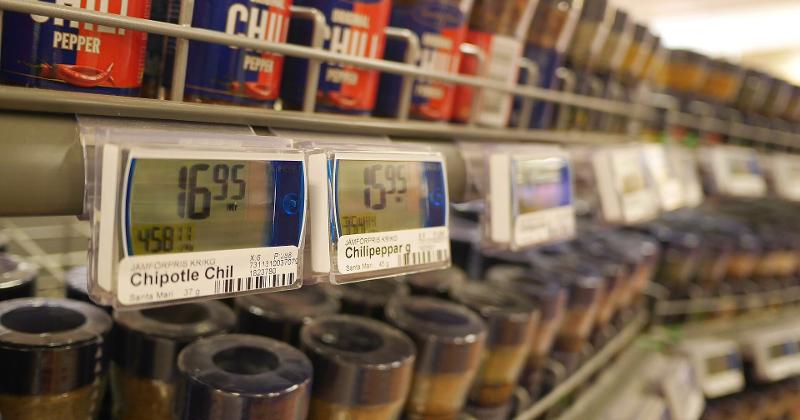
Digital pricing could soon hit retail shelves. | Photo Credit: Wikimedia Commons/Flickr/amsfrank

In February 2024, Wendy’s sparked public backlash by talking about the company’s experimentation with dynamic pricing. The idea that a restaurant would use surge pricing — typically associated with airlines and ride-share apps — to sell fast food for higher prices during peak times did not go over well with the general public, to say the least.
Now, almost three years later, the next generation of smart pricing is here, and the new question isn’t, “When should prices change?” but rather, “Who gets which price?”
It’s called personalized pricing: using consumer data to create custom discounts and retail prices based on what an algorithm or AI tool thinks an individual customer might be willing to pay.
Maryland just became the latest state to crack down on this new type of dynamic pricing. The state’s Protection from Predatory Pricing Act took effect on October 1, banning food retailers and third-party food delivery services from using customer data to set custom prices. A separate provision of the law requires other types of merchants — likely including restaurants — to disclose algorithmic or personal data-driven pricing to customers.
Other states are taking similar precautions against the use of customer data to dictate pricing. New Jersey passed the Fair Price Protection Act in July, which similarly bans grocery stores and third-party grocery delivery companies from charging different prices for identical products based on what an algorithm predicts a shopper is willing to pay, starting Aug. 1, 2027. New Jersey also enacted a one-year moratorium on electronic price tags for retailers, while the state’s government studies their legality and impact.
Connecticut, meanwhile, passed Public Act 26-130 in June. The new surveillance pricing law, which goes into effect on July 1, 2027, also prohibits retailers from using customer data to create personalized pricing. It also carves out exemptions for loyalty discounts, shipping/delivery costs and supply-and-demand pricing.
While big-box retailers like Walmart have denied using customer data to fluctuate prices in real time, grocery chains are experimenting with electronic shelf labels that can change prices digitally.
For the most part, these laws target retailers, not restaurants, and are largely a preemptive response to potential pricing strategies.
“A lot of the concerns are truly hypothetical at this point,” Paul Singer, a consumer protection attorney at Kelley Drye & Warren, said. “It’s more of a response to new technology that would allow a retailer to develop a pricing model using personal information, rather than in response to concrete, specific examples where retailers have engaged in those kinds of practices. … These laws want to make sure that two individual consumers who are similarly situated aren’t receiving two different prices for the same item.”
While restaurant operators are not experimenting with personalized pricing (yet), these laws open a whole can of worms around new-age consumer protection laws. As AI tools become more common for operators of all sizes, where do legislators draw the line? Are customized loyalty discounts based on previous consumer purchases allowed? Can operators use AI tools to recommend pricing to franchisees?
McDonald’s is currently under scrutiny over that last question. Following a story published in Reuters last week claiming the company uses AI to set prices, a McDonald’s customer sued the quick-service chain. The potential class action lawsuit alleges that the tool draws on data from millions of transactions to recommend menu prices across thousands of U.S. restaurants.
McDonald’s, for its part, has vehemently denied the content of the lawsuit, stating that while AI can recommend prices, ultimately the franchisees set their own pricing. The company says its pricing tools provide optional, restaurant-specific recommendations and do not automate prices.
That is not personalized pricing. But it shows how quickly algorithms and consumer data are moving into the pricing process, and the slippery slope from recommending prices for each restaurant location, to price-setting for individual customers.
These issues bring up several aspects of the law, including consumer protection, business regulation, data privacy and AI regulation, the latter of which is new ground legally. That’s what makes them so complex, and ultimately, why restaurants should pay attention, even if these new pricing regulations specifically target grocery retailers.
“It all intersects together,” Singer said. “We’re asking the question, ‘How are we using these new technologies, and AI in particular, to make consumers pay more?’ These laws are targeted for now, but that won’t always be the case. Any business that is collecting personal information could be impacted.”
Dining and Cooking