

This series will feature some of the oldest restaurants across the state. Come with us as we journey down memory lane to explore these eateries’ early days, and see where they are now.
When she was coming up with ideas for the wallpaper for Tūtū’s Place — Highway Inn’s cafe at Bishop Museum — Highway Inn president/owner Monica Toguchi Ryan recalls looking at the menu collection from DeSoto Brown, the historian at the museum.
The cafe’s wallpaper was inspired by vintage menu covers; among them was now-closed Kekaulike Poi Bowl.
“We selected a bunch of menus of restaurants that no longer exist (as inspiration for the wallpaper),” Toguchi Ryan says. “Unbeknownst to me, that is where my grandfather (the founder of Highway Inn), learned how to cook Hawaiian food. When I saw the image (of the menu), I thought, ‘There’s a lot of stuff on here that we cook, like naʻau; we used to do lomi ʻōʻio.
“When we had our Tūtū’s Place blessing, my auntie came in and was like, ‘That’s where grandpa worked,’” she adds. “That’s where he learned how to cook Hawaiian food. That was serendipitous.”
 Seiichi and Nancy Toguchi, founders of Highway Inn. Photo courtesy Highway Inn (Highway Inn)
Seiichi Toguchi — Toguchi Ryan’s grandfather and the founder of Highway Inn — wasn’t necessarily planning to start a restaurant business. According to Toguchi Ryan, Highway Inn’s early days are “a story about survival.” She explains that her grandfather had a third-grade education; when Pearl Harbor was bombed during World War II, her grandfather, who was Okinawan, was taken by the U.S. government to an internment camp.
“When you got into these camps, you had to list what your occupation was,” she explains. “My grandfather indicated that he was a cook. He was placed in the mess hall with other Japanese Americans around the country during the war. That’s the reason why we have a lot of American dishes — like hamburger steak — on the menu; it’s from my grandpa’s time there.”
Toguchi Ryan’s grandfather returned to Hawaiʻi in January 1946. After trying out various occupations, including a pig farmer and junk collector, Toguchi resorted to cooking.
“A lot of Okinawans were pig farmers, but he (my grandfather) joked that his pigs got skinnier; he was not doing it right,” she says. “He went back to what he knew, which was cooking.”
Toguchi found a place on Farrington Highway that came with a little two-bedroom house, which was basically a living room and one bedroom, according to Toguchi Ryan. But that was enough to house his family and start Highway Inn.
“He loved Hawaiian food; he wanted to do Hawaiian food and share that it was really good,” she says.
The original Highway Inn was located on Farrington Highway and opened in September 1947. According to Toguchi Ryan, the business’s name was derived from its physical location.
“At that time, there were a lot of other well-known restaurants like Wisteria Inn,” Toguchi Ryan explains. “Highway Inn derived its name from that time period, when a lot of restaurants were calling their restaurants ‘Inn.’”
From talking to customers — now in their 70s, 80s and 90s — who went to the original Highway Inn, Toguchi Ryan says the eatery was “quite popular,” due to its location.
“I had to ask my uncle and my dad to draw a picture of the original Highway Inn on Farrington Highway, because we don’t have it (a photo) in our albums,” Toguchi Ryan says. “For Tūtū’s Place, I had to ask my uncle to draw what it looked like out of memory. Had I not asked my uncle — and he’s 82 years old — we may never have known what the original Highway Inn looked like.”
When Highway Inn first opened, its menu featured a combination of dishes that Toguchi learned to make at Kekaulike Poi Bowl, along with dishes — corned beef and hash, sirloin cutlets and corned beef cabbage — he made at the internment camp.
“I think the top dishes were always the pipikaula, the lau lau and beef stew,” Toguchi Ryan says. “The naʻau and tripe were far more popular back in the day. You’re old-school if you come into Highway Inn and ask for the naʻau (intestines), because that’s not the easiest dish to eat.”
The move to Depot Road
In the 1960s, Highway Inn moved to Depot Road, which is “what a lot of people remember,” according to Toguchi Ryan, who says that location was right across Arakawa’s, a plantation store.
“When it (Highway Inn) was on Depot Road, there were a lot of customers who would share memories of standing in line to wait to eat because the restaurant was so small,” Toguchi Ryan says.
According to Toguchi Ryan, Highway Inn’s Depot Road location had four booths, a community table and tall green seats. The kitchen was small, and her grandpa started out with only three employees. Back then, the restaurant was only open from 7 a.m. to 2 p.m.
“The bathroom was outside, so you had to take this funky key to go outside and open the door,” Toguchi Ryan remembers. “People would tell me they remember seeing the pipikaula hanging in the kitchen. I have memories of going across to Arakawa’s and playing in their clothing racks, then going back to Highway Inn and eating stew and rice at my grandpa’s place when it was closed (for the day).”
The second generation: Bobby Toguchi Bobby Toguchi. Photo courtesy Highway Inn (Highway Inn)
Toguchi Ryan’s father, Bobby, was in a “completely different career” when he transitioned to take over the family business. When her grandfather retired, Highway Inn was 30 years old, and Bobby Toguchi was working for Japan Airlines. Toguchi Ryan says she gave her father “a lot of credit” because his days always started early.
“He would go and work with my grandfather from 4 to 6 a.m. every day for several years before he fully committed to take over for my grandfather,” she says. “My father had incredible discipline like that.
“When he took over in the late ’70s, my grandfather said to my dad, ‘I will be with you for five years to help you,’” she adds.
According to Toguchi Ryan, her grandpa would still come into the restaurant to do tasks like peeling potatoes. Her father and his dad would also have a weekly routine of cleaning the equipment on Sundays — when the restaurant was typically closed all day — and then have breakfast together.
Closing early on Sundays and being closed on major holidays is something that Highway Inn still does to this day, so that employees can spend time with their families.
“Sundays are a really important thing for my family; that’s the reason we close at 3 p.m.,” Toguchi Ryan says. “That is the one time our staff knows they can spend time with their families, the way I did growing up with my grandpa and my cousins, my aunties and uncles.
“My grandfather lost his wife so early; his grandkids were his joy,” she adds. “It was important for him to see his family every Sunday. That is what he looked forward to; he cooked for the entire family every Sunday for dinner.”
Seiichi Toguchi lived until around 79 years old, according to Toguchi Ryan. She remembers visiting him when he was sick at St. Francis West; she recalls he initially went to the hospital due to a pneumothorax (collapsed lung).
“I would hang out with my grandpa in the hallway; we would check out the nurses together,” she says, chuckling. “My grandfather made a white curry dish that I loved; he would make it as a special (at the restaurant). Before he passed away, he said, ‘I’m going to get out of here and I’m going to make the curry dish for you when I get home.’”
Toguchi Ryan still remembers the last time she saw her grandpa before he died in January 1994.
“I left for the Mainland for a quick stint, and he was in a wheelchair, back at home,” she says. “He cried (when I said good-bye to him); that was the last time I saw him.”
Many of the dishes on the Waipahu store’s menu were there from the time that the restaurant opened, but under Bobby’s leadership, new dishes were introduced. Haupia, squid lūau, and kalua pig were all added to the Highway Inn menu once he fully took over.
“My father opened up a seafood market in 2000,” Toguchi Ryan says. “That was a time we were going through a recession, and my father struggled with the business, as many people were. He decided he was going to expand; he expanded the seafood market with poke.”
Highway Inn’s current Waipahu store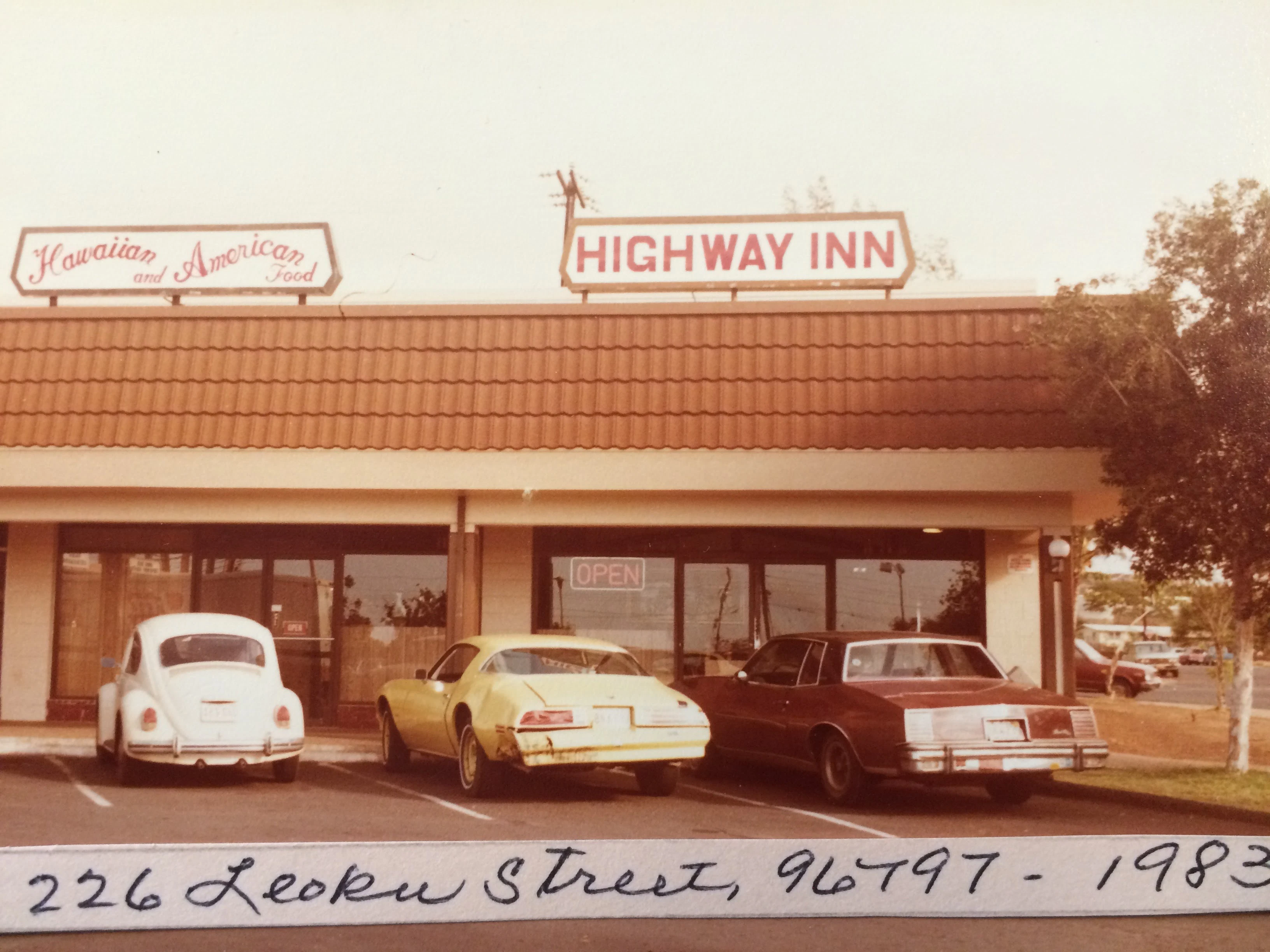 The Waipahu store was at its Leoku Street location for more than 30 years. Photo courtesy Highway Inn (Highway Inn)
When a small fire happened at the Depot Road location, Toguchi Ryan’s dad moved the restaurant to Leoku Street.
“He moved it (Highway Inn) to Leoku Street around 1983; he realized the building we were in was quite old,” Toguchi Ryan says.
After 35 years of having the same address, the restaurant moved again — this time, to its current location on Moloalo Street. Toguchi Ryan remembers the master lease on the Leoku Street location was coming up, and with that, there was uncertainty about the property’s future.
“We were also getting the business to the point where it just made sense to look for another location in Waipahu that would support our needs,” she says.
 Highway Inn’s current Waipahu location opened in 2020. Photo courtesy Highway Inn (Highway Inn)
Highway Inn’s last day at the Leoku Street location was in December 2019; the biz opened in its current location in January 2020. The restaurant’s state-of-the-art photovoltaic system — which produces nearly all of the venue’s power needs — is one of its most impressive features, according to Toguchi Ryan.
“There’s certain elements about our business where we try to be very progressive in mind — preserve the old, but try to be forward-thinking in other ways,” she says, noting that the Waipahu location is one of the most energy-independent restaurants in Hawaiʻi.
 The Waipahu store honors the past through its decor. Photo courtesy Highway Inn (Highway Inn)
The Waipahu store still features old photos of what the community used to look like, news articles about the restaurant’s early days, and photos that were from the Arakawa store.
“We thought that was important because we honor the past,” Toguchi Ryan says. “I think that (concept) always resonated with us here at Highway Inn because we’ve been around for so long.”
There are even mementos and old décor from the business’s previous locations throughout the restaurant. Near the host stand is a butcher block, where Toguchi Ryan’s grandfather and father would make lau lau.
“We were small enough (then) to have that little butcher block,” she says. “They would also cut lomi aku (on the block); back then, we served aku (instead of ‘ahi). The sign that says ‘Waipahu is made out of sugar cane’ is from the Arakawa store; we were able to borrow it from the Arakawa family.”
As an adult, some of Toguchi Ryan’s fondest memories is seeing the multi-generational families of customers who still come to dine at the restaurant.
“We see a lot of people quite often and then they pass away,” she says. “We see children growing up to be adults and have their own children.
“I think the best thing for me was people sharing with me about my grandmother,” she adds, noting that her grandma, Nancy Toguchi, died in 1975. Since she was only 3 years old at the time, Toguchi Ryan says she has no memory of her grandmother.
“All the things I know about my grandmother — who helped my grandfather open Highway Inn — these stories have come through customers,” she says. “That’s been quite special.”
One of her favorite stories of her grandmother revolved around her generosity.
“It wasn’t unusual where people would come in and eat, and then realize they didn’t have the money to pay,” Toguchi Ryan says. “They had books of what you owe stores; that was their version of credit. My grandmother would say, ‘That’s OK, you pay next time.’ My grandfather would be so mad because he was the one paying the bills!”
Expanding to Honolulu
Toguchi Ryan recalls looking at Google Analytics and seeing that there was a lot of interest in Highway Inn from individuals in the Honolulu area.
“Highway Inn in Waipahu was an ‘if you know, you know’ kind of thing because we were out here in the country,” she says. “We were paying attention to these Google analytics and thought, ‘OK, maybe it’s time to open a second store.’
Toguchi Ryan’s team looked for a town location for two years, but nothing was the right fit. Then, the business was approached by Kamehameha Schools in 2011.
“Kamehameha Schools was looking to develop their property,” she remembers. “When Kamehameha Schools reached out to us, we started a conversation; the timing was just right.”
At the time, the 680 Ala Moana property — where Highway Inn’s Kakaʻako location is — wasn’t developed.
“We were really taking a risk,” Toguchi Ryan says. “There was a lot of pressure, in a sense, but we also received a lot of support from Kamehameha Schools, in regards to coming to town. That was quite a challenging experience because I’ve never done it before.”
 Highway Inn’s Kakaʻako store opened in 2013, and continues to be a popular destination for local-style comfort food. Photo courtesy Highway Inn (Highway Inn)
The Kakaʻako store was developed in 2012 and opened on Oct. 20, 2013. Toguchi Ryan remembers Hank’s Haute Dogs and Paiko being there, along with the beginning of the street art on the Kakaʻako walls.
“When you know what the vision is years ahead of it being developed and to see it all come together — to be part of that process is really fascinating for me,” she says.
 Highway Inn’s restaurants continue to focus on Hawaiian food. Photo courtesy Highway Inn (Highway Inn)
The menu at the Kakaʻako restaurant is slightly different from the one at Highway Inn’s Waipahu location. While Hawaiian food remains at the eatery’s core, other dishes have been added to the Kakaʻako menu to appeal to Honolulu’s visitors.
“There are items like the fish tacos, that started off in Kakaʻako and we ended up bringing to Waipahu,” Toguchi Ryan says. “We do kalua pig nachos; that’s something that we didn’t do before. That’s really to address the diversity of clientele that an urban community like Kakaʻako would attract.”
The eatery’s roasted garlic ʻulu lūʻau dip — a Hawaiian-style version of spinach artichoke dip — and lau lau spring rolls, which are filled with the eatery’s signature pork lau lau, are newer menu items.
“It’s funny because here in Waipahu, they don’t care about our specials as much as maybe people in town (do),” Toguchi Ryan says. “Before they walk in the door, they want their usual (order); they know what they want.”
 Lau lau spring rolls are filled with the eatery’s signature pork lau lau. Photo courtesy Highway Inn. (Highway Inn)A third generation takes over
When it came to the family business, Toguchi Ryan says she “intuitively knew, at some point, it would come her way.”
“My father has four girls, and I’m significantly older than the next daughter by six years, but it (the business) came my way a bit too early,” she says.
Toguchi Ryan’s father suffered a stroke in 2003. At the time, Toguchi Ryan was a Ph.D. candidate in psychology at the University of Oregon; she returned to Hawaiʻi to help her younger sister, Regina, run the store. Toguchi Ryan and her sister co-managed the store from 2007 to 2009.
Toguchi Ryan earned her Bachelor of Arts in business administration for the University of Hawaiʻi at Mānoa; she eventually earned her Master of Education from UH Mānoa as well. She took over sole management of Highway Inn in 2010. Around that time, Guy Fieri’s team from Food Network’s “Diners, Drive-Ins and Dives” reached out to Highway Inn to be featured.
“Triple D was super popular back then; it was in the height of its time in the 2000s,” Toguchi Ryan recalls. “They called us to be featured; it was Nico’s (Pier 38), Hank’s Haute Dogs and Highway Inn. We filmed in October; when it aired the following year, in 2010, it aired on my grandpa’s birthday. On April 5 — my grandpa, who started Highway Inn — that’s the day we went national.”
In 2011, Toguchi Ryan took over ownership from her father. In 2015, Highway Inn partnered with the Bishop Museum to open a third restaurant on the museum campus. Last year, the museum cafe was rebranded and re-opened at Tūtū’s Place.
Industry lessons
Highway Inn prides itself on making all of its food in-house. Its lau lau, in particular, is known for being wrapped in ti leaves by hand. But, in the current economy, having a quality product while retaining staff remains difficult, according to Toguchi Ryan.
“It’s hard for people to understand that for a local homegrown brand like Highway Inn, it’s hard to keep the costs down,” she says. “Our prices on our menu are not dynamic; they’re fixed. When it’s fixed pricing, it’s very hard to absorb this (rising prices of ingredients).
“With labor shortages, sometimes we just struggled to get through the demand,” she adds. “I’m so proud that we make everything here, even our sauces. It’s hard to be consistent when you’re serving so many people across multiple locations.”
Food cost increases, minimum wage increases, rent increases and increases in insurance costs are all “hard costs that restaurants have to bear,” according to Toguchi Ryan. For individuals looking to get into the restaurant industry, she refers to having “the eye of the tiger.”
“This business is rough,” she says. “Think about how many restaurants survived over the course of time. Whatever cuisine you do, you have to do it because you love it, and there’s a strong passion that never dies.”
While she acknowledges that Hawaiʻi’s tough economic environment has its challenges, she says the local culture and Aloha Spirit are unmatched.
“You have this culture that is, at the end of the day, about relationships,” she says. “It’s about reciprocal relationships; it’s about family being fundamentally important. That helps to counter some of the negative parts about doing business here in Hawaiʻi.”
Speaking of relationships, giving back to the community is important to Toguchi Ryan, who explains that Highway Inn’s frequent diner program is a way to give customers rewards throughout the year.
“I love when I go to local businesses and there’s a rewards program,” she says. “My sister Regina started this (our frequent diner program) in 2006. My sister had the foresight of recognizing that we want to find a way to thank our regular customers; we have been doing this for the past 20 years.”
Highway Inn’s frequent diner program is free to join; benefits include double points on your first order; 5% cash back on all restaurant food, beverage and merchandise; and a special reward to celebrate your birthday each year, to name a few.
‘The best reward’
Over the years, Highway Inn has gained recognition, been mentioned in state and national publications, and won numerous awards. Highway Inn is a two-time U.S. Small Business Administration, Honolulu County “Family Business of the Year” winner (both in 2006 and 2014) and was named the 2023 Hawaiʻi State Women-Owned Business of the Year by the U.S. Small Business Administration. The latter is especially meaningful to Toguchi Ryan.
“I have a largely woman-led management team, and I’m exceptionally proud of that,” she says. “I can honestly say it’s the people that are doing the everyday lifting — our managers and general managers — that really give Highway Inn the growing credibility. We’ve won a lot of awards during the years, and it’s not possible without a great team.”
Seiichi and Nancy Toguchi are also inductees in the Hawaiʻi Restaurant Association’s Hall of Fame, which is “a huge honor,” according to Toguchi Ryan.
“It was my grandparents and my father who really shouldered the laborious part of growing the brand for 60 years, without much accolade or fanfare,” she says. “A lot of the attention is on me now, as third generation. But what was happening prior to me stepping into the business? They were quietly making the lau lau, making one pot of stew every single day.
“At the end of the day, it’s not about the awards,” she adds. “It’s what you do every day and whether your customers come back and still regard you as a place worthy of revisiting. The best reward is when people come back.”
Next year marks Highway Inn’s 80th anniversary. When thinking about the future, it’s important to Toguchi Ryan to stick to the business’s core values.
“It’s not about growing; it’s really being able to serve a good product and have a company that is thriving,” she says.
“I hope my parents are proud and my grandparents are proud, because they really started from nothing,” she adds. “Being the granddaughter and now being the matriarch of this business, but also being the matriarch of one of the largest Hawaiian food restaurant businesses, is quite a story to tell when you come from humble beginnings. It’s really this idea that every generation works hard for the next generation.”
Kelli Shiroma Braiotta can be reached at kelli@alohastatedaily.com.
For the latest news of Hawai‘i, sign up here for our free Daily Edition newsletter.
Dining and Cooking