

You might need to have passed an upper-level statistics class to fully grasp what’s going on with college and university enrollment trends. U.S. college enrollment rose 1% overall in 2025, per a report from the National Student Clearinghouse Research Center. At public four-year universities, enrollment was up 1.4%, driven by a 1.9% jump in freshmen.
Yet the longer-term trend shows enrollment slumping across all colleges and universities, says Peter Stokes, managing director at Huron Consulting Group. “U.S. higher education enrollment has declined from a high of about 21.5 million in 2010 to about 18.5 million today,” he explains. It’s a result of not only the much-discussed demographic cliff associated with the nation’s lower birth rate, he says, but also a “demand cliff.” Today, 63% of high school seniors apply to attend college the year after they graduate, as compared to 66% in 2019.
 On the other hand, high school students who are aiming for college are applying to more institutions. This is especially true of highly selective campuses. Between 2015 and 2024, the number of applications submitted to the 113 most selective U.S. colleges and universities rose 62%, according to college admissions consulting firm College Transitions. But it’s being seen across the board. Per a report from Common App (the primary way high school students now apply to colleges and universities), 1.4 million high school seniors had submitted more than 9.2 million college applications by early 2026 — seven per applicant — up 5% from the same time last year.
It’s complicated, acknowledges Robert Nelson, president and CEO of NACUFS, the National Association of College & University Food Services. “Higher education is not experiencing a straightforward decline,” he says. “Some institutions are gaining; some are facing declines. Undergraduate enrollment is below pre-pandemic levels, and post-pandemic shifts continue to shape the landscape.”
While overall enrollment is on the decline, the number of college students using meal plans is rising, Nelson says, and not just because of more freshmen moving into residence halls. He explains, “There’s greater reliance on campus dining even from students living off campus. Rising off-campus housing, transit and food costs can make meal plans more attractive, even two or three times a day.” Flexible meal plans provide those off-campus students with access to both retail and residential foodservice.
And dining can be a differentiator in attracting prospective students to one campus over another. This year, “Best Colleges” from The Princeton Review ranks 391 colleges and universities on different attributes based on surveys. The 2026 College Hopes and Worries survey asked students and their parents to rank which considerations mattered most in their college searches. While academics understandably topped the list, financial aid and amenities — campus facilities, dorms and food — tied for second place, with 69% saying amenities were a key consideration.
Let’s take a look at how four universities are updating dining services for today’s students.
 The dining facility at Indiana University’s new Wright Hall complex welcomes students with natural light, colorful history-focused murals, and stations with front-of-the-house prep. A separate kitchen serves foods free from gluten, nuts and shellfish. Photos courtesy of Indiana University Dining & Hospitality
Bloomington
New tech for a state-of-the-art food hall
Indiana University (IU) Bloomington has seen a steady year-over-year surge in applications and enrollment. The 10,682 new undergraduate students who arrived at the Bloomington campus in the fall of 2025 represented an 11% jump from the 2024-25 incoming undergraduate class. Over the past decade, IU Bloomington’s average incoming class has grown almost 25%.
Rahul Shrivastav, executive director of the self-operated IU Dining & Hospitality department, has witnessed the divergent and fast-moving trends in college enrollment over the course of his career. Shrivastav previously worked at Penn State and the University of Michigan, and he chaired the board of NACUFS last year.
“Impacts at different campuses are all over the place,” Shrivastav says. “There are more women joining freshman classes. There’s less international enrollment. There’s strong brand awareness, with students choosing their college strategically based on what majors they think will do well in coming years. It’s a very competitive landscape.”
During such dynamic times, dining services become more important than ever. “Dining locations are where students interact with each other without being in a programming space,” Shrivastav points out. “You might sit next to someone, form a bond and become best friends. The dining hall becomes a home you come back to every day. It’s what you remember about college.”
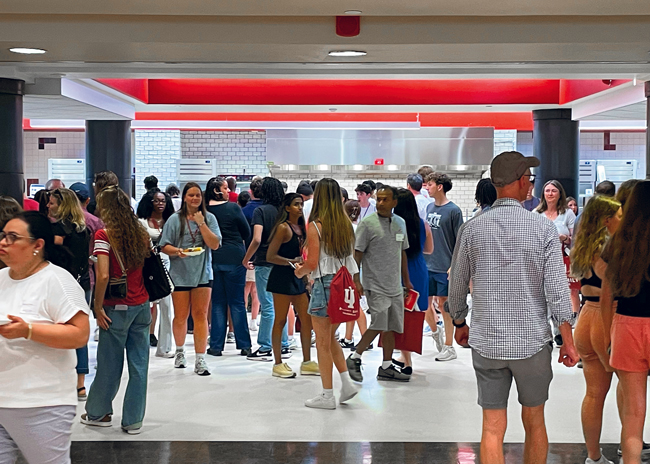 Photo courtesy of Indiana University Dining & HospitalityTo house and feed a growing cohort of students living on campus, the university overhauled a residence hall complex, the Joseph A. Wright Quadrangle, reopening it in September 2025. The new Wright Dining Hall features abundant natural light, colorful murals and an array of stations with front-of-the-house prep. Stations include Medley for soups, salads, fruits and veggies; Spice Road for international cuisines including Indian, Japanese, Indonesian and Middle Eastern; Slice for brick-oven-baked pizza; Clubhouse for panini and sub sandwiches; Stone Grill, with burgers, chicken sandwiches, tenders and fries; Scratch Table, which switches daily from breakfast fare to lunch and dinner comfort foods; and Worry Free, where all items, prepared in a separate kitchen, are free from gluten, nuts and shellfish.
IU’s emphasis on scratch-made meals and locally and ethically sourced food pairs with attention to supplier partnerships. The university sources beef and pork from Indiana-based Fischer Farms; milk, cheese and ice cream also come from local purveyors, and the IU Campus Farm and Hilltop Gardens supply tomatoes, peppers, zucchini, and more.
The dining director also believes it’s important to keep up with the latest developments in foodservice equipment and related technology. “One of the key things that’s happened is better technology in fleet dish machines, so we’re pretty happy with that,” he says. “We buy combis and speed ovens with the latest technology so our employees have the best possible equipment to do their work. We don’t do pricing or labeling by hand; we use a nutrition app.”
For the dining hall at Wright, Shrivastav says, “We went with more large ovens for back-of-house prep, combined with finishing woks, fryers, grills, skillets and smaller combis for front-of-house finishing. There’s an open kitchen with servers everywhere you look.”
 A rendering of the 830-seat dining hall in the University of Michigan’s new Wolverine Village complex, set to open in fall 2026. Rendering courtesy of RAMSA (Robert A.M. Stern Architects)
Ann Arbor
A brand-new residential complex
Undergraduate application and enrollment numbers at the University of Michigan remain on a slow rise. By February 2026, the school had received more than 115,000 applications for the coming fall, a 29% increase over the past five years. The 9,711 undergrads enrolled in fall 2025 represented a 12% jump over the same period.
“We’ve had a record number of applicants over the last three to four years; the freshman class has grown; and we anticipate that the trend will continue over the next couple of years,” says Steve Giardini, senior director of Michigan Dining, which has been self-operated since ending an Aramark contract in 2025.
Michigan Dining deals with some additional pressures. “Any admitted first-year student who wants to live in university housing is guaranteed a spot,” Giardini notes. “And students not living in university housing are also buying more meal plans.”
In fall 2026, the University of Michigan will open the first phase of the new Wolverine Village, a central-campus complex designed to house 2,300 students across five residence halls. Amenities include laundry facilities, computer learning centers, community kitchens and a state-of-the-art 830-seat dining hall.
 A view from the entry of the Wolverine Village dining hall toward the salad bar featuring fresh produce from the University of Michigan campus farm. Rendering courtesy of RAMSA (Robert A.M. Stern Architects)While existing residential dining facilities at the university offer up to 10 self-sufficient, front-of-the-house stations, the design of the new hall will save labor by featuring just three self-sufficient stations, with other stations backing up to a production kitchen behind the service line.
“We took the best practices from our nine existing dining halls to design the new space,” Giardini explains. “We also surveyed students, did Q and A sessions and asked students for feedback on a variety of seating and table options.”
The new dining facility is “smart, sustainable and all-electric,” Giardini says. “We’re excited about newer versions of equipment we have in the other dining halls, that come with tools to help staff create more consistent menu items.” He mentions recipe programs that notify the cook when it’s time to add a certain ingredient and a tilt skillet that also functions as a kettle and pressure cooker.
Giardini says his department, which has no commissary, continues to struggle with large-scale food production in compact kitchens. “Our staff numbers have increased slightly, but at a far lower rate than the number of meal plans,” he says. “To give students a wide variety of choices and a program we can be proud of, we push the envelope on production. We bring in speed-scratch products. We look for multifunctional equipment. We use a lot of combi ovens because they’re really versatile. We continue to work with manufacturer partners, but we’re still waiting for automation to catch up to the scale of the food quantities we want to produce.”
 The rethinking of the ground floor Cox Hall Food Market is part of a remodel of Cox Hall, Emory’s central campus community hub featuring lounges, meeting rooms, a computer lab and university offices. Photos courtesy of Ricca Design Studios
Atlanta
Transforming a food hall to a market model
In the run up to the 2026-27 academic year, Emory University in Atlanta received 43,269 applications and admitted 5,317 students, or 12.3%. Emory clearly isn’t having any issues attracting applicants. But a beautiful, contemporary food hall with healthy eating options and the latest technology is always something universities can market to impress prospective students and their families, says Garret Sletten, a principal at Ricca Design Studios. Ricca was the foodservice design consultant on Emory’s newly transformed Cox Hall Food Market, collaborating with the university administration, its dining contractor Bon Appétit, and architects Arcturis | Square Feet Studio and Perkins&Will on a major remodel.
Located on the ground floor of Cox Hall, a central-campus community hub, the dining facility reopened in fall 2025. It was the final part of a building overhaul that included updates to the two floors above, which house lounges, meeting rooms, a computing center, an arts and technology lab and the Belonging and Community Justice offices.
 Emory remodeled its Cox Hall food court to create a more efficient service model — a true food hall with point of sale at each service counter, instead of a single checkout. The redesigned Cox Hall Food Market is an airy, welcoming retail operation open to the surrounding community. Photos courtesy of Ricca Design StudiosThe goal of the dining hall renovation was a new service model, Sletten says. “The hall had a scramble server with different platforms where students would get food and drink and then join a long line with everybody else for the same checkout,” he explains. “If you wanted grab-and-go, you’d get in the same line. The functionality made no sense. Emory wanted a new model in which diners would pay at a dedicated POS at each platform counter.”
The new Cox Hall Food Market serves more than students; it’s a retail operation open to the public, including traffic from the adjacent Emory University Hospital campus. “Nurses, doctors, patients and hospital guests know they can get a quick meal there,” Sletten explains. “The new food-market model engages the public, provides interaction with the neighboring hospital and doesn’t feel confined.”
A diverse selection of stalls offers everything from burgers and sushi to grain bowls and Mediterranean dishes. Grab-and-go customers are served by a separate cashier-less store. The food hall’s back-of-the-house kitchen was untouched by the remodel.
While Cox Hall Food Market provides a solution for a specific problem, Sletten explains, “most college campuses are looking to change some outdated processes in scratch cooking, on-site finishing, being able to cook healthy food in a cost-effective manner.” In addition, “technology is always advancing, labor-saving options make the back of house more efficient, and new equipment saves on energy and water costs.”
 The University of Tennessee Knoxville partnered with developers of privately owned off-campus student housing for Cumberland Food Hall, a facility on the ground floor of the Hub Knoxville apartment complex adjacent to the university’s close-to-downtown campus. The eatery, leased by the university and operated on its behalf by Aramark, is the only off-campus dining option that accepts the university’s dining plans. It offers four branded concepts: Zen Sushi & Wok, with a counter and front-of-house wok cooking, plus three ghost brands.
Knoxville
Partnering for an off-campus eatery
The University of Tennessee’s entire five-campus system is seeing rising applications and enrollment. The flagship Knoxville (UTK) campus has become more selective to avoid overcrowding, with a 43.6% admit rate for 2025 when freshman enrollment was 7,143 — almost all of whom were required to live on campus. In addition, an estimated 30% to 40% of off-campus students live in the immediate vicinity and may also use UTK meal plans.
To address the growing demand for foodservice, UTK continues to tap into its resourcefulness. “Our campus in Knoxville is landlocked. We don’t have a lot of space to get creative and build new buildings, so we partner with university departments to renovate buildings for new retail outlets where students can use their meal plans,” says Amanda Hough, director of dining, who overseeing an Aramark-contracted department.
Recently, an opportunity arose for the university to partner with Core Spaces and Schenk+, two companies that build and manage privately owned off-campus student housing. The co-managed project is a food hall in a new apartment building on Cumberland Avenue, which connects the campus to Knoxville’s central business district. Hub Knoxville, which offers upscale apartments and amenities for UTK students, is a three-minute walk to campus and a five-minute walk to downtown, per the university. It also sits on a campus bus route. Several campus residence halls are within a few minutes’ walk as well.
The university’s vision for the partnership was a retail space that would be leased by the university and allow students to use their meal plans, Hough explains.
Cumberland Food Hall, which opened in November 2025 on the ground floor of Hub Knoxville, is part of a 30,000-square-foot area set aside for retailers. Measuring 14,000 square feet and seating 350 customers, Cumberland Food Hall has “the largest seating capacity of any restaurant on the Strip [a main dining and nightlife area near campus],” Hough says. It’s the only off-campus eatery where students can use their UTK dining plan. (The separate VolCard, a digital UTK identity card, does have a declining-balance account option for use in local restaurants and food stores.)
The new food hall offers four dining concepts: Regional brands Athenian Grill and Zen Sushi & Wok, and UTK brands Big Orange Grill and South Street Steaks. Only Zen Sushi & Wok has a physical counter, with wok cooking up front in view of customers and a sushi preparation area in back. The three other concepts are ghost brands, with menu items all prepared in the facility’s common back-of-the-house kitchen.
 Diners at Cumberland Food Hall can order food on a phone app or at an in-restaurant kiosk, then pick up their meal from a secure locker to eat there or take to go. Photos courtesy of University of Tennessee Knoxville; Photos by Ryan BeattyStudents and other customers can order food on the GrubHub app or at an in-restaurant kiosk. They pick up their dine-in or to-go meals at a bank of secure food lockers, minimizing wait times and reducing congestion.
The food hall was developed through UTK and UTK facilities services partnerships with Schenk+ and Core Spaces as well as Dwell Design Studio, Z Creative Group, Aramark Collegiate Hospitality and KaTom Restaurant Supply. Ricca Design Studios oversaw the design of food prep spaces before equipment installation. The space is staffed by Aramark employees on behalf of UTK.
“This private partnership with off-campus developers is a new and exciting way of reinventing the campus dining experience,” Hough says. “Gone are the days of generic all-you-care-to-eat buffets. An off-campus food hall like this one gives students the ability to come together, all using their meal plans, all ordering something different and still being able to sit together.”
Dining and Cooking