
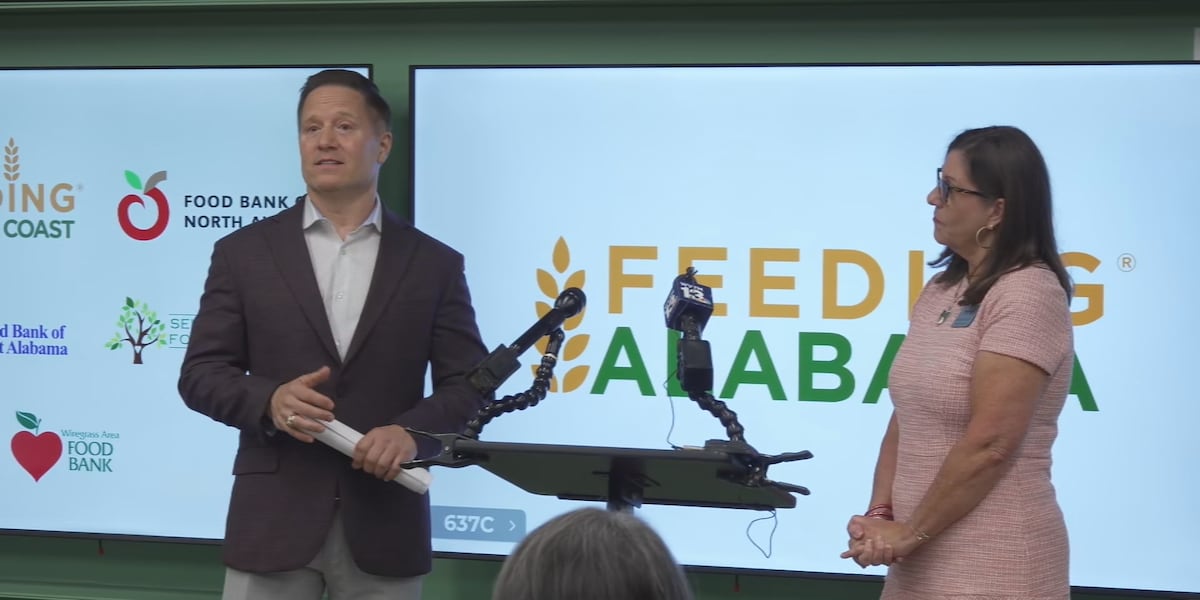
MONTGOMERY, Ala. (WSFA) – Alabama food bank leaders held a press conference Wednesday morning to ask the state’s congressional delegation to help get a delay on SNAP-related fees under the One Big Beautiful Bill Act.
States that incorrectly distribute funds from the Supplemental Nutrition Assistance Program (SNAP) will have to pay a greater share of costs starting in fiscal year 2028.
Food bank leaders say the extra time would give the state a greater opportunity to lower the error rate and avoid the fees.
“I know SNAP has become a four-letter word in much of the country but in reality, our neighbors across the state rely on this program every day,” said Michael Ledger, CEO and President of Feeding the Gulf Coast.
SNAP error rates are a combined percentage of overpayment and underpayment of SNAP benefits.
In the One Big Beautiful Bill Act, states with an error rate of six percent or more have to pay a greater share of SNAP costs.
States with error rates between 6 and 7.99 percent would pay 5 percent of SNAP costsStates with error rates between 8 and 9.99 percent would pay 10 percent of SNAP costsStates with error rates greater than 10 percent would pay 15 percent of SNAP costs
However, the bill gives a buffer period to states with error rates of greater than 13.3 percent.
Specifically, the bill says states will have a buffer period if “the payment error rate of a State multiplied by 1.5 is equal to or above 20 percent”; that means a state with an error rate of 13.4 percent or greater in Fiscal Year 2025 will have its fees delayed until Fiscal Year 2029. The same applies to Fiscal Year 2026; any state with an error rate of 13.4 percent or greater will have its fees delayed until Fiscal Year 2030.
In Fiscal Year 2025, Alabama’s error rate was 9.52 percent, which means the state’s error rate is high enough for the state to be penalized, but it is not high enough to receive a buffer period under the One Big Beautiful Bill Act.
Alaska, Delaware, Georgia, Illinois, New Mexico, Oregon and Washington, D.C. have error rates in Fiscal Year 2025 that make them eligible for the buffer period.
“We are a critical safety net, but we were never built to replace the federal nutrition support that lets families buy groceries consistently and with dignity,” said Nicole Williams, CEO of the Community Food Bank of Central Alabama.
In the press conference, food bank leaders asked U.S. Senators Katie Britt, R-Alabama, and Tommy Tuberville, R-Alabama, to add a buffer period for Alabama into the 2026 Farm Bill.
Sen. Britt’s office provided the following statement:
“Senator Britt and her team are in constant communication with local leaders across the state to ensure that those eligible for SNAP benefits receive them without disruption and that the state’s payment error rate is properly addressed. Senator Britt does not sit on the Senate Agriculture Committee and therefore will have no opportunity to offer amendments to the farm bill until it advances to the Senate floor.”
Sen. Tuberville’s office did not respond to request for comment.
Rep. Terri Sewell, D-AL-07, provided the following statement:
“President Trump’s Big Ugly Bill is taking food out of the mouths of vulnerable Alabama children and families in order to pay for tax breaks for the wealthy. That is one of the many, many reasons I voted against it. I am open to exploring any proposal that would reverse or mitigate the harm that this cruel bill is inflicting on our children, but let’s be clear—these cuts to SNAP should never have become law in the first place. Hard working Alabama families should not have to struggle to put food on the table so that billionaires can get even richer.”
The following states and territories have payment error rates of less than six percent from Fiscal Year 2025: Idaho, Iowa, Kentucky, Nebraska, South Dakota, Utah, Vermont, the U.S. Virgin Islands, Wisconsin and Wyoming.
Not reading this story on the WSFA News App? Get news alerts FASTER and FREE in the Apple App Store and the Google Play Store!
Copyright 2026 WSFA. All rights reserved.
Dining and Cooking