

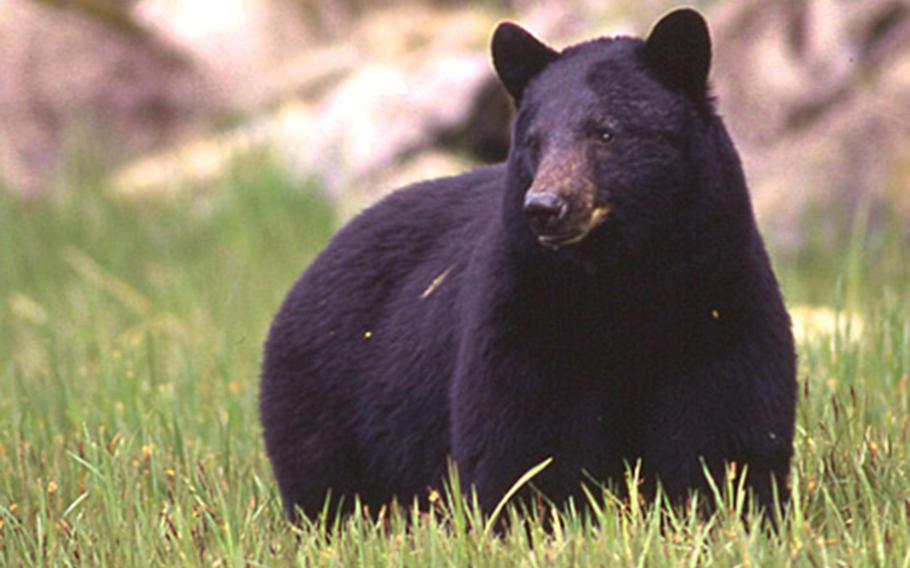
An undated photograph of an Alaskan black bear. (Alaska Department of Fish and Game)
The third visit within eight hours by a curious black bear to a military hospital in Alaska ended in the animal being euthanized “for public safety,” said a spokesman for Joint Base Elmendorf-Richardson.
The bear first entered the hospital at 1:23 a.m. Oct. 12 through automatic doors and was safely escorted from the premises by conservation agents of the 673rd Security Forces Squadron, according to an email Friday from base spokesman Capt. Nathan Poblete.
The bear re-entered the facility outside downtown Anchorage at 4:22 a.m. and exited on its own once authorities responded.
After laying low for several hours, the bear pried open the hospital doors at 9:32 p.m., Poblete said. No staff or patients were injured, and the bear did not damage the building beyond consuming food from an indoor coffee stand.
“Following the third entrance, which involved forced entry into the facility, responding authorities determined the bear had to be euthanized for public safety,” Poblete said. “Personnel from the Alaska Department of Fish and Game subsequently euthanized the bear.”
An estimated 100,000 black bears inhabit Alaska, according to the department’s website. The bears can vary in color from jet black to white, are the smallest of all the species of bears indigenous to North America and have a straight facial profile.

The 673d Medical Group at Joint Base Elmendorf-Richardson, shown in October 2024, where a bear entered three times on Oct. 12, 2026. (Hunter Hites/U.S. Air Force)
The black bear was the 13th euthanized by the department this year and the 12th on Elmendorf-Richardson, according to a report Friday by KTUU, which cited an unnamed Fish and Game spokesman.
“It’s extremely important to report wildlife that is posing a threat or potential threat to people or conducting themselves in a manner that is outside of standard wildlife behavior in natural settings,” Ms. Jeanne Dy-Porto, chief of installation management, said in the email.
Poblete said biologists noted the bear was experiencing an intense period of overeating to build fat reserves prior to winter hibernation or hyperphagia.
“To maintain healthy bear populations and reduce conflicts with bears, certain precautions should be taken,” base spokeswoman Maria Galvez said by email Saturday. “Keeping the residential garbage secure, maintaining a clean campsite, securing food sources, etc. can all help deter bear interaction.”
The base partners with the Fish and Game Department to mitigate wildlife risks and guide wildlife policies.
“Following the complete transition to bear-resistant dumpsters this year, overall nuisance calls have decreased relative to prior years, despite a brief initial displacement toward secondary food attractants,” Galvez said.
Bear encounters have caused three nonfatal injuries and no fatalities, so far, this year, said Galvez, who could not provide the total number of bear incidents.
The official tally is “currently being reconciled by the installation wildlife biologist and will be finalized to ensure accurate reporting for the calendar year,” she said.
Service members at the base receive wildlife awareness training during their newcomer orientations and ongoing education is reinforced through campaigns and seasonal advisories, Galvez said.
The base also conducts unit-specific briefings prior to high-risk field activities, offers hands-on bear spray training and coordinates frequent public service announcements with the 673d Air Base Wing, she said.
Dining and Cooking