


Price signs are displayed on shelves inside a Walmart store, highlighting retail pricing and consumer shopping activity.
Photo credit should read ROBYN BECK/AFP via Getty Images
The Briefing:Maryland became the first state in the country to ban surveillance pricing in grocery stores; the Protection from Predatory Pricing Act took effect October 1, 2026. Connecticut (signed June 4, 2026, effective July 2027) and New Jersey (signed July 23, 2026, effective August 2027) followed as the second and third states to enact similar bans.Walmart is on track to equip all approximately 4,600 of its Walmart-branded U.S. retail stores — plus over 600 Sam’s Club locations — with electronic shelf labels by year’s end, while simultaneously holding two AI pricing patents that use machine learning to calculate prices based on demand and inventory data.The approximately 65 million Hispanic Americans who drive 15% of total U.S. consumer spending over-index on grocery purchases, making Latino households disproportionately exposed if AI-driven personalized pricing becomes the industry standard.The Stop Price Gouging in Grocery Stores Act of 2026, introduced in the U.S. Senate by Senator Ben Ray Luján (D-NM) and co-sponsored by Senator Jeff Merkley (D-OR), would ban surveillance pricing and electronic shelf labels in large retail food stores nationwide.
Maryland’s landmark ban on surveillance pricing at grocery stores officially took effect October 1, 2026 — and it may be the only thing standing between millions of shoppers and an algorithm designed to charge the maximum price each individual will pay. As Walmart finishes deploying digital shelf labels across its roughly 4,600 Walmart-branded U.S. retail stores and more than 600 Sam’s Club locations by year’s end, the technical infrastructure for AI-driven pricing is now physically present in virtually every American neighborhood — including the ones that can least afford sudden price volatility.
This is not a future risk. It is today’s retail reality, and for the approximately 65 million Latino Americans who represent 15% of total U.S. consumer spending — but whose per-household spending growth has recently collapsed to just 0.8% annually — the stakes are unusually high.
What Is Actually On the Shelf
Electronic shelf labels are compact digital displays that replace paper price tags on store shelves, letting a retailer update its entire inventory pricing from a central system in minutes rather than sending employees down every aisle with a sticker gun. That operational efficiency case is exactly how Walmart and Kroger have framed the rollout publicly.
But the same company installing those labels also holds two patents secured in 2026 for machine learning-based pricing systems — one that automates markdown pricing for its e-commerce platforms, and a second that uses demand forecasting to generate price recommendations for merchant teams. Consumer advocates argue that combination is the complete technical blueprint for personalized pricing, regardless of what Walmart pledges publicly.
Walmart CEO John Furner moved to get ahead of that narrative in a September 26 letter addressed directly to customers and Sam’s Club members. He wrote that the company does not and would not set prices based on a shopper’s income, purchase history, or urgency — and extended that promise to cover Sparky, Walmart’s AI shopping assistant. The pledge covers both digital labels and the pricing systems that feed them.
Critics say pledges are not protections. Matt Hamory, a grocery industry consultant at AlixPartners, told the Financial Times that anything resembling dynamic pricing in a grocery context is “playing with fire.”
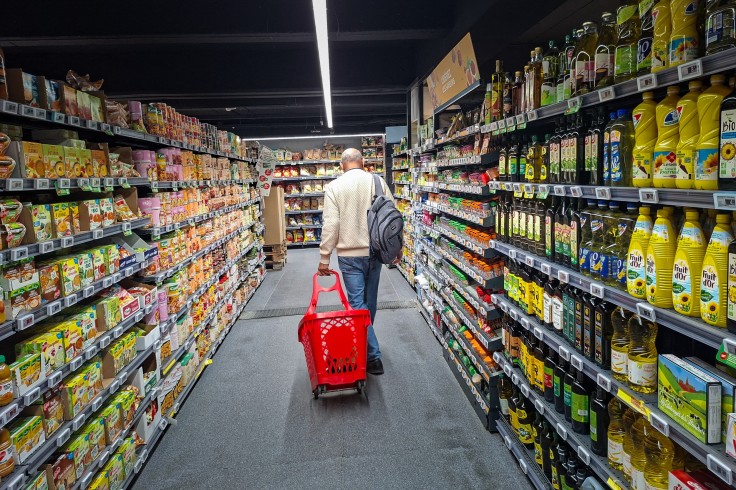
A shopper pushes a red basket down a supermarket aisle lined with food products and electronic shelf labels, highlighting the use of digital pricing technology in grocery retail.
Photo by Riccardo Milani / Hans Lucas / AFP via Getty Images
Why Latino Shoppers Are Disproportionately Exposed
The concern is sharpest in communities where grocery budgets are tightest and cultural food traditions drive consistent, essential spending. Hispanic households represent about 14.7% of all U.S. households but punch well above that share in consumer spending — with larger average family sizes leading to more frequent shopping trips and higher basket totals. That combination of high visit frequency, essential-goods focus, and brand loyalty around cultural staples makes Latino families particularly vulnerable if AI systems are calibrated to extract the maximum price each individual will pay.
That vulnerability has grown alongside financial pressure. A 2025 Numerator report found that after years of leading spending growth among all demographic groups, Hispanic households saw per-household spending gains slow dramatically — and for the least-acculturated families, actual spending per household fell 4.8%. A Pew Research Center survey conducted in October 2025 found that nearly two-thirds of Latinos rated their current financial situation as only fair or poor, and half said they expected their family’s finances to worsen in the coming year.
Surveillance pricing, as defined by the FTC, draws on a shopper’s location, purchase history, browsing habits, device type, and demographic data to generate individualized prices. In neighborhoods where Latino residents shop in concentrated patterns and competition is limited, the structural conditions for extraction are already built into the landscape.
Legislators Push Back — Led in Part by Latino Voices in Congress
Senator Ben Ray Luján (D-NM), along with co-sponsor Senator Jeff Merkley (D-OR), introduced the Stop Price Gouging in Grocery Stores Act of 2026 in the U.S. Senate on February 12, 2026. The legislation would ban surveillance pricing at grocery stores, prohibit electronic shelf labels in food retail stores larger than 10,000 square feet, require disclosure of any facial recognition technology in use, and establish an enforcement mechanism to hold corporations accountable. In his statement, Luján said the bill exists to ensure Americans can shop at their local grocery store “without worrying about predatory pricing.” Rep. Val Hoyle (D-OR) introduced a companion bill in the House.
At the state level, the movement has already produced active law. Maryland became the first state to ban surveillance pricing in grocery stores after Governor Wes Moore signed the Protection from Predatory Pricing Act on April 28, 2026; it took effect October 1, 2026. Connecticut became the second state on June 4, 2026, when Governor Ned Lamont signed a broader surveillance pricing ban — though that law does not activate until July 1, 2027. New Jersey became the third state when Governor Mikie Sherrill signed the Fair Price Protection Act on July 23, 2026 — a law that also imposes a one-year moratorium on new electronic shelf label installations, making it the most sweeping ESL restriction enacted anywhere in the country. New York’s legislature passed its own comprehensive ban in June 2026, which awaited Governor Kathy Hochul’s signature as of publication.
The UFCW’s model legislation has now been introduced in at least 12 states. In May, New York Attorney General Letitia James led a rally in the Bronx — one of the most Latino-dense areas of any congressional district in the country — calling on the state legislature to pass a package that would ban both surveillance pricing and electronic shelf labels simultaneously.
A September 2026 UFCW national poll found that 67% of American voters support banning the technology in grocery stores. Sixty-five percent said they believe electronic shelf labels will drive grocery prices higher; 68% said the same specifically about surveillance pricing.
What Families Can Do Right Now
Legal protection currently depends entirely on where you live. Shoppers in Maryland have an active legal right to the same shelf price as every other customer in that store. New Jersey’s ban is signed and coming. Connecticut’s is on the books but more than a year from taking effect. Everywhere else, families are navigating without any regulatory floor beneath them.
Consumer advocates recommend several immediate steps for households in unprotected states:
Opt out of store loyalty apps where permitted — these programs are the primary data pipeline retailers use to build individual pricing profiles over time.Compare the shelf price to the receipt at checkout. Most state laws still require stores to honor the posted shelf price, triggering refund obligations when discrepancies appear.Use price-tracking tools such as Flipp or Basket to compare unit prices across stores before purchasing higher-cost staples.Contact your state representative. Legislation has moved fastest in districts where constituent pressure has been most sustained and direct.
The technical infrastructure is installed. The legal fights are live. For Latino households managing grocery budgets against a backdrop of growing economic uncertainty, the outcome of this policy battle will land not in a hearing room but in the weekly grocery cart.
© {{Year}} Latin Times. All rights reserved. Do not reproduce without permission.
Dining and Cooking