
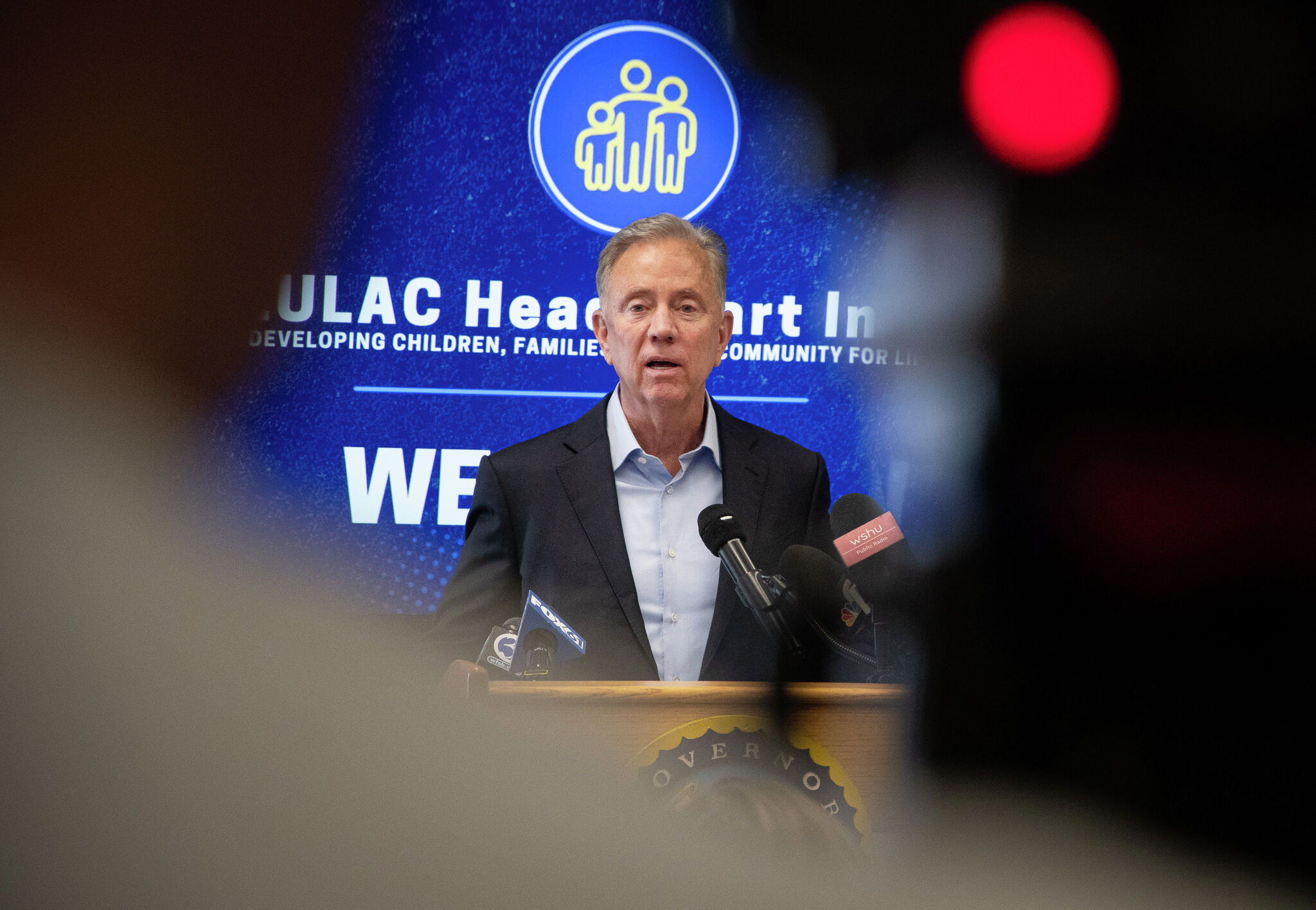
Gov. Ned Lamont discusses the importance of Head Start on Tuesday at LULAC Head Start in New Haven.
Colin Tiernan/Hearst Connecticut Media
Democratic Gov. Ned Lamont is running a gubernatorial campaign on establishing universal preschool education and school meals but leaving the actual plans to be worked out during his third administration — if reelected.

The demand for preschool and childcare slots continues to outpace supply in Connecticut. Childcare and preschool represent huge expenses in many family budgets, and, like many other costs of living in Connecticut, each service is more expensive than many other places in the country.
Article continues below this ad
One in five children in Connecticut face hunger, according to Feed America estimates, and schools often serve as a reliable source of meals for children. Nearly 220,000 students attending public schools are eligible for free or reduced-priced meals under the federal guidelines of the National School Lunch Program, according to state Department of Education statistics.
Lamont said he is counting on the recently established Governor’s Blue Ribbon Panel on K-12 Education to help map a plan for achieving universal pre-kindergarten and school meals.
In April 2026, the governor issued an executive order creating the panel of parents, early childhood education experts, business leaders, educators on all levels and state legislators to deliver a top-to-bottom overhaul of how the state funds its public schools. The executive order requires the commission to submit its strategic plan by Jan. 15, 2027.
Article continues below this ad
The claim
The Lamont campaign is claiming Connecticut has made “historic progress” toward establishing universal pre-kindergarten and expanding access to affordable childcare through the Early Childhood Education Endowment that was established last year and seeded with $300 million in state surplus funds.
Lamont and his campaign are also taking credit for the governor having signed a $28.1 state budget that provides $12 million for universal free school breakfasts, one of his administration’s major proposals of the 2026 legislative session.
The research
Lamont and the General Assembly created the Early Childhood Education Endowment in 2025 to expand childcare and preschool availability through state-fund programs such as Early Start CT and Smart Start.
Article continues below this ad
Launched on July 1 2025, Early Start CT combined three previous state-funded early childhood programs for provider contracts, school readiness grants and supplemental state grants for Head Start programs. Smart Start is a grant program that provides funding to establish or expand preschool programs in public schools.
Beginning July 1, 2027, families enrolled in Early Start CT earning up to $100,000 per year will pay no cost for childcare, and costs for families earning more than $100,000 per year will be capped at 7% of household income.
The legislature and Lamont initially used $300 million in state surplus funds to seed the Early Childhood Education Endowment. Earlier this month, state officials announced that $411.7 million of the projected general fund surplus for the 2026 fiscal year that concluded June 30 will be transferred to the endowment fund. It had a balance of $723 million at the close of the fiscal year on June 30, according to the treasurer’s office.
Under state law, the treasurer’s office oversees the investment of the endowment fund, and the state Office of Early Childhood distributes the funds.
Article continues below this ad
State statute caps annual spending from the Early Childhood Education Endowment at 12% of the fund’s total value for its first two years. The cap is then scheduled to drop to 10% a year. In July, the treasurer’s office reported to the Early Childhood Education Endowment Advisory Board that $99.4 million is available to spend in the current 2027 fiscal year, including $12.6 million in unexpended funds being carried forward from the 2026 fiscal year.
The Early Childhood Education Endowment spent $469,299 during between last July 1 and Dec. 31, including $367,500 for capital improvements Smart Start classrooms, $68,967 for Smart Start expansion operating costs, and $32,832 for administrative costs, according to its first annual report.
The report, which was submitted Jan. 1, explained that spending was limited at first because the endowment’s financial and administrative systems were still being set up. Another $30.9 million in planned expenditures were reported representing committed or obligated funds that were expected to be spent by the end of the 2026 fiscal year. The treasurer’s office subsequently reported to the Early Childhood Education Endowment Advisory Board in July that $23.4 million had been spent in the 2026 fiscal year.
According to the annual report, the Office of Early Childhood received 548 applications for new state-funded child-care spaces: 271 from licensed family-home providers and 277 from center and group-home providers. It said the OEC was reviewing applications for an estimated 1,039 spaces across 56 providers, all new to state funding. The report projected those spaces would open in January 2026, with 385 for infants and toddlers, 467 for preschoolers, and 187 for school-age children.
Article continues below this ad
Effective last Oct 1, the OEC raised per-space rates by 8% for Early Start CT providers for full-day infant and toddler, preschool, and school-age spaces. Annual rates rose from $13,500 to $14,580 for infant and toddler spaces, $10,500 to $11,340 for preschool spaces, and $4,125 to $4,464 for school-age spaces. The increase was intended to improve provider stability and support workforce recruitment and retention.
Through Smart Start grants, the OEC funded 11 new preschool classrooms in Bridgeport, New London, Norwalk, Norwich, Stamford, Thomaston, and Watertown, creating room for 165 children. Seven classrooms opened in fall 2025; four were expected to open in January 2026. Capital improvement funding to 10 districts was intended to support 20 more classrooms the following year.
Meanwhile, federal relief funds allowed for a statewide universal school meals program during the COVID-19 pandemic, but those funds were only temporary. The state Department of Education covered the cost of one breakfast and one lunch per day for students qualifying for reduced-price meals for the 2024-25 school year using expiring federal funds received through American Rescue Plan Act.
In legislative session 2025, proposals for universal school meals failed to move forward in the legislature, including one that proposed a tax on sweetened beverages to fund free school breakfasts and lunches for all.
Article continues below this ad
In the 2026 legislative session, Lamont proposed to budget $12 million in state funding to support universal free breakfast for all Connecticut students. Senate Democrats made free lunches for all students a caucus priority. The legislature’s nonpartisan Office of Fiscal Analysis estimated that a free lunch program would cost an additional $64.2 million in the 2027 fiscal year.
In the end, the legislature adopted the governor’s universal breakfast recommendation in a revised $28.1 billion budget for the 2027 fiscal year that was approved in May. The 2027 budget allocated $12.5 million for universal free breakfast and free lunch for students who qualify for reduced-price meals for one year.
Only four Republican legislators voted for the budget bill; Greenwich state Sen. Ryan Fazio, the Republican nominee for governor, was among the overwhelming majority of GOP legislators who voted against the legislation. As a candidate for governor, Fazio has also proposed to halt annual contributions from the state’s operating surplus to the Early Childhood Endowment and to sweep $616 million from the endowment to pay down state debt. The proposals were included in Fazio’s plan for providing $2.5 billion in tax relief by the fourth year of his administration. The plan proposed spending changes that Fazio estimated would save $1 billion a year by 2031 to help pay for the tax cuts.
The next governor and legislature will be adopting a new two-year state budget for the 2028 and 2029 fiscal years in the 2027 legislative session.
Article continues below this ad
The verdict
While there remain pressing continuing needs, the establishment of the Early Childhood Education Endowment under Lamont has expanded childcare and preschool spaces in state-funded programs.
Starting next July 1, families enrolled in Early Start CT earning up to $100,000 per year will pay no cost for childcare, and costs for families earning more than $100,000 per year will be capped at 7% of household income. But this is not a universal public system that ensures every family can access early childhood care and education for free or at low cost, regardless of income, zip code, or employment status.
Lamont said he is starting with free or low-cost child care for families enrolled in Early Start CT and the Smart Start grant program to increase preschool spaces.
Article continues below this ad
“I do that targeted at those families with one or two little kids, be able to save them $1,000 to $2,000 a month, and make sure that kid gets the very best head start,” he said.
House and Senate Democrats have been proposing a refundable child tax credit for last six year. The latest proposal called for credit against the state income tax of $600 per child, up to three children. Lamont has instead favored targeted or one-time relief. In 2022, Lamont signed a one-time rebate of up to $250 per child, capped at three children. Three years later, he made a budget deal that included an annual $250 payment for families receiving the state Earned Income Tax Credit; that narrower benefit took the place of a proposed child tax credit.
Lamont has repeatedly raised concerns about the cost and sustainability of a recurring child tax credit
“You can say, let’s do a lot of other stuff. Let’s do credits and things. You’ve got to be able to pay for things in life,” he said. “What I’ve done so far over the last eight years is these initiatives in a way that is sustainable, everything from tax cuts to the endowment.”
Article continues below this ad
The 2027 budget included $12.5 million based on Lamont’s recommendation to fund universal free breakfasts for students and free lunch for students who qualify for reduced-price meals. But Lamont acknowledged that this is not same as free school breakfasts and lunches for all students.
“We’re trying to make it easier and less expensive for kids to be able to start the day right,” he said.
Lamont said he is waiting on the recommendations on school meals and other subjects from the Governor’s Blue Ribbon Commission on K-12 Education, which are due 74 days after the Nov. 3 election for governor is over.
Article continues below this ad
“Let’s hear what the commission has to say,” he said.
Dining and Cooking