
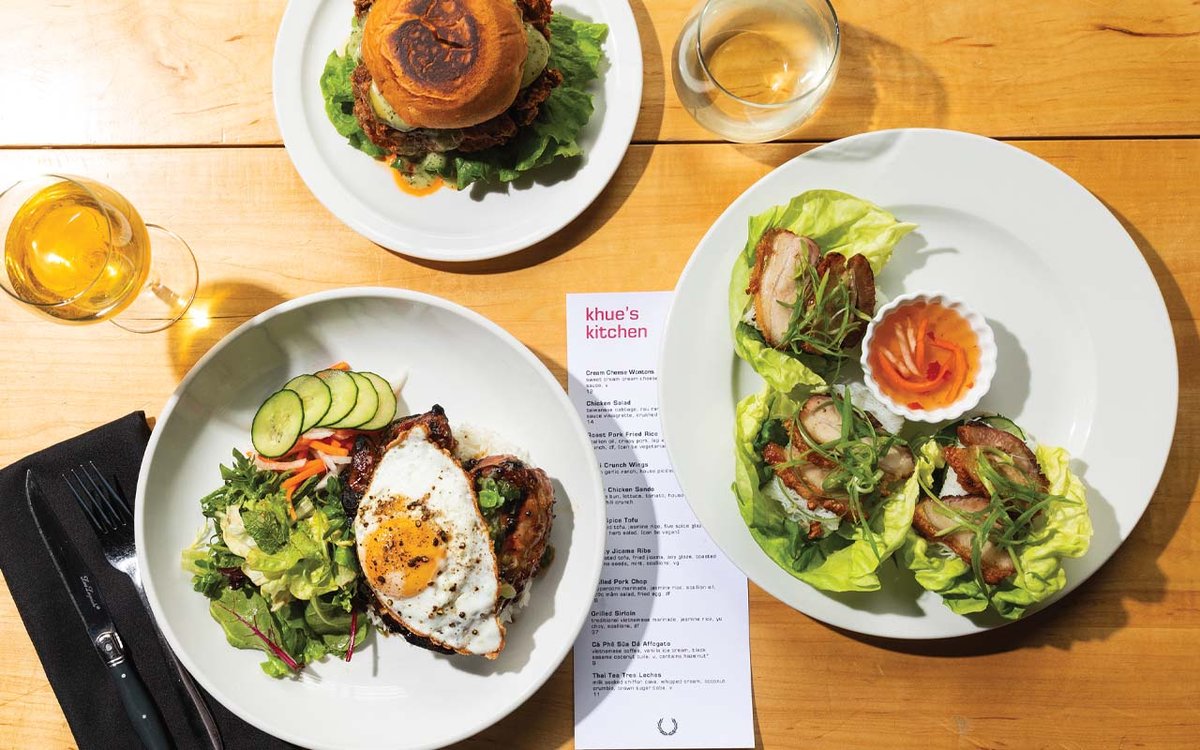
Opening a new restaurant is always fraught—financiers vanish; stoves die; inspections fail and bring new headaches. But in all my years, I’ve never heard of an opening that involved dropping out of college twice, a mom not speaking to her kid for a year, and a ready-to-open restaurant burning to the ground. Which is to say, it may seem like a no-brainer that a son of the Quang family—in fact, a son of the main Quang chef—who was raised in one of the highest-volume and most beloved restaurants in the state, has opened his own upscale Vietnamese spot, Khue’s Kitchen, at the tender age of 25. But this isn’t just the newest spot for Slovenian pét-nat and killer chicken wings in the industrial Minneapolis–St. Paul borderlands where Highway 280 meets University Avenue. It’s a place that tells the story of Minnesota, Vietnam, and restaurants and how old-school inevitably births new-school, even when it really, really doesn’t want to.
But first, let’s settle in with some snacks before we tell the tale. The snacks are at Khue’s Kitchen, the new spot in an airy, recently industrial space way back in a parking lot off Raymond, not too far south of University Avenue, in that part of town that was, until lately, all warehouses and rock-and-roll practice spaces and is now getting fancy, like Khue’s is, black and gray and steel all over.
For snacks, you’ll want the chicken wings, classic Southern American–style, buttermilk soaked, flour-and-spice tossed, crisp as crackle, served with some fancy chef-made green-garlic ranch sauce, which both cools them down and extends the flavor. A more perfect wing you will not find—deeply seasoned, boasting a batter that is not merely crisp but its own sort of delicious.
More snacks! How about the best vegan barbecue we’ve ever had in Minnesota: so-called Sticky Jicama Ribs, made by layering slices of marinated tofu and fried jicama, arranging them into a long rectangle, then glazing the “rib” with successive layers of classic sweet-and-sticky barbecue sauce till the soft tofu and crunchy jicama come to create the sense of meat, fat, and gristle in your mouth. Your taste receptacles say, “Baby back rib,” while your brain tells you, “Vegan, actually.”
With your snacks, a glass of something? Khue’s has a short but most excellent natural wine list, full of rarities like a Slovenian pét-nat sparkling with the bright fragrances of strawberry and bread or a moody, leathery orange wine from Oregon’s Maloof.
Snacks in hand, let’s tell the tale. Your principal characters: Eric Pham and his mom, Khue, pronounced kway. Khue is the eldest daughter of Lung Tran, who emigrated to Minnesota from Vietnam after the war and, as a widow at 35 with seven kids to support in 1989, opened a small lunch counter spot named for her late husband, Quang Truong. The rest is Minneapolis food legend—the initial spot grew, relocated across the street to the current space in 1999, kept growing, and has, for decades now, been one of Minnesota’s signature restaurants, serving a few thousand of us our daily pho with consistency, speed, and grace.
“All 15 of us grandkids worked in the restaurant,” recalls Eric. “But they only put us in the positions that would make sure we would never want to keep working in a restaurant. So, no working in the kitchen, because they didn’t want us to develop a passion for cooking. No serving, because they didn’t want us wanting that serving money. They wouldn’t schedule us grandkids together, because they didn’t want it to be fun. Just the hard jobs: host, cash register, bussing. If there was a job where you’d get yelled at by customers and make no money, that’s where you found the grandkids. If you ever ate at Quang and remember a little kid clearing your plate, chances are not bad it was me.”
Growing up in Little Canada, with his dad or an aunt or uncle who had the day off from Quang ferrying the kids to sports and such, Eric’s life was arranged around Quang’s one closed day, Tuesday, when the family always ate together, either at home with Dad manning the grill or somewhere else in the extended Truong family. “Right now, my dad has a backyard pizza oven, and all day in the family group chat: ‘Is it pepperoni? Who’s bringing the arugula with balsamic vinaigrette? Oh, you’re making kimbap?’” At home in the 21st century, the Truongs and Phams are a very foodie family.
“No one believes me, but I did not learn one Vietnamese recipe or technique until I was 22 years old,” recalls Eric. “There was one message from my family: ‘Go to college. We worked this hard so you can have stability. Go to college; have the life we never could.’” He heard the immigrants’ familiar refrain for American-born kids: “Try to become a doctor, lawyer, or CEO, or barring that, choose any path that doesn’t require finding a dishwasher repairman at seven o’clock on a Saturday night.”
Eric listened respectfully but quietly began to have his own thoughts. “At 15, I started watching YouTube videos,” he remembers. “Gordon Ramsay— I thought he was so cool. Ugly Delicious, the Dave Chang series—when he talks about his Asian American upbringing, I was like: That’s me. ‘Asian parents don’t want their kids to be chefs; they want them to be doctors or lawyers or have other high-status jobs’—I thought, That’s my family, both sides.”
Eric started dabbling at home with French recipes and followed his older brother to Gustavus Adolphus in St. Peter. “Other kids brought mini fridges to college; I brought a spice rack,” he laughs. He started cooking for friends in his dorm lounge: pasta, chicken, and steak. As he grew ever more interested in cooking, he grew less interested in school. “My grades started to dip. I just had this longing: What would my life look like if I pursued cooking? I remember sitting in my macroeconomics class. Everyone had their computers out, so I did too, but instead of being on the lesson page, I was on Google: ‘Who’s the best chef in the Twin Cities? Gavin Kaysen. Spoon and Stable.’”
He cold-emailed Kaysen and dropped out of college. “My mom, to this day, says it was the worst day of her life.” To make things worse, Eric got to Spoon and Stable for a day-long tryout and: “I sucked,” laughs Eric now. “I was so slow. I was so bad. I thought I had some skills. I was wrong. The execution, the responsibility, the standards—I had never seen anything like it, and I wasn’t there.”
“No one believes me, but I did not learn one Vietnamese recipe or technique until I was 22 years old.”
Eric Pham
Determined, he talked to Chris Nye, Spoon’s executive chef, and said, “Let me come back, please.” He went home, studied, practiced, got ready, and eventually felt he was passable. “I realized that this was the first thing in my life I was not going to quit,” he says. “They offered me a job at $12 an hour, starting at 7:30 the next morning.” His next two years were pure survival, he says. “Tweezers and markers in my pocket, backpack with my chef roll—it’s a very competitive space. A lot of what cooks are coming for is to see if you can handle the level of abuse, the standards. Can you handle the customers at this level of friction and stay on top? The yelling, the stress, the crash-outs—can I go through it and not quit? I always say it’s such an archaic and barbaric system, where 99 percent of the time any and every decision leads to disaster and closing. But Quang beat the odds, so I know it can be done.”
Eric Pham spent six months as a prep cook at Spoon and Stable, six months on bread and pasta, and a year as a line cook. “It was unbelievable to me, the level of product we got in from farmers and purveyors—Onyx tomatoes, white strawberries—the level of professionalism and class you need to carry in front of the guests.”
Then came the Synergy Series, when the greatest chefs in the world come to Spoon and Stable to cook with the team. “Thomas Keller came,” he recalls. “It was the most intense cooking I’ve ever seen. He brought his team from Per Se and The French Laundry. For two days, it was like going from being a dog to a wolf—so intense. And I was like, I don’t think this is for me. I don’t want to do French food.”
Meanwhile, his dad had been talking to Eric about opening his own restaurant. And for Eric, those videos in which Dave Chang talked about finding his way to his own Asian food from French kitchens—it all started to click. Eric’s dad told him the family would back him, on one condition: He had to finish college. So, he enrolled at Concordia and decided it was time to learn Quang’s Vietnamese style from the master herself, his mother. She refused. So, Eric flew to Texas, where he learned to cook Vietnamese from his father’s brother, a manufacturing consultant.
“It was a tumultuous period,” reflects Eric now. “I was banking on her teaching me. She said, ‘I’m not going to teach you. I’m not going to help you. I’m going to stop my son from ruining his life.’” So instead, he was cooking his uncle’s food, trying to make it taste like his mother’s, living life as the rebellious middle kid, dropping out of his second college, and his mother was definitely not talking to him. “For a year,” he notes. “I was 21, like: ‘What the hell, Mom? Why are you standing in the way of my dreams?’ She was hearing: ‘Sorry your sacrifice for me was in vain. Sorry I’m rejecting your dream for me.’” The two chefs mainly communicated through his dad.
Then, in the ultimate Stop Ignoring Me Mom checkmate of all time: Eric named his restaurant for her! He opened first as a ghost kitchen, and soon after as a pop-up inside Bar Brava. She was still mad, and the two were not directly speaking until a newspaper reporter set up a photo shoot and interview for a feel-good Mother’s Day story about various local parents and children in the business of food. Eric didn’t even know if his mom was going to show up, but she walked in with his dad. “There were things I hadn’t been able to say to my mom in a year that spilled out in this interview,” recalls Eric. “After this whole time of my mom and me not talking, I didn’t understand why she stood in my way. I was maturing; I was working. Why didn’t she see this? Then I understood: She was just trying to save me, to help me. Now I realize: Life is a finite thing, and we wasted a chunk of it for nothing.”
He was counting down the days till open when he got a text from the person who was on board to be the dishwasher. “Looks like your building is on fire?”
So, he staffed up to open Khue’s Kitchen, put all his money into the beautiful former Ngon Bistro location, filling it with premium ingredients and wonderful wines. He was counting down the days till open when he got a text from the person who was on board to be the dishwasher. “Looks like your building is on fire?” He drove over with his dad, and the two sat there till three o’clock in the morning watching it burn to the ground. Electrical fire.
By noon the next day, his dad was dragging him around to look at new spaces. “He said, ‘I’m worried that if you don’t get back up and try again, you’ll give up.’” It was the restaurant rule, Eric says now. Do everything right, and you still have a 99 percent chance of failure, because natural disasters are part of what can go wrong. But conversely, community support is part of what can make it go right—Picnic in Linden Hills threw a fundraiser, Spoon and Stable did one too, and Khue’s Kitchen finally opened for real this past March.
That’s a lot of suffering and personal growth on the road to adding a new really good Vietnamese pork chop to the local mix.
I mean, once you know the story behind Khue’s Kitchen, the place can feel as comprehensible and inevitable as simple arithmetic: If the Quang family has a son who multiplied his skills at Spoon and Stable, then you add in that he built his name at Bar Brava, this must equal a new fine Vietnamese spot with great wines! Those pork chops everyone loves at Quang, so
thin, so nicely charred? Here, they are the way we like them in American restaurants: thick. Thick, meaty, luxurious, a little char here, a little fat there, served with a salad of Vietnamese herbs with nuoc cham, sliced cucumbers, a scoop of jasmine rice, and a fried egg with a classic modern-restaurant runny yolk. If you know the legendary pork chop broken rice platter at Quang, this dish will seem as inevitable as babies growing up: the original cuisine, now luxurious. All those good herbs, those bright and delicate sour and hot notes, the char and fat, all bigger, all completely maxed out.
This is exactly what happened when Italian food in Italy leapt from the cocina povera, the food of poverty, to the Italian American classics we know and love today, all the meatballs ballooned up to the size of softballs. This is what happens when you eat broken rice so that your children can afford to buy top-shelf whole rice. And this is what happens when a son asks his mom who her pork supplier is, and can she add a case to the order, and can Dad drive it over, and does she have an extra bunch of Vietnamese coriander to spare?
Do you need to be a Quang lifer to really appreciate new Khue’s Kitchen? Probably not, but this is a very Twin Cities story, so it would help. It would also help to have been to Bar Brava a few times and to have developed a taste for wines both esoteric and fun.
The wine list at Khue’s, by fellow Bar Brava veteran Nick Steinkamp, is a model of what you can do with a list of a dozen options when you’re swinging for the rafters: a chewy, violet-scented Chianti; a gingery Riesling; and a rare and nicely grassy southern Japanese sake. There’s a good argument to be made that Khue’s is instantly the second-best natural wine bar in the state, after Brava, and a nice proof of concept of the good that is coming from Brava’s commitment to nurturing the next generation of chef talent: Once a chef and a customer base take on a passion for wine like it was before the modern science of tinkering in the cellars made it taste all the same, they are yours forever!
That’s how you grow an individual passion into a scene. And St. Paul peeps: With Khue’s, Herbst, and Caffe Biaggio all on the Raymond Avenue light rail stop, do you want to start calling this St. Paul’s newest wine-bar district? It’s happening.
Happening too? Brevity. Blessedly short, well-refined menus are the soul of Khue’s Kitchen. The food menu at Khue’s is on point, only offering eight or nine food options when I’ve been. Do not miss those perfect Southern chicken wings, and if you’re a chicken sandwich fanatic, try the same excellent recipe rendered as a fried chicken sandwich, lively with house-made pickles and tender with a brioche bun. A grilled sirloin steak is made similarly to the pork chop and is excellent. I thought the cream cheese wontons were a bit of a snooze, but I’ve eaten a lot of cream cheese wontons in this town. There was nothing wrong with them; they were just well made and ordinary. The five-spice fried tofu is so much like the Sticky Jicama Ribs that you’ll be disappointed if you order both, but it’s a very nice different sweet-and-sticky barbecue dish. The desserts are fine, a Vietnamese coffee affogato and a simple Thai tea tres leches; neither seemed remarkable.
The other standout dish I tried was a roast pork fried rice made millionaires’ style with nothing but all the good stuff: good plump rounds of Chinese sausage, rice as tender as the best risotto, outrageously delicious roast pork. “The rice, that comes from Gavin’s technique,” Eric tells me. “I cook jasmine rice like it’s arborio, getting it just to al dente. Then for the pork, that’s my family’s technique. It’s a 48-hour brine-and-roast process—that’s how you get those good little chicharrón nuggets and the moist meat.” He invests 48 hours to get pork just for fried rice? I asked. “That’s how my mom does it. I told you: I’m spoiled!”
Fair enough.
But it made me think. In restaurant parlance, we usually talk about two restaurants by the same owner as “sister restaurants.” Khue’s Kitchen isn’t really any kind of sister restaurant to Quang. It’s way more interesting and complicated than that. But could we say it’s a surprise granddaughter restaurant? Arriving unsuspected, let’s say nervous and alone in a car, to the home of a large and prosperous and grandchild-free family? At first denied, then embraced! Given a golden bed for her doll, the best tidbits for her plate, and if all the Twin Cities is lucky, living together as a family for a happily ever after? Let’s hope!
693 Raymond Ave., St. Paul, 612-600-9139
Dining and Cooking