

Beaufort
South Carolina residents will soon be able to confirm whether the shrimp on their plate at the local restaurant is locally caught wild seafood or imported from shrimp farms in Asia.
Having foreign shrimp served in South Carolina, where catching, preparing and eating shrimp is a way of life, sticks in the craw of local shrimpers who are struggling to survive in the face of rising imports and costs and dwindling infrastructure like deep-water docks.
It was local shrimpers who pushed for the new South Carolina law that will require restaurants to disclose if they are serving imported shrimp as opposed to shrimp caught in South Carolina or U.S. waters.
The new law goes into effect Oct. 28.
The new shrimp disclaimer law, passed by the legislature in June and signed into law in July by Gov. Henry McMaster, requires restaurants, mobile food units, cafeterias and seafood retailers that sell ready-to-eat shrimp to disclose to consumers — on their menus and front door signs – if they serve foreign shrimp.
Look for answers on the menu or front door
Restaurants will be required to choose between two disclaimers.
Restaurants that use both domestic and foreign shrimp (usually when domestic is not available) must state it on the menu and on a sign at the main entrance. The sign must say: “Some items served at this establishment may contain foreign imported shrimp. Ask for more information.”
If a restaurant only serves imported shrimp, the menu and sign disclaimer must state: “Some items served at this establishment contain foreign imported shrimp. Ask for more information.”
The South Carolina Department of Agriculture will enforce the law. Unannounced routine inspections are planned. The department also will conduct inspections in response to complaints.
Restaurants that only serve shrimp caught in coastal U.S. waters don’t have to do anything.
The law does not apply to retail food establishments that only sell raw shrimp.
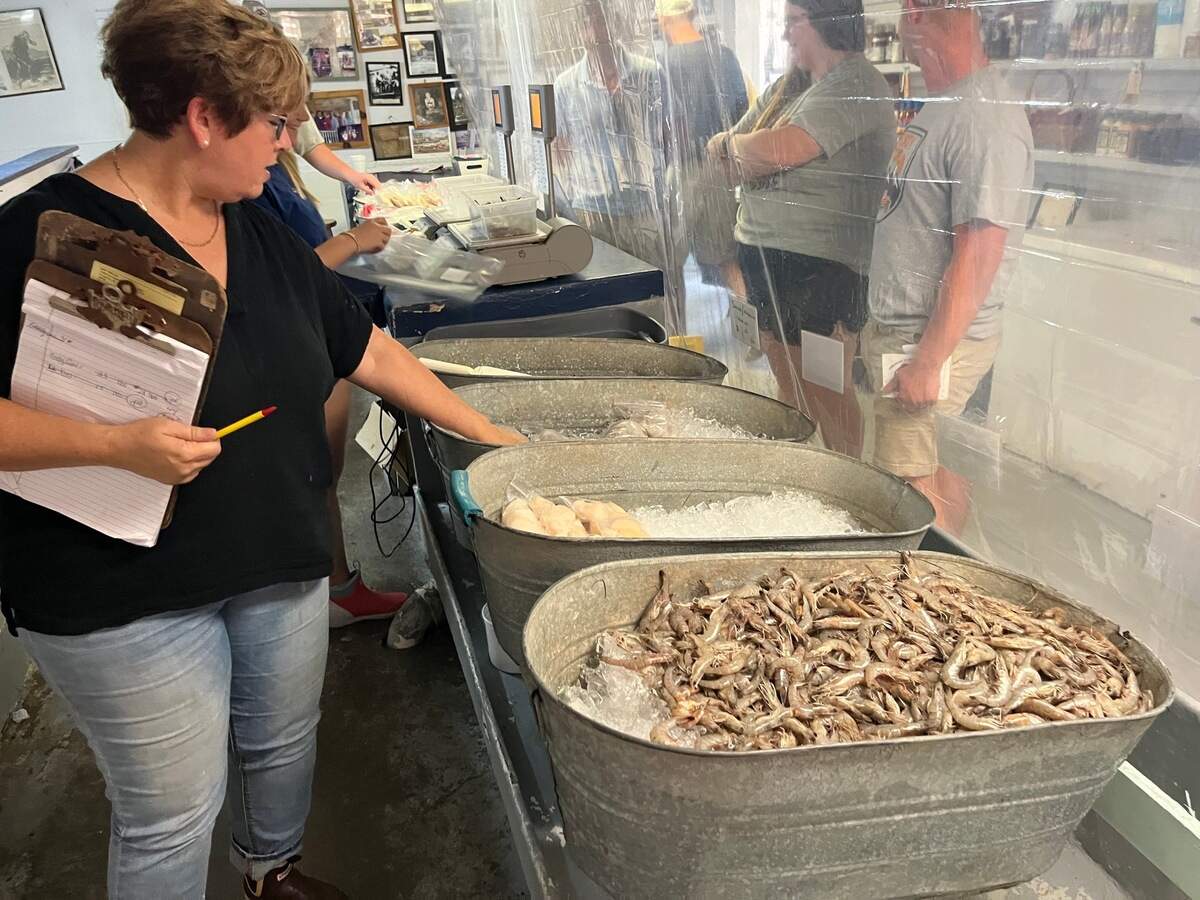 Cyndy Carr checks the display counter at Gay Fish Co. on St. Helena Island which includes fresh seafood including locally caught shrimp delivered to its docks on Ward Creek, located directly behind the retail store. Karl Puckett kapuckett@islandpacket.com Local restaurants can agree to testing
The state’s total shrimp harvest — there are spring, summer and fall seasons — averages about 2.5 million pounds annually and carries a value of around $8 million, according to the South Carolina Department of Natural Resources. That makes it the top seafood in the state.
The state law with the foreign shrimp disclosure requirements will dovetail an effort by The Beaufort Area Hospitality Association (BAHA) to promote local restaurants that serve domestic shrimp.
BAHA’s Ashlee Houck says the group plans to launch a certification program later this month in which restaurants that have their seafood genetically tested receive a large decal that says “only from our waters” and “proudly serving local and American and wild-caught shrimp.”
Houck says 25 restaurants already have signed up. The University of South Carolina-Beaufort will handle the testing. BAHA, she says, will promote the program during Beaufort’s annual Shrimp Festival, which is Oct. 2-3.
 The Beaufort Area Hospitality Association (BAHA) will issue these stickers to restaurants that agree to sell locally caught wild shrimp. BAHA What led to disclosure, certification efforts
The proactive steps by the state and BAHA follow undercover testing of shrimp sold in South Carolina restaurants by SeaD Consulting on behalf of the Southern Shrimp Alliance (SSA). The results found many restaurants advertising local shrimp but selling farmed-raised imported shrimp. Shrimping industry advocates called it “shrimp gate.” The new law and marketing campaign address this “fraud.”
“I think it’s wonderful,” Craig Reaves, a Beaufort shrimper who owns Sea Eagle Market, said of the new law, which the South Carolina Shrimp Association and Southern Shrimp Alliance, a group of eight shrimping states, had been pushing.
Reaves said the 106-0 vote in the House was rare in this day and age when politics are so divisive.
The new law will push restaurants to buy and serve local shrimp or at least shrimp caught in domestic waters.
“There’s no way it can’t help because now restaurants will need to be honest in their menus and labelling,” Reaves said.
 Sea Eagle Market in Beaufort advertises where its shrimp are come from. South Carolina’s new “Shrimp Law” requires any retail food establishment that sells ready-to-eat shrimp to provide a specific disclaimer to consumers it serves imported shrimp. Karl Puckett kapuckett@islandpacket.com Why shrimpers are struggling
Reaves said shrimpers from Texas to the Carolinas are struggling to compete with cheap imports. Increasing fuel prices this year are also hitting shrimpers hard, he said. The difficult economic climate for the industry comes at a time when 85% of the shrimping infrastructure has been lost over the past 25 years, he said.
Reaves has said previously that 8 or 9 commercial shrimp boats operated in Beaufort County compared to 50 or 60 in the 1980s and 90s.
“But we’re working hard to change things and this law is definitely one of those things that could have a positive impact,” he said.
This story was originally published September 1, 2026 at 2:20 PM.
Related Stories from Hilton Head Island Packet

Karl Puckett
The Island Packet
Karl Puckett covers the city of Beaufort, town of Port Royal and other communities north of the Broad River for The Beaufort Gazette and Island Packet. The Minnesota native also has worked at newspapers in his home state, Alaska, Wisconsin and Montana.
Dining and Cooking